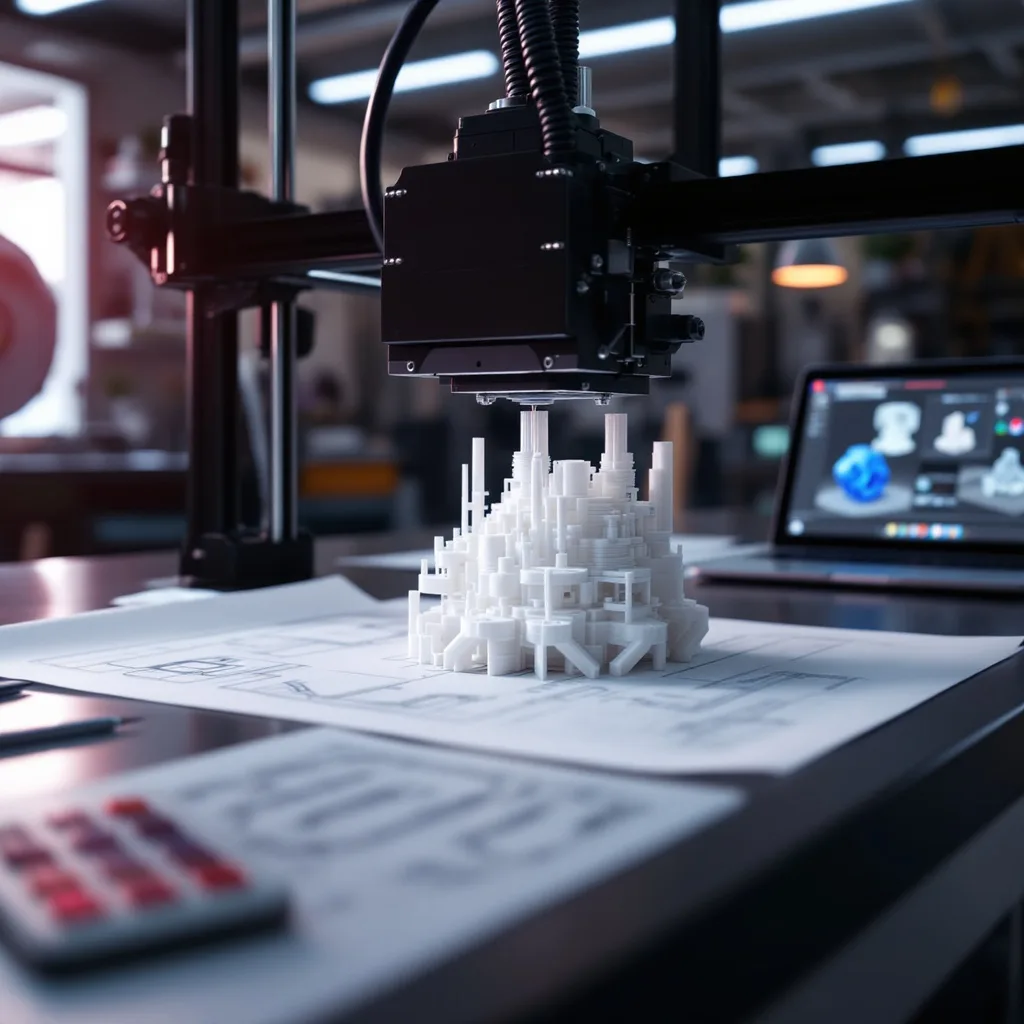
What is 3D Printing and Prototyping?
3D Printing and Prototyping Training
This 3D Printing and Prototyping certificate program equips you with the end-to-end skills to transform digital concepts into physical, functional prototypes. It is designed for engineers, product designers, entrepreneurs, and makers who need to rapidly iterate and validate ideas without relying on external manufacturing. By the end of the program, you will have built a complete workflow—from design and slicing to material selection and advanced finishing—and will produce a portfolio-ready functional prototype that demonstrates real-world problem-solving.
The training follows a carefully scaffolded journey that begins with the 3D printing landscape and design essentials, then moves into hands-on machine operation with FDM setup, calibration, and slicing software. As you progress, you explore resin, powder, and other printing technologies alongside materials science, before mastering post-processing, advanced finishing, and Design for Additive Manufacturing (DfAM) strategies. The program balances theory with intensive practice, building four core skill areas: foundational design and slicing, multi-technology operation, material and finishing expertise, and iterative prototyping workflows. With lessons on cost analysis and scaling to production, this program is ideal for those who want to future-proof their skills and lead rapid innovation in a world where speed to market and supply chain agility are critical.
What is 3D Printing and Prototyping?
3D printing and prototyping is the practice of creating physical objects layer by layer from digital models, enabling rapid iteration and functional testing of designs. It encompasses a wide spectrum of additive manufacturing technologies—from fused deposition modeling (FDM) and stereolithography (SLA) to selective laser sintering (SLS) and beyond—each with distinct material capabilities and precision levels. At its core, the discipline merges computer-aided design (CAD), materials science, and mechanical engineering to turn abstract ideas into tangible parts, tools, and products. Prototyping, in this context, is not just about making a single model; it is a systematic process of building, evaluating, and refining a design through successive physical versions, often using 3D printing as the primary fabrication method.
Today, 3D printing and prototyping has moved far beyond niche hobbyist circles to become a cornerstone of modern industry. It accelerates product development cycles in automotive, aerospace, and consumer electronics, enables patient-specific medical devices and surgical guides, and empowers small businesses to manufacture on demand without massive tooling investments. The recent shift toward distributed manufacturing, coupled with advances in high-performance polymers, metal printing, and generative design software, has made additive manufacturing a strategic asset for supply chain resilience and mass customization. As a result, the ability to prototype quickly and cost-effectively is no longer optional—it is a competitive necessity across sectors.
Mastering 3D printing and prototyping builds a versatile skill stack that bridges digital design and physical production. It requires an understanding of how geometry, material properties, and printing parameters interact to produce reliable, functional parts. This knowledge is invaluable for product designers refining ergonomics, engineers validating mechanical assemblies, researchers creating custom lab equipment, and educators fostering hands-on STEM learning. In personal contexts, it unlocks the ability to repair household items, create custom art, or launch a small-scale manufacturing venture. Ultimately, the subject empowers individuals to think like digital craftsmen, combining creativity with technical precision to solve tangible problems in an increasingly decentralized manufacturing landscape.
Common Questions About 3D Printing and Prototyping
Is the 3D Printing and Prototyping certificate valuable for job applications?
Can a beginner with no CAD experience take this 3D printing course?
What is the role of slicing software in G-code generation?
- Importing the 3D model (STL or OBJ file)
- Orienting the model on the virtual build plate
- Setting parameters such as layer height, infill density, and print speed
- Generating support structures for overhangs
- Previewing the toolpath layer by layer
- Exporting the G-code file to the printer
How do resin printing technologies like SLA differ from FDM?
Which thermoplastics are best for rapid prototyping?
What strategies reduce cost when scaling 3D printing to production?
Is 3D printing only suitable for plastic prototypes?
What Will This Course Bring You?
- Compare and contrast major 3D printing technologies to select the most appropriate process for a given prototyping scenario.
- Design a 3D model with considerations for overhangs, support structures, and build orientation to ensure printability.
- Configure slicing software settings, including layer height and infill density, to generate efficient G-code for an FDM print.
- Calibrate an FDM printer's bed leveling and extruder steps to achieve accurate first-layer adhesion and dimensional precision.
- Evaluate the mechanical properties of common 3D printing materials to select the optimal filament or resin for a functional prototype.
- Apply post-processing techniques such as sanding, chemical smoothing, and painting to transform a raw print into a presentation-ready model.
- Implement design for additive manufacturing strategies to consolidate multi-part assemblies into a single printed component.
- Analyze the total cost of ownership and break-even point for scaling a 3D printed product from prototype to low-volume production.
Curriculum
12 Units1. The 3D Printing Landscape
1 hour
2. Design Essentials for Additive Manufacturing
1 hour
3. Slicing Software and G-Code Generation
1 hour
4. FDM Printer Setup, Calibration, and First Prints
1 hour
5. Resin, Powder, and Other Printing Technologies
1 hour
6. Materials Science for 3D Printing
1 hour
7. Post-Processing Fundamentals
1 hour
8. Advanced Finishing and Functional Prototypes
1 hour
9. Design for Additive Manufacturing (DfAM) Strategies
1 hour
10. Prototyping Workflows and Iterative Design
1 hour
11. Cost Analysis and Scaling to Production
1 hour
12. Emerging Trends and the Future of Prototyping
1 hour
Exam – 3D Printing and Prototyping
20 Questions • 70% Pass • 30 min
Unlock All Units for Free
Create an account, enroll in the course, and start with the first unit right away.
Exam – 3D Printing and Prototyping
20 Questions • Pass: 70% • 30 min
Course Duration
720
Total Minutes
12
Unit
1
Final Exam
~60
Min / Unit
3D Printing and Prototyping Certificate Program
Document Your Skill
Those who pass the 20-question, 30-minute exam with 70% receive the 3D Printing and Prototyping Certificate.
Stand Out on Your CV
By adding your certificate to your CV, gain a professional reference in job applications and stand out from the crowd.
Career Advantage
Catch Wisdom certificates are recognized by HR departments and increase career opportunities.
CERTIFICATE FEE
At the end of the course, an online exam consisting of 20 questions with a 30-minute time limit is given. The exam appears automatically after you complete the topics. Anyone who scores at least 70 out of 100 on the certificate exam is awarded the 3D Printing and Prototyping Document (certificate of attendance). You can add the certificate you earn to your CV for job applications in the many sectors listed above, and use it as a reference proving that you took this interactive course.
The Certificate of Achievement you receive with the 3D Printing and Prototyping course program holds value that proves your personal and professional development in the business world. By adding it to your CV, it can serve as an important reference in your job applications. Moreover, compared with certificates from other private training institutions, Catch Wisdom certificates are offered to our participants at a much more affordable price.
Because HR departments recognize Catch Wisdom as a reputable institution in this field, they value these certificates and may evaluate your job applications favorably. For this reason, a 3D Printing and Prototyping course certificate from Catch Wisdom can make your applications more attractive and place you in an advantageous position in the business world.
For more information, we recommend visiting the Support page.
Certificate in 7 Languages
Earning success certificates from our courses is now more meaningful and global. With certificates available in Turkish, English, German, French, Spanish, Arabic, and Russian, we fully unlock the potential of students worldwide.
Why Certificate in 7 Languages?
-
01
Global Skill Development
Receiving your certificates in 7 different languages strengthens your communication skills as you engage with more people worldwide. It lets you operate more confidently and capably on the international stage.
-
02
International Job Opportunities
Employers may see your certificates in multiple languages as a sign of your ability to seize global opportunities. You can open more doors to new jobs and projects.
-
03
Cultural Richness
The chance to earn certificates in different languages helps you build closer ties with various cultures and broadens your worldview. It enriches your global perspective and deepens cultural understanding.
-
04
Ability to Participate in International Projects
Multilingual certificates give you an edge to work more effectively on international projects. They boost your chances of leadership and participation in diverse projects in the business world.
-
05
Prove Yourself on the Global Stage
Certificates in multiple languages let you showcase your skills and knowledge worldwide. You can become an internationally recognized professional.
Language diversity opens worldwide opportunities. If you want to prove yourself in the international arena, join our online 3D Printing and Prototyping course program and begin this journey with us.
Frequently Asked Questions (FAQ)
Is this course paid?
How do I join the course?
Can I take the course at my own pace?
How can I get my certificate?
What are the advantages of the Certified Certificate?
Boost Your Career
Take a new career step with the 3D Printing and Prototyping course. Add your certificate to your CV, stand out in job applications, and open the door to new opportunities in the industry.
StartStudent Reviews
No reviews yet
Enroll in this course and be the first to leave a review about your experience with 3D Printing and Prototyping.
Start