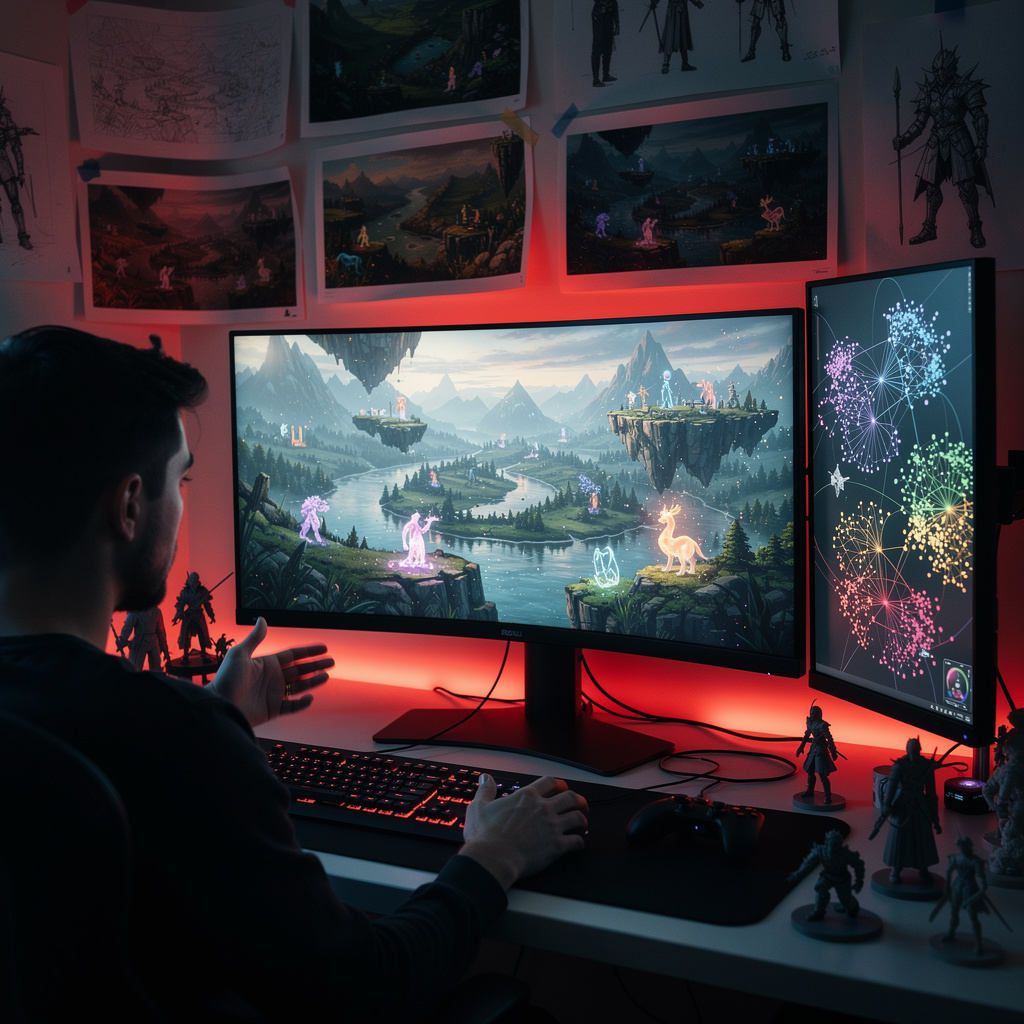
What is AI for Game Design?
AI for Game Design Certificate Program
AI for Game Design certificate program equips game designers, indie developers, creative leads, and narrative architects with the practical skills to weave artificial intelligence into every stage of game creation. The curriculum spans foundational AI concepts, generative text and large language models, AI-assisted concept art, audio and voice generation, level and world design, mechanics balancing, AI-driven NPCs, dynamic storytelling, playtesting analytics, and the ethical and legal dimensions of production. It is designed for both newcomers to AI and experienced designers who want to modernize their workflow without abandoning creative control. The main practical outcome is a complete, AI-enhanced game design pitch that demonstrates how these tools can elevate gameplay, narrative, and production efficiency.
The program follows a beginner-friendly progression that starts with core AI literacy and gradually builds toward advanced integration, always balancing conceptual theory with hands-on design exercises. Learners develop five core skill areas: AI foundations and generative media, AI-assisted visual and audio ideation, AI for systems and mechanics balancing, AI-driven behavior and narrative design, and ethical production integration. Each module pairs short theoretical explanations with applied challenges, so designers immediately test new techniques on real game design problems. This program is worth choosing now because the game industry is rapidly adopting AI tools for prototyping, asset creation, and player analytics, and designers who can thoughtfully direct these systems will shape the next generation of interactive experiences.
What is AI for Game Design?
AI for Game Design is the discipline of applying artificial intelligence techniques to the creative and technical processes of making games. Its scope covers generative models for art, audio, and text; procedural content generation for levels and worlds; reinforcement learning and utility systems for balancing mechanics; large language models for dialogue and dynamic narratives; and machine learning for playtesting and player behavior analysis. Core concepts include prompt engineering, latent space exploration, behavior trees, emergent systems, and human-in-the-loop design workflows. Rather than replacing designers, the field focuses on augmenting human creativity with computational tools that can iterate, suggest, and adapt at scale.
This subject matters today because AI has moved from academic research labs into mainstream game production, from indie studios using text-to-image tools for concept art to AAA teams deploying AI-driven NPCs and procedural quest generators. Recent shifts—such as diffusion models for real-time asset variation, LLM-powered conversational characters, and automated playtesting that predicts player churn—have changed how designers prototype, iterate, and personalize game experiences. In academia, AI for game design fuels research in computational creativity, affective computing, and human-computer interaction. Commercially, it enables smaller teams to compete with larger studios by automating labor-intensive tasks while opening new creative possibilities for adaptive and emergent gameplay.
Mastering this subject builds a hybrid skill stack that combines creative direction, technical literacy, systems thinking, and ethical judgment. Professionals learn to evaluate when and how to deploy AI tools, how to craft prompts and constraints that yield usable design assets, and how to integrate AI outputs into coherent game systems without sacrificing player agency or artistic intent. These skills benefit game designers, technical artists, narrative leads, producers, and educators who create serious games or simulations. Beyond entertainment, the same competencies apply to training simulations, educational games, and interactive experiences where adaptive content and intelligent agents enhance engagement and learning outcomes.
Common Questions About AI for Game Design
Does the AI for Game Design certificate add real value to a junior portfolio?
Is this AI for Game Design course suitable for complete beginners?
How does a behavior tree decide what an NPC does next?
- Selector: tries children in priority order and picks the first one that succeeds, which is useful for urgent reactions such as fleeing.
- Sequence: runs children in order and fails if any step fails, which suits multi-step routines like walking to ore, checking inventory, then forging.
- Conditions and actions: leaf nodes test world state or perform behavior; the tree re-evaluates on each tick rather than scripting every outcome.
- Memory and context: shared state such as a blacksmith remembering your ore can feed conditions, so the same tree produces different choices for different players.
What is the most common mistake when using dynamic difficulty adjustment?
How do large language models turn a sentence into a playable loop?
Why does persistent character memory change narrative design?
Do you need to code to use AI for game design effectively?
What Will This Course Bring You?
- Analyze core AI concepts such as machine learning, generative models, and reinforcement learning to explain their relevance to game design decisions.
- Apply large language models to generate and refine branching dialogue, quest text, and dynamic narrative beats that preserve tone and player agency.
- Design AI-assisted concept art workflows that produce and iterate visual ideas for characters, environments, and user interface elements.
- Implement generative AI tools to create adaptive game audio, character voices, and soundscapes that respond to player actions and mood.
- Evaluate AI-assisted level design and mechanics balancing workflows for generating playable spaces and tuning challenge, pacing, and system parameters.
- Implement AI-driven NPC systems that combine perception, decision making, and emergent behavior within interactive game scenarios.
- Assess playtesting analytics, ethical-legal constraints, and production integration needs for responsible AI use in game projects.
- Create a capstone pitch that demonstrates an AI-enhanced game concept, justifies design choices, and outlines a feasible production roadmap.
Curriculum
12 Units1. Foundations of AI for Game Design
1 hour
2. Core AI Concepts for Designers
1 hour
3. Generative Text and Large Language Models
1 hour
4. AI-Assisted Concept Art and Visual Ideation
1 hour
5. AI for Game Audio and Voice
1 hour
6. AI-Assisted Level and World Design
1 hour
7. AI for Mechanics and Systems Balancing
1 hour
8. AI-Driven NPCs and Emergent Behavior
1 hour
9. AI for Narrative Design and Dynamic Storytelling
1 hour
10. AI for Playtesting and Player Analytics
1 hour
11. Ethics, Law, and Production Integration
1 hour
12. Capstone: AI-Enhanced Game Design Pitch
1 hour
Exam – AI for Game Design
20 Questions • 70% Pass • 30 min
Unlock All Units for Free
Create an account, enroll in the course, and start with the first unit right away.
Exam – AI for Game Design
20 Questions • Pass: 70% • 30 min
Course Duration
720
Total Minutes
12
Unit
1
Final Exam
~60
Min / Unit
AI for Game Design Certificate Program
Document Your Skill
Those who pass the 20-question, 30-minute exam with 70% receive the AI for Game Design Certificate.
Stand Out on Your CV
By adding your certificate to your CV, gain a professional reference in job applications and stand out from the crowd.
Career Advantage
With the verification code, employers can check your certificate instantly — a concrete way to show your growth.
CERTIFICATE FEE
At the end of the course, an online exam consisting of 20 questions with a 30-minute time limit is given. The exam appears automatically after you complete the topics. Anyone who scores at least 70 out of 100 on the certificate exam is awarded the AI for Game Design Document (certificate of attendance). You can add the certificate you earn to your CV for job applications in the many sectors listed above, and use it as a reference proving that you took this interactive course.
The Certificate of Achievement you receive with the AI for Game Design course program holds value that proves your personal and professional development in the business world. By adding it to your CV, it can serve as an important reference in your job applications. Moreover, compared with certificates from other private training institutions, Catch Wisdom certificates are offered to our participants at a much more affordable price.
The AI for Game Design course certificate is a document that proves, with a unique verification code, that you completed the course. Employers can instantly check its authenticity with this code, which helps you show your development concretely in your job applications.
For more information, we recommend visiting the Support page.
Certificate in 7 Languages
Earning success certificates from our courses is now more meaningful and global. With certificates available in Turkish, English, German, French, Spanish, Arabic, and Russian, we fully unlock the potential of students worldwide.
Why Certificate in 7 Languages?
-
01
Global Skill Development
Receiving your certificates in 7 different languages strengthens your communication skills as you engage with more people worldwide. It lets you operate more confidently and capably on the international stage.
-
02
International Job Opportunities
Employers may see your certificates in multiple languages as a sign of your ability to seize global opportunities. You can open more doors to new jobs and projects.
-
03
Cultural Richness
The chance to earn certificates in different languages helps you build closer ties with various cultures and broadens your worldview. It enriches your global perspective and deepens cultural understanding.
-
04
Ability to Participate in International Projects
Multilingual certificates give you an edge to work more effectively on international projects. They boost your chances of leadership and participation in diverse projects in the business world.
-
05
Prove Yourself on the Global Stage
Certificates in multiple languages give you the opportunity to present your skills and knowledge worldwide.
Language diversity opens worldwide opportunities. If you want to prove yourself in the international arena, join our online AI for Game Design course program and begin this journey with us.
Frequently Asked Questions (FAQ)
Is this course paid?
How do I join the course?
Can I take the course at my own pace?
How can I get my certificate?
What are the advantages of the certificate?
Boost Your Career
Take a new career step with the AI for Game Design course. Add your certificate to your CV, stand out in job applications, and open the door to new opportunities in the industry.
StartStudent Reviews
No reviews yet
Enroll in this course and be the first to leave a review about your experience with AI for Game Design.
Start