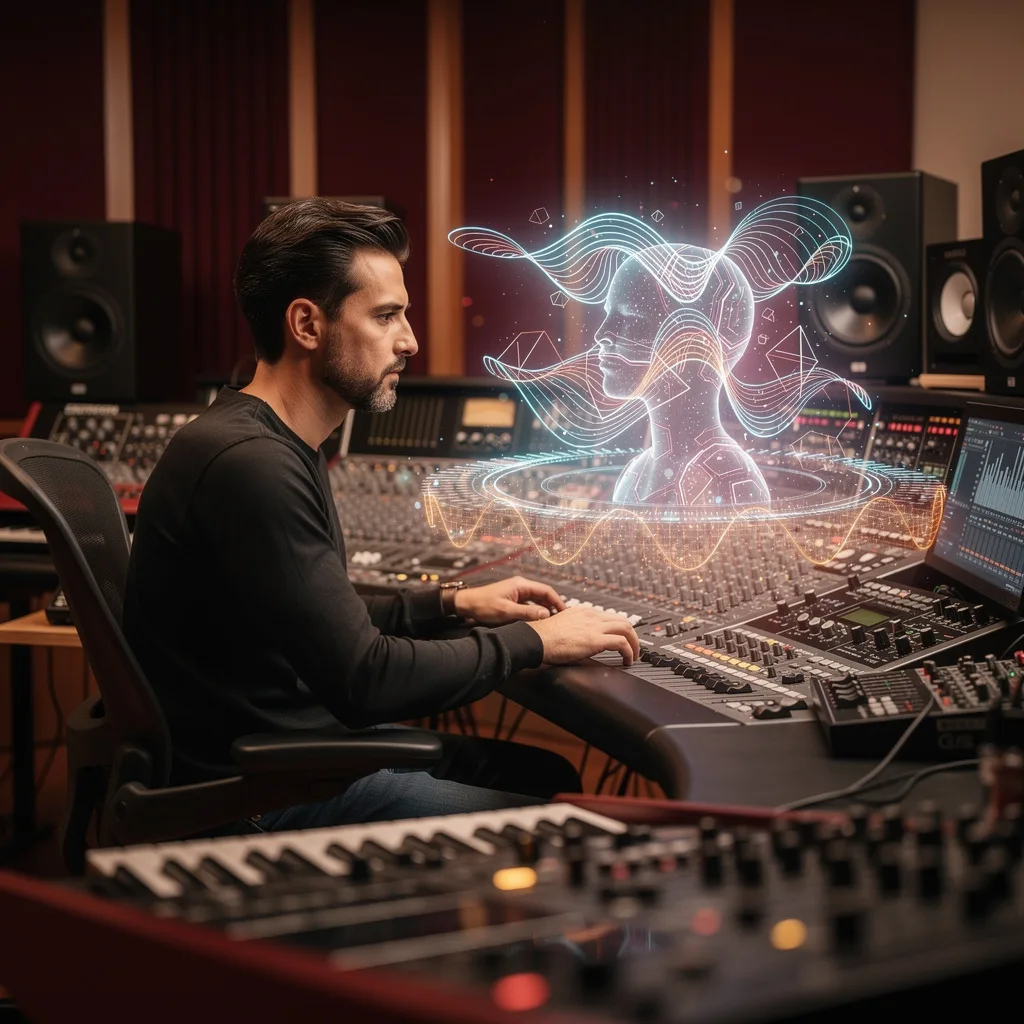
What is AI Music Generation Tools?
AI Music Generation Tools Certificate Program
The AI Music Generation Tools certificate program provides a comprehensive, hands-on education in using artificial intelligence to create, produce, and refine music. Designed for musicians, producers, content creators, and tech enthusiasts with no prior AI experience, this program equips learners with the practical skills to generate melodies, harmonies, lyrics, and full track arrangements using cutting-edge AI tools. By the end, participants will have produced a portfolio of original AI-assisted music projects ready for real-world application.
The program follows a beginner-friendly progression, starting with foundational concepts like what AI music tools can do and essential music theory for non-musicians, then advancing through text-to-music generation, melody and harmony generators, AI-assisted lyric writing, and full track production. It balances theoretical understanding with practical exercises across four core skill areas: creative ideation, technical tool mastery, ethical and legal awareness, and project integration. With the rapid evolution of AI in music, this program offers a timely opportunity to gain a competitive edge in the industry.
What is AI Music Generation Tools?
AI Music Generation Tools refer to software and platforms that leverage machine learning models—such as transformers, diffusion models, and generative adversarial networks—to autonomously or semi-autonomously create musical content. These tools can generate melodies, harmonies, rhythms, lyrics, and even full arrangements from text prompts, audio samples, or stylistic references. Core concepts include latent space manipulation, style transfer, and fine-tuning on custom datasets, enabling users to produce original compositions or transform existing pieces.
Today, AI music generation is reshaping the creative landscape across industries. Musicians use it for rapid prototyping and inspiration, game developers for adaptive soundtracks, filmmakers for cost-effective scoring, and content creators for royalty-free background music. Recent advances like real-time interactive AI and text-to-music models have lowered barriers to entry, while ethical debates around copyright and originality have spurred new frameworks for responsible use. Academic research continues to push boundaries in generative models and human-AI co-creation.
Mastering AI music generation builds a versatile skill stack combining creative intuition, technical proficiency with AI tools, understanding of music theory and production, and critical thinking about intellectual property. This expertise benefits professionals in music production, media creation, education, and technology development, as well as hobbyists seeking to expand their creative toolkit. The field offers growing career opportunities in AI-assisted composition, sound design, and music technology innovation.
Common Questions About AI Music Generation Tools
Is the AI Music Generation certificate useful for a music producer?
Can a beginner with no music theory join this course?
How does text-to-music generation actually work?
What is the difference between melody and harmony generators?
What are the two core approaches to AI music generation?
How do you train a custom AI music model?
- Prepare Your Dataset: Collect a set of audio or MIDI files that represent the sound you want to teach the model.
- Choose a Base Model: Select a pre-trained model (e.g., from Magenta or Lyria) as your starting point.
- Fine-Tune: Run the training process where the model learns patterns from your dataset while retaining its general music knowledge.
- Evaluate and Iterate: Test the output and adjust your dataset or training parameters for better results.
Is AI music generation just pressing a button with no skill?
What Will This Course Bring You?
- Analyze the capabilities and limitations of current AI music generation tools for various creative tasks.
- Apply fundamental music theory concepts such as harmony, rhythm, and structure to guide AI music generation outputs.
- Generate musical compositions from textual descriptions using text-to-music AI models.
- Design original melodies and harmonies by leveraging AI melody and harmony generators.
- Create coherent and stylistically appropriate lyrics using AI-assisted lyric writing tools.
- Produce a complete musical track by arranging AI-generated elements with traditional production techniques.
- Apply style transfer techniques to transform existing musical pieces into different genres or artist styles.
- Evaluate ethical and copyright implications of using AI-generated music in commercial projects.
Curriculum
12 Units1. What AI Music Generation Tools Can Do
1 hour
2. Essential Music Concepts for AI Users
1 hour
3. Text-to-Music Generation
1 hour
4. Melody and Harmony Generators
1 hour
5. AI-Assisted Lyric Writing
1 hour
6. Full Track Arrangement and Production
1 hour
7. Style Transfer and Cover Generation
1 hour
8. Real-Time and Interactive AI Music
1 hour
9. Custom Model Training and Fine-Tuning
1 hour
10. Ethics, Copyright, and Responsible Use
1 hour
11. Integrating AI Music into Real Projects
1 hour
12. Future Directions and Career Opportunities
1 hour
Exam – AI Music Generation Tools
20 Questions • 70% Pass • 30 min
Unlock All Units for Free
Create an account, enroll in the course, and start with the first unit right away.
Exam – AI Music Generation Tools
20 Questions • Pass: 70% • 30 min
Course Duration
720
Total Minutes
12
Unit
1
Final Exam
~60
Min / Unit
AI Music Generation Tools Certificate Program
Document Your Skill
Those who pass the 20-question, 30-minute exam with 70% receive the AI Music Generation Tools Certificate.
Stand Out on Your CV
By adding your certificate to your CV, gain a professional reference in job applications and stand out from the crowd.
Career Advantage
With the verification code, employers can check your certificate instantly — a concrete way to show your growth.
CERTIFICATE FEE
At the end of the course, an online exam consisting of 20 questions with a 30-minute time limit is given. The exam appears automatically after you complete the topics. Anyone who scores at least 70 out of 100 on the certificate exam is awarded the AI Music Generation Tools Document (certificate of attendance). You can add the certificate you earn to your CV for job applications in the many sectors listed above, and use it as a reference proving that you took this interactive course.
The Certificate of Achievement you receive with the AI Music Generation Tools course program holds value that proves your personal and professional development in the business world. By adding it to your CV, it can serve as an important reference in your job applications. Moreover, compared with certificates from other private training institutions, Catch Wisdom certificates are offered to our participants at a much more affordable price.
The AI Music Generation Tools course certificate is a document that proves, with a unique verification code, that you completed the course. Employers can instantly check its authenticity with this code, which helps you show your development concretely in your job applications.
For more information, we recommend visiting the Support page.
Certificate in 7 Languages
Earning success certificates from our courses is now more meaningful and global. With certificates available in Turkish, English, German, French, Spanish, Arabic, and Russian, we fully unlock the potential of students worldwide.
Why Certificate in 7 Languages?
-
01
Global Skill Development
Receiving your certificates in 7 different languages strengthens your communication skills as you engage with more people worldwide. It lets you operate more confidently and capably on the international stage.
-
02
International Job Opportunities
Employers may see your certificates in multiple languages as a sign of your ability to seize global opportunities. You can open more doors to new jobs and projects.
-
03
Cultural Richness
The chance to earn certificates in different languages helps you build closer ties with various cultures and broadens your worldview. It enriches your global perspective and deepens cultural understanding.
-
04
Ability to Participate in International Projects
Multilingual certificates give you an edge to work more effectively on international projects. They boost your chances of leadership and participation in diverse projects in the business world.
-
05
Prove Yourself on the Global Stage
Certificates in multiple languages give you the opportunity to present your skills and knowledge worldwide.
Language diversity opens worldwide opportunities. If you want to prove yourself in the international arena, join our online AI Music Generation Tools course program and begin this journey with us.
Frequently Asked Questions (FAQ)
Is this course paid?
How do I join the course?
Can I take the course at my own pace?
How can I get my certificate?
What are the advantages of the certificate?
Boost Your Career
Take a new career step with the AI Music Generation Tools course. Add your certificate to your CV, stand out in job applications, and open the door to new opportunities in the industry.
StartStudent Reviews
No reviews yet
Enroll in this course and be the first to leave a review about your experience with AI Music Generation Tools.
Start