What is Asian Textile Traditions: Weaving and Dyeing?
Asian Textile Traditions: Weaving and Dyeing Certificate Program
The Asian Textile Traditions: Weaving and Dyeing certificate program provides a comprehensive foundation in the fiber, loom, weave, dye, and finishing practices that have shaped textile making across Asia. It examines how regional fiber sources, spinning methods, loom architectures, foundation and patterned weaves, natural dye chemistry, resist techniques, and finishing choices produce distinct textile traditions. The program is designed for designers, craft practitioners, museum and conservation professionals, educators, and textile historians who want a technical and cultural understanding of Asian textiles rather than a purely visual survey. Its main practical outcome is the ability to analyze textile structures and dye processes, document samples and references with accurate vocabulary, and connect making techniques to regional contexts and trade histories.
Learning progresses from fiber identification and yarn preparation through loom mechanics and weave drafting to natural dyes, resist patterning, block printing, and finishing, so beginners can build competence without prior specialist training. Each stage pairs concise technical explanation with guided observation and sampling tasks, allowing learners to test how material, structure, and chemistry interact rather than memorizing isolated terms. Across the program, five core skill areas are developed: fiber and yarn literacy, loom and weave analysis, dye and mordant reasoning, resist and patterning control, and finishing and contextual interpretation. This program is timely because sustainable material choices, heritage preservation, transparent craft supply chains, and cross-cultural design research all depend on professionals who can read textiles as both technical objects and cultural records.
What is Asian Textile Traditions: Weaving and Dyeing?
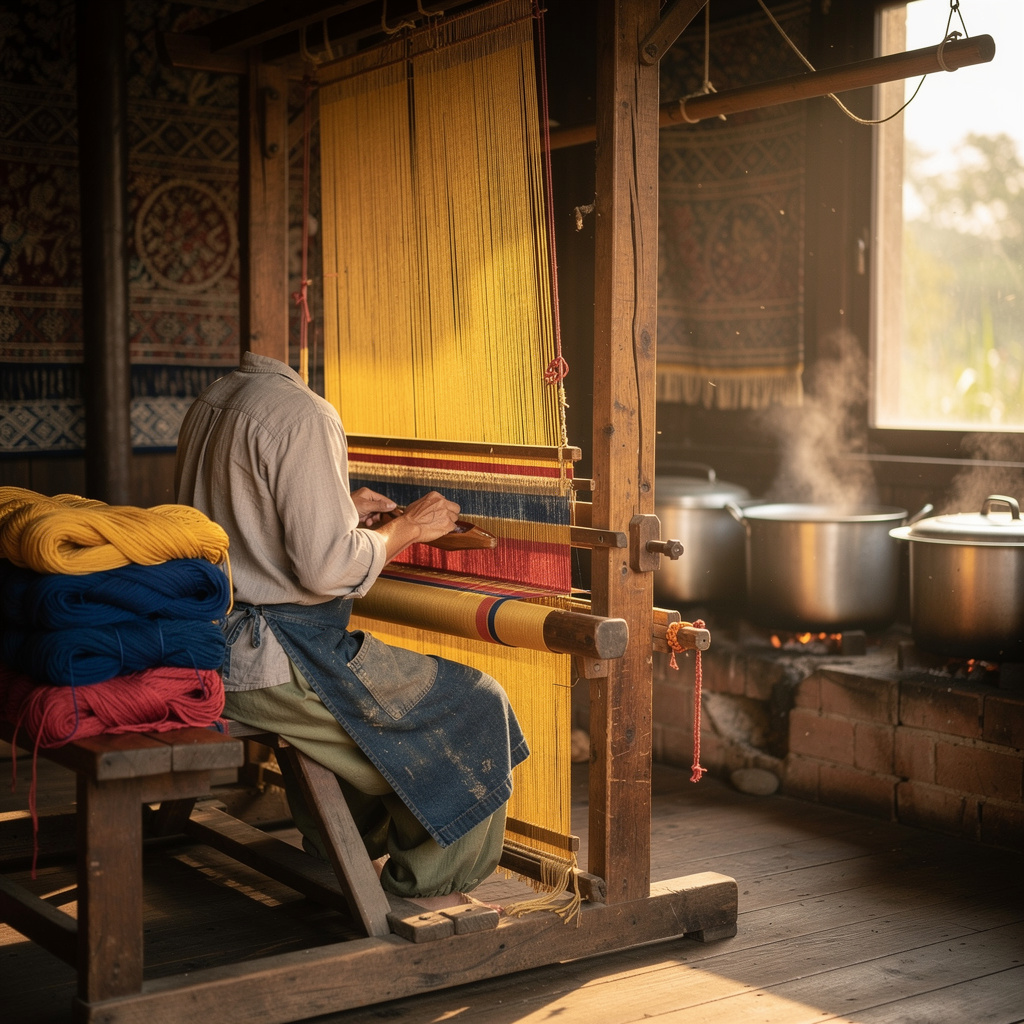
Asian textile traditions refer to the interrelated systems of fiber selection, yarn preparation, loom construction, weave structure, dye chemistry, resist patterning, embellishment, and finishing that communities across the continent have developed and exchanged over centuries. The subject’s scope ranges from the material properties of bast, cotton, silk, and wool fibers to the mechanics of tension and interlacing, and from the chemistry of mordants and natural colorants to the social meanings of cloth in trade, ritual, and daily life. Core concepts include the distinction between structural pattern and applied surface pattern, the role of mordants in fixing and shifting color, the logic of bound-resist patterning, and the regional variation that emerges when shared techniques meet local materials and markets. Understanding these concepts requires attention to both hands-on process and historical context, because a textile’s appearance is shaped as much by labor organization, available resources, and exchange networks as by design intention.
The subject matters today because textiles are central to conversations about sustainable production, cultural heritage, museum conservation, and ethical supply chains. Designers and material researchers study Asian weaving and dyeing systems for low-energy patterning methods, renewable colorants, and structural solutions that can inform contemporary textiles without reducing traditions to surface decoration. Museums, archives, and heritage organizations increasingly need precise technical vocabularies to catalog, conserve, and interpret cloth, while craft enterprises and fair-trade initiatives depend on accurate provenance and process knowledge. Recent shifts toward digitized collection access, natural dye revivals, artisan-led documentation, and transparent sourcing have made textile literacy more relevant beyond specialist craft circles.
Mastering this subject builds a skill stack that combines material literacy, structural analysis, process reasoning, visual discrimination, and contextual interpretation. These capabilities support textile design, conservation, curation, collections documentation, craft education, sustainable sourcing, and cultural heritage work, where decisions depend on recognizing how a cloth was made and why. They also benefit personal practice by giving makers a grounded vocabulary for sampling, troubleshooting, and adapting techniques responsibly across cultural contexts. The result is a form of expertise that treats textiles as evidence of technical choice, environmental constraint, economic exchange, and cultural continuity rather than as static decorative objects.
What Will This Course Bring You?
- Map major Asian fiber-producing regions and evaluate how local climate, agriculture, and trade shaped textile geographies.
- Demonstrate fiber preparation by comparing cleaning, reeling, and spinning methods used to transform Asian silk, cotton, and bast fibers into yarn.
- Analyze loom architectures and weaving mechanics to explain how shedding, picking, and beating produce plain, twill, and satin foundations.
- Design a patterned woven sample by selecting supplementary weft, supplementary warp, or brocade structures appropriate to a specific visual effect.
- Apply natural dye and mordant chemistry principles to predict and test color outcomes on at least two Asian textile fibers.
- Compare bound, stitched, and clamped resist techniques by producing small samples that demonstrate controlled pattern formation before dyeing.
- Evaluate batik, ikat, and block-printed textile examples to distinguish wax-resist, bound-resist, and mordant-patterned processes and their regional identifiers.
- Build a finishing and interpretation plan that documents embellishment choices and explains how trade and regional context affect a completed cloth's meaning.
Curriculum
12 Units1. Fibers and Textile Geographies of Asia
1 hour
2. From Fiber to Yarn: Cleaning, Reeling, and Spinning
1 hour
3. Loom Architectures and Weaving Mechanics
1 hour
4. Foundation Weaves: Plain, Twill, Satin, and Their Variations
1 hour
5. Patterned Weaving: Supplementary Weft, Supplementary Warp, and Brocade
1 hour
6. Natural Dyes and Mordant Chemistry
1 hour
7. Resist Dyeing Foundations: Bound, Stitched, and Clamped Patterns
1 hour
8. Batik and Wax-Resist Traditions
1 hour
9. Ikat: Warp, Weft, and Compound Bound-Resist Patterning
1 hour
10. Block Printing, Painting, and Mordant-Patterned Textiles
1 hour
11. Finishing, Embellishment, and Cloth as a Completed Object
1 hour
12. Regional Traditions, Trade, and Textile Interpretation
1 hour
Exam – Asian Textile Traditions: Weaving and Dyeing
20 Questions • 70% Pass • 30 min
Unlock All Units for Free
Create an account, enroll in the course, and start with the first unit right away.
Exam – Asian Textile Traditions: Weaving and Dyeing
20 Questions • Pass: 70% • 30 min
Course Duration
720
Total Minutes
12
Unit
1
Final Exam
~60
Min / Unit
Asian Textile Traditions: Weaving and Dyeing Certificate Program
Document Your Skill
Those who pass the 20-question, 30-minute exam with 70% receive the Asian Textile Traditions: Weaving and Dyeing Certificate.
Stand Out on Your CV
By adding your certificate to your CV, gain a professional reference in job applications and stand out from the crowd.
Career Advantage
With the verification code, employers can check your certificate instantly — a concrete way to show your growth.
CERTIFICATE FEE
At the end of the course, an online exam consisting of 20 questions with a 30-minute time limit is given. The exam appears automatically after you complete the topics. Anyone who scores at least 70 out of 100 on the certificate exam is awarded the Asian Textile Traditions: Weaving and Dyeing Document (certificate of attendance). You can add the certificate you earn to your CV for job applications in the many sectors listed above, and use it as a reference proving that you took this interactive course.
The Certificate of Achievement you receive with the Asian Textile Traditions: Weaving and Dyeing course program holds value that proves your personal and professional development in the business world. By adding it to your CV, it can serve as an important reference in your job applications. Moreover, compared with certificates from other private training institutions, Catch Wisdom certificates are offered to our participants at a much more affordable price.
The Asian Textile Traditions: Weaving and Dyeing course certificate is a document that proves, with a unique verification code, that you completed the course. Employers can instantly check its authenticity with this code, which helps you show your development concretely in your job applications.
For more information, we recommend visiting the Support page.
Certificate in 7 Languages
Earning success certificates from our courses is now more meaningful and global. With certificates available in Turkish, English, German, French, Spanish, Arabic, and Russian, we fully unlock the potential of students worldwide.
Why Certificate in 7 Languages?
-
01
Global Skill Development
Receiving your certificates in 7 different languages strengthens your communication skills as you engage with more people worldwide. It lets you operate more confidently and capably on the international stage.
-
02
International Job Opportunities
Employers may see your certificates in multiple languages as a sign of your ability to seize global opportunities. You can open more doors to new jobs and projects.
-
03
Cultural Richness
The chance to earn certificates in different languages helps you build closer ties with various cultures and broadens your worldview. It enriches your global perspective and deepens cultural understanding.
-
04
Ability to Participate in International Projects
Multilingual certificates give you an edge to work more effectively on international projects. They boost your chances of leadership and participation in diverse projects in the business world.
-
05
Prove Yourself on the Global Stage
Certificates in multiple languages give you the opportunity to present your skills and knowledge worldwide.
Language diversity opens worldwide opportunities. If you want to prove yourself in the international arena, join our online Asian Textile Traditions: Weaving and Dyeing course program and begin this journey with us.
Frequently Asked Questions (FAQ)
Is this course paid?
How do I join the course?
Can I take the course at my own pace?
How can I get my certificate?
What are the advantages of the certificate?
Boost Your Career
Take a new career step with the Asian Textile Traditions: Weaving and Dyeing course. Add your certificate to your CV, stand out in job applications, and open the door to new opportunities in the industry.
StartStudent Reviews
No reviews yet
Enroll in this course and be the first to leave a review about your experience with Asian Textile Traditions: Weaving and Dyeing.
Start

