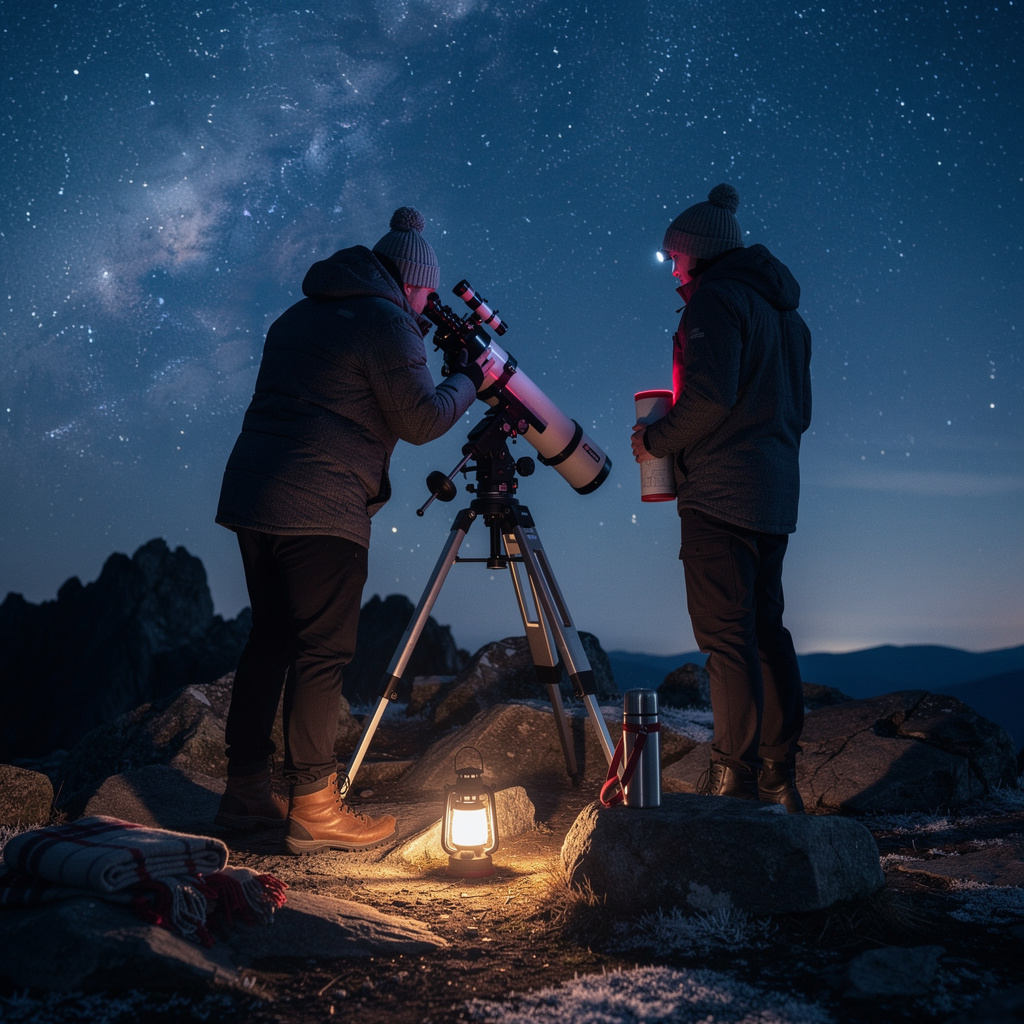
What is Astronomy Basics?
Astronomy Basics Certificate Program
Astronomy Basics certificate program is a structured introduction to the science of the universe, designed for absolute beginners and curious stargazers who want to move from casual sky-watching to informed observation. Across twelve lessons, the curriculum moves from the scope and history of astronomy and the practical mapping of constellations to telescope technique, the physics of light and matter, and the structure of the solar system. Learners then examine the Sun, stellar evolution, the Milky Way and other galaxies, cosmology, exoplanets, and modern frontiers such as black holes and gravitational waves. The main practical outcome is the ability to plan and carry out meaningful observing sessions, interpret astronomical data and images, and explain celestial phenomena with confidence.
The program is structured as a beginner-friendly progression: early lessons establish sky orientation and observational vocabulary, middle lessons build physical understanding of light, planets, and stars, and later lessons connect those ideas to galaxies, cosmology, and current research. Theory is balanced with practice through telescope handling, observing techniques, and amateur astronomy projects, so learners apply concepts under real skies rather than only reading about them. It builds five core skill areas: sky navigation and constellation recognition; telescope setup and visual observing; interpretation of light, spectra, and astronomical images; conceptual understanding of stellar, galactic, and cosmological processes; and practical project planning for amateur astronomy. Someone would choose this program now because affordable smart telescopes, accessible astrophotography tools, and rapid public discoveries in exoplanet and black-hole science make it an ideal moment to build a durable foundation in astronomy.
What is Astronomy Basics?
Astronomy Basics is the study of the universe beyond Earth at an introductory level, covering the positions and motions of celestial objects, the nature of light as an astronomical messenger, and the physical processes that shape planets, stars, galaxies, and the universe as a whole. Its scope ranges from practical sky orientation and the apparent motion of the night sky to the structure of the solar system, the life cycles of stars, the classification of galaxies, and the cosmological models that describe the origin and evolution of the cosmos. Core concepts include celestial coordinates and timekeeping, the electromagnetic spectrum, gravitation and orbital motion, stellar magnitude and spectra, the Hertzsprung-Russell diagram, redshift, and the expanding universe. It also introduces the instruments and methods that make astronomical knowledge possible, from optical telescopes and detectors to space-based observatories and gravitational-wave detectors.
Astronomy Basics matters today because it provides the conceptual vocabulary needed to follow a steady stream of public discoveries, from exoplanet atmospheres and black-hole imaging to gravitational-wave events and early-universe observations. In academia, it is the foundation for astrophysics, planetary science, and cosmology, while in industry its methods support satellite operations, remote sensing, precision optics, data analysis, and science communication. Recent shifts include the rise of time-domain astronomy, the routine detection of gravitational waves, the growth of large survey telescopes, and the increasing role of machine learning in processing astronomical data. These developments make basic astronomical literacy relevant not only to students but also to educators, journalists, engineers, and citizen scientists who need to interpret claims about the cosmos accurately.
Mastering the subject builds a skill stack that combines observational planning, instrument handling, data interpretation, spatial reasoning, and evidence-based explanation of complex systems. It also strengthens the ability to connect physical principles across scales, from planetary orbits to galactic structure and cosmological expansion, which is valuable in scientific, technical, and educational contexts. Professionally, these skills support roles in science education, outreach, observatory support, data analysis, aerospace and remote sensing, and science writing; personally, they enrich amateur observing, astrophotography, and informed engagement with astronomy news. Because astronomy is both a practical field and a conceptual gateway to physics, the subject serves learners who want a rigorous but accessible entry point into how the universe works.
What Will This Course Bring You?
- Analyze historical discoveries and changing models of the universe to explain how astronomy developed from naked-eye observation to modern astrophysics.
- Apply celestial coordinate systems and constellation patterns to locate visible stars and predict their apparent nightly and seasonal motion.
- Design a practical night-sky observing plan by selecting telescope types, mounts, and techniques that reduce atmospheric and equipment limitations.
- Interpret stellar spectra and light-matter interactions to infer stellar temperature, composition, and motion from observed electromagnetic radiation.
- Compare formation and characteristics of planets, moons, and small bodies to explain structural patterns and dynamic processes within our solar system.
- Trace stellar evolution from protostars to remnants, including the Sun's structure and activity, by relating mass, fusion stages, and observational evidence.
- Evaluate galaxy classification and cosmological models using evidence for expansion, dark matter, and large-scale structure to explain the universe's evolution.
- Assess detection methods for exoplanets and evidence for black holes and gravitational waves to evaluate modern frontiers in astronomy.
Curriculum
12 Units1. The Scope and History of Astronomy
1 hour
2. Observing the Night Sky: Constellations and Celestial Motion
1 hour
3. Telescopes and Observing Techniques
1 hour
4. Light and Matter: Decoding Starlight
1 hour
5. The Solar System: Planets, Moons, and Small Bodies
1 hour
6. The Sun: Structure and Solar Activity
1 hour
7. Stellar Evolution: The Life Cycles of Stars
1 hour
8. The Milky Way and Other Galaxies
1 hour
9. Cosmology: The Origin and Fate of the Universe
1 hour
10. Exoplanets and the Search for Extraterrestrial Life
1 hour
11. Practical Amateur Astronomy: Equipment and Projects
1 hour
12. Modern Frontiers: Black Holes, Gravitational Waves, and Beyond
1 hour
Exam – Astronomy Basics
20 Questions • 70% Pass • 30 min
Unlock All Units for Free
Create an account, enroll in the course, and start with the first unit right away.
Exam – Astronomy Basics
20 Questions • Pass: 70% • 30 min
Course Duration
720
Total Minutes
12
Unit
1
Final Exam
~60
Min / Unit
Astronomy Basics Certificate Program
Document Your Skill
Those who pass the 20-question, 30-minute exam with 70% receive the Astronomy Basics Certificate.
Stand Out on Your CV
By adding your certificate to your CV, gain a professional reference in job applications and stand out from the crowd.
Career Advantage
With the verification code, employers can check your certificate instantly — a concrete way to show your growth.
CERTIFICATE FEE
At the end of the course, an online exam consisting of 20 questions with a 30-minute time limit is given. The exam appears automatically after you complete the topics. Anyone who scores at least 70 out of 100 on the certificate exam is awarded the Astronomy Basics Document (certificate of attendance). You can add the certificate you earn to your CV for job applications in the many sectors listed above, and use it as a reference proving that you took this interactive course.
The Certificate of Achievement you receive with the Astronomy Basics course program holds value that proves your personal and professional development in the business world. By adding it to your CV, it can serve as an important reference in your job applications. Moreover, compared with certificates from other private training institutions, Catch Wisdom certificates are offered to our participants at a much more affordable price.
The Astronomy Basics course certificate is a document that proves, with a unique verification code, that you completed the course. Employers can instantly check its authenticity with this code, which helps you show your development concretely in your job applications.
For more information, we recommend visiting the Support page.
Certificate in 7 Languages
Earning success certificates from our courses is now more meaningful and global. With certificates available in Turkish, English, German, French, Spanish, Arabic, and Russian, we fully unlock the potential of students worldwide.
Why Certificate in 7 Languages?
-
01
Global Skill Development
Receiving your certificates in 7 different languages strengthens your communication skills as you engage with more people worldwide. It lets you operate more confidently and capably on the international stage.
-
02
International Job Opportunities
Employers may see your certificates in multiple languages as a sign of your ability to seize global opportunities. You can open more doors to new jobs and projects.
-
03
Cultural Richness
The chance to earn certificates in different languages helps you build closer ties with various cultures and broadens your worldview. It enriches your global perspective and deepens cultural understanding.
-
04
Ability to Participate in International Projects
Multilingual certificates give you an edge to work more effectively on international projects. They boost your chances of leadership and participation in diverse projects in the business world.
-
05
Prove Yourself on the Global Stage
Certificates in multiple languages give you the opportunity to present your skills and knowledge worldwide.
Language diversity opens worldwide opportunities. If you want to prove yourself in the international arena, join our online Astronomy Basics course program and begin this journey with us.
Frequently Asked Questions (FAQ)
Is this course paid?
How do I join the course?
Can I take the course at my own pace?
How can I get my certificate?
What are the advantages of the certificate?
Boost Your Career
Take a new career step with the Astronomy Basics course. Add your certificate to your CV, stand out in job applications, and open the door to new opportunities in the industry.
StartStudent Reviews
No reviews yet
Enroll in this course and be the first to leave a review about your experience with Astronomy Basics.
Start