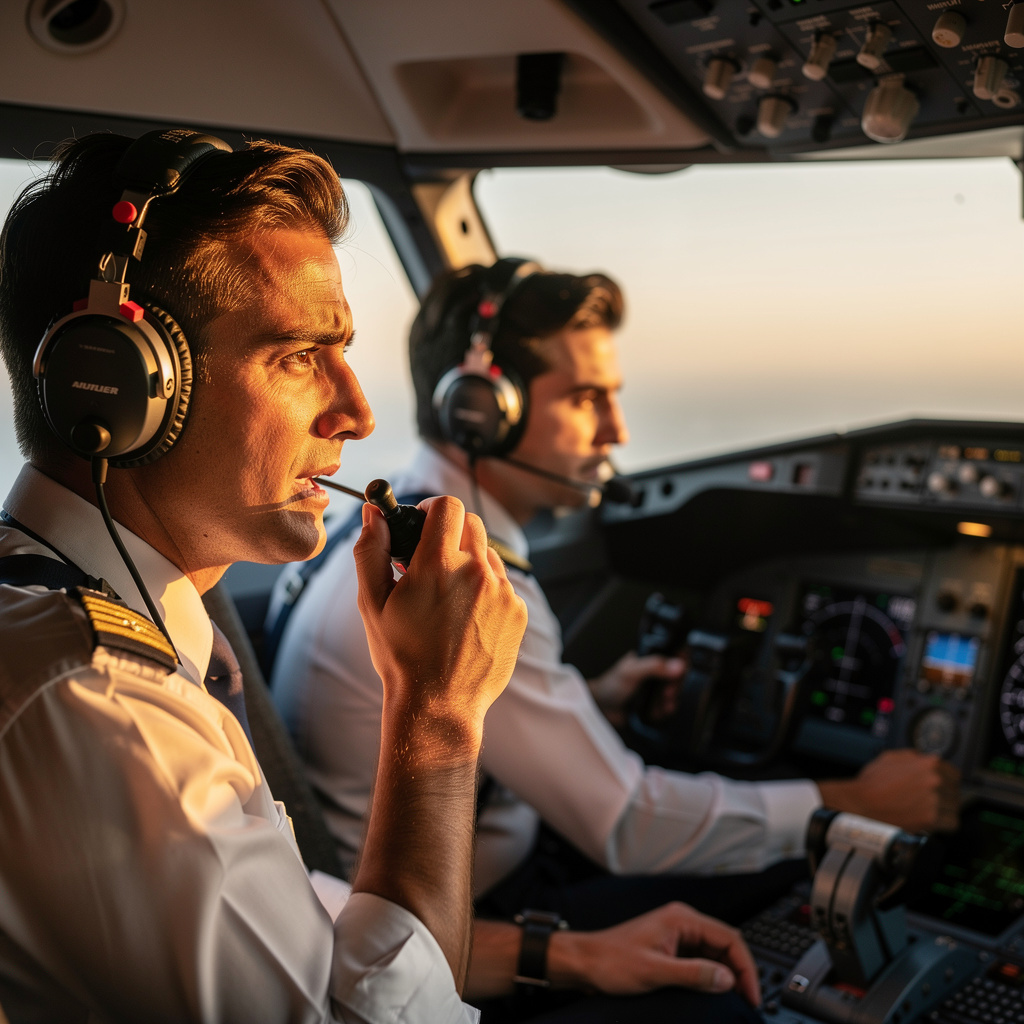
What is Aviation English Radio Communication?
Aviation English Radio Communication Training
The Aviation English Radio Communication certificate program equips pilots, air traffic controllers, and aviation enthusiasts with the precise language skills required for safe and efficient radiotelephony. This course systematically covers the ICAO phonetic alphabet, standard phraseology for clearances, ground and tower communications, and en-route procedures, while also addressing weather reports, emergency situations, and non-routine exchanges. Designed for learners from beginner to intermediate levels, the program's primary outcome is the ability to conduct clear, unambiguous radio communication in real-world ATC environments, reducing the risk of misunderstandings that can compromise flight safety.
Structured as a progressive journey, the program begins with fundamentals and builds through listening comprehension and simulated radiotelephony scenarios, ensuring a balanced blend of theoretical knowledge and practical application. Each lesson targets core skill areas: speaking, listening, reading, and situational awareness, with special emphasis on handling misunderstandings and abnormal situations. By integrating realistic ATC recordings and interactive simulations, this course offers an immersive learning experience that mirrors current industry demands. With global aviation expanding and ICAO language proficiency requirements becoming stricter, mastering this specialized English is now more critical than ever for career advancement and operational excellence.
What is Aviation English Radio Communication?
Aviation English Radio Communication is the specialized subset of English used in pilot-controller dialogue, governed by ICAO standards to ensure global intelligibility and safety. Its core concepts include standardized phraseology, the phonetic alphabet, numerical transmission rules, and the strategic use of plain language for non-routine situations. The subject encompasses everything from initial contact and taxi instructions to approach clearances and emergency declarations, forming the backbone of air traffic management worldwide.
Today, as air traffic density increases and international routes multiply, the relevance of this subject has never been higher. It is applied daily in every control tower, approach radar room, and cockpit across the globe, and is a mandatory requirement for obtaining and maintaining pilot and controller licenses under ICAO Annex 1. Recent shifts toward digital communication and data-link systems have not diminished the need for robust voice communication skills; instead, they have highlighted the importance of clear, concise, and error-free exchanges, especially during unexpected events or system failures.
Mastering this subject builds a skill stack that includes precise pronunciation, active listening under stress, rapid decision-making, and cross-cultural communication competence. For aviation professionals, it directly enhances operational safety and career prospects, while for linguists or researchers, it offers a fascinating case study in high-stakes, regulated language use. Beyond the cockpit, these skills translate to improved communication in any high-pressure, safety-critical environment, making the subject valuable for emergency responders, maritime operators, and corporate crisis teams seeking to adopt aviation-grade communication standards.
Common Questions About Aviation English Radio Communication
How do I start learning aviation radio communication?
What certificate do I get after completing aviation communication training?
Can I learn aviation English radio communication online?
How long does it take to complete the aviation radio course?
What is the ICAO phonetic alphabet and why is it important?
Can a beginner with no aviation experience learn radiotelephony?
What does the CRAFT clearance format stand for?
- Cleared to: the destination or fix
- Route: the flight path
- Altitude: the initial assigned level
- Frequency: the departure frequency
- Transponder: the squawk code
What Will This Course Bring You?
- Apply the ICAO phonetic alphabet and numerical pronunciation to accurately transmit and receive alphanumeric information in radiotelephony.
- Use standard phraseology for clearances and instructions to ensure unambiguous communication with ATC.
- Execute ground and tower communication procedures, including taxi instructions and runway clearances, in a simulated environment.
- Implement departure and arrival communication protocols, including initial contact and approach clearances, to coordinate aircraft movements.
- Manage en-route communications, including position reports and frequency changes, while maintaining situational awareness.
- Interpret and relay meteorological information, such as ATIS and SIGMET, to make informed flight decisions.
- Evaluate emergency and abnormal situations and apply appropriate radiotelephony procedures to communicate distress and urgency messages.
- Analyze real-world ATC audio to identify non-standard exchanges and apply strategies to resolve misunderstandings.
Curriculum
12 Units1. Fundamentals of Radiotelephony
1 hour
2. The ICAO Phonetic Alphabet and Numbers
1 hour
3. Standard Phraseology for Clearances and Instructions
1 hour
4. Ground and Tower Communications
1 hour
5. Departure and Arrival Procedures
1 hour
6. En-Route Communications
1 hour
7. Weather and Meteorological Information
1 hour
8. Emergency and Abnormal Situations
1 hour
9. Handling Misunderstandings and Non-Routine Exchanges
1 hour
10. Listening Comprehension in Real-World ATC
1 hour
11. Simulated Radiotelephony Scenarios
1 hour
12. Review and Assessment
1 hour
Exam – Aviation English Radio Communication
20 Questions • 70% Pass • 30 min
Unlock All Units for Free
Create an account, enroll in the course, and start with the first unit right away.
Exam – Aviation English Radio Communication
20 Questions • Pass: 70% • 30 min
Course Duration
720
Total Minutes
12
Unit
1
Final Exam
~60
Min / Unit
Aviation English Radio Communication Certificate Program
Document Your Skill
Those who pass the 20-question, 30-minute exam with 70% receive the Aviation English Radio Communication Certificate.
Stand Out on Your CV
By adding your certificate to your CV, gain a professional reference in job applications and stand out from the crowd.
Career Advantage
Catch Wisdom certificates are recognized by HR departments and increase career opportunities.
CERTIFICATE FEE
At the end of the course, an online exam consisting of 20 questions with a 30-minute time limit is given. The exam appears automatically after you complete the topics. Anyone who scores at least 70 out of 100 on the certificate exam is awarded the Aviation English Radio Communication Document (certificate of attendance). You can add the certificate you earn to your CV for job applications in the many sectors listed above, and use it as a reference proving that you took this interactive course.
The Certificate of Achievement you receive with the Aviation English Radio Communication course program holds value that proves your personal and professional development in the business world. By adding it to your CV, it can serve as an important reference in your job applications. Moreover, compared with certificates from other private training institutions, Catch Wisdom certificates are offered to our participants at a much more affordable price.
Because HR departments recognize Catch Wisdom as a reputable institution in this field, they value these certificates and may evaluate your job applications favorably. For this reason, a Aviation English Radio Communication course certificate from Catch Wisdom can make your applications more attractive and place you in an advantageous position in the business world.
For more information, we recommend visiting the Support page.
Certificate in 7 Languages
Earning success certificates from our courses is now more meaningful and global. With certificates available in Turkish, English, German, French, Spanish, Arabic, and Russian, we fully unlock the potential of students worldwide.
Why Certificate in 7 Languages?
-
01
Global Skill Development
Receiving your certificates in 7 different languages strengthens your communication skills as you engage with more people worldwide. It lets you operate more confidently and capably on the international stage.
-
02
International Job Opportunities
Employers may see your certificates in multiple languages as a sign of your ability to seize global opportunities. You can open more doors to new jobs and projects.
-
03
Cultural Richness
The chance to earn certificates in different languages helps you build closer ties with various cultures and broadens your worldview. It enriches your global perspective and deepens cultural understanding.
-
04
Ability to Participate in International Projects
Multilingual certificates give you an edge to work more effectively on international projects. They boost your chances of leadership and participation in diverse projects in the business world.
-
05
Prove Yourself on the Global Stage
Certificates in multiple languages let you showcase your skills and knowledge worldwide. You can become an internationally recognized professional.
Language diversity opens worldwide opportunities. If you want to prove yourself in the international arena, join our online Aviation English Radio Communication course program and begin this journey with us.
Frequently Asked Questions (FAQ)
Is this course paid?
How do I join the course?
Can I take the course at my own pace?
How can I get my certificate?
What are the advantages of the Certified Certificate?
Boost Your Career
Take a new career step with the Aviation English Radio Communication course. Add your certificate to your CV, stand out in job applications, and open the door to new opportunities in the industry.
StartStudent Reviews
No reviews yet
Enroll in this course and be the first to leave a review about your experience with Aviation English Radio Communication.
Start