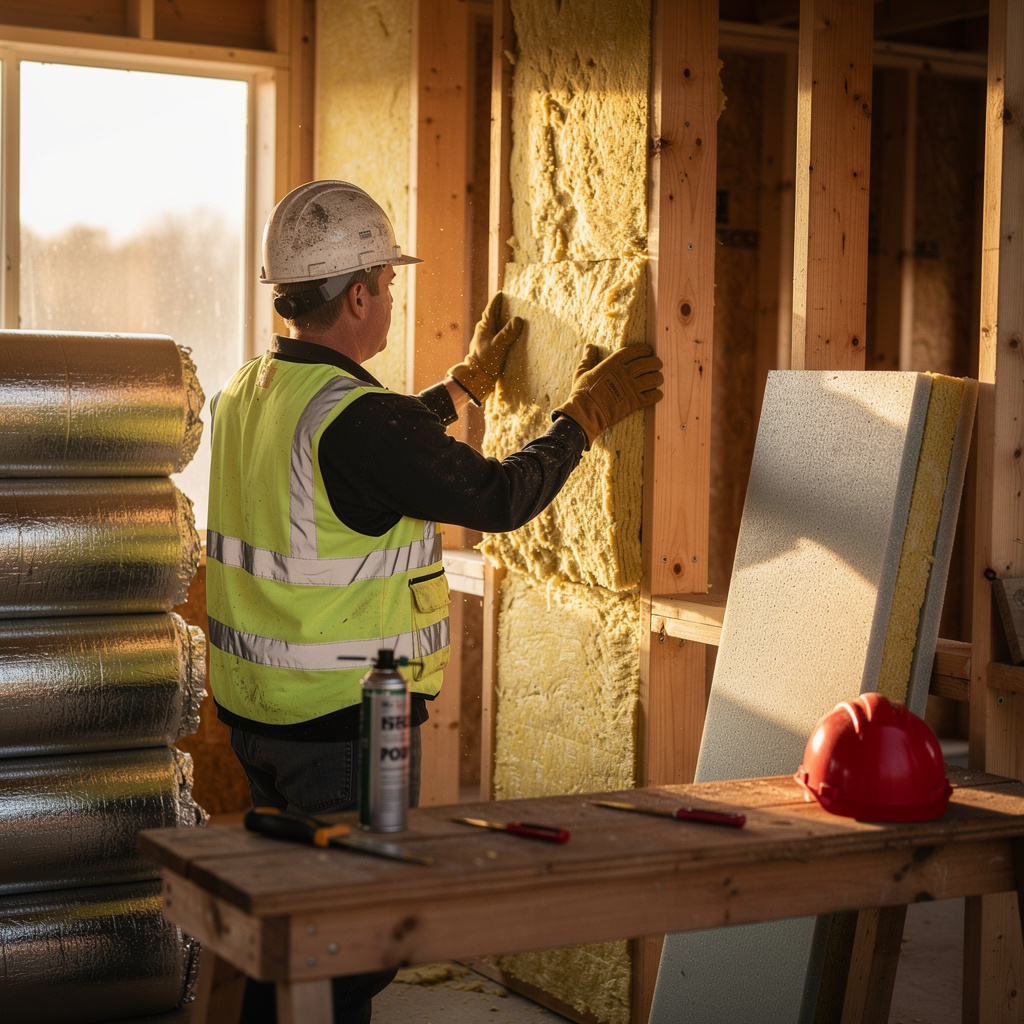
What is Building Insulation Fundamentals?
Building Insulation Fundamentals Training
Building Insulation Fundamentals certificate program is designed for construction professionals, energy auditors, architects, facility managers, and motivated homeowners who need a practical grounding in how insulation controls heat flow through building assemblies. The course teaches the physics of conduction, convection, and radiation alongside material selection, R-value and U-factor interpretation, and assembly detailing for walls, roofs, attics, foundations, floors, and slabs. Learners examine air sealing, moisture control, ventilation balance, retrofit challenges, and code compliance as interconnected parts of envelope performance. The main practical outcome is the ability to evaluate insulation systems and recommend assemblies that improve thermal performance without creating moisture or durability problems.
The program follows a beginner-friendly progression from heat transfer basics and material properties to performance metrics, then moves into assembly-specific applications for walls, roofs, foundations, floors, and slabs. Theory is balanced with practice through applied detailing scenarios, retrofit problem-solving, and code-compliance reasoning that mirror real project decisions. It builds five core skill areas: thermal performance analysis, insulation material selection, envelope assembly design, air and moisture control integration, and compliance or retrofit planning. Choosing this program now makes sense because tightening energy codes, decarbonization targets, and a large existing-building stock are increasing demand for professionals who can specify and troubleshoot insulation systems correctly.
What is Building Insulation Fundamentals?
Building insulation fundamentals is the study of how thermal resistance, material behavior, and assembly continuity reduce heat transfer through the building envelope. Its scope covers conduction, convection, and radiation; the properties of fibrous, cellular, rigid, and emerging insulation materials; and the metrics used to compare performance, including R-value and U-factor. Core concepts also include thermal bridging, air leakage, vapor movement, moisture durability, and the interaction between insulation and ventilation. The subject applies to walls, roofs, attics, foundations, basements, crawl spaces, floors, and exposed slabs, where the same physical principles meet different construction constraints.
This subject matters today because buildings account for a large share of energy use, and insulation is one of the most cost-effective levers for reducing heating and cooling demand. Real-world practice spans new construction, deep retrofits, energy audits, code compliance, and green certification, where insulation decisions affect comfort, utility bills, condensation risk, and structural durability. Recent shifts toward electrification, heat pumps, net-zero targets, and performance-based codes have raised expectations for envelope quality and moisture-safe detailing. Emerging materials and advanced strategies are also expanding the options available, making informed evaluation more important than ever.
Mastering this subject builds a skill stack that connects thermal analysis, material selection, assembly detailing, air sealing, moisture management, and code interpretation into one coherent decision framework. Those skills are valuable in design offices, construction sites, auditing firms, facilities teams, manufacturing, and policy or standards work, where insulation choices must survive real weather, budgets, and inspection. Professionals who understand the subject can diagnose thermal bridges, compare assemblies beyond a single R-value, and anticipate moisture problems before they are built into the envelope. Personal contexts benefit too, because homeowners and small-scale renovators can make better decisions about upgrades, ventilation, and retrofit sequencing.
What Will This Course Bring You?
- Analyze heat transfer mechanisms—conduction, convection, and radiation—to explain how insulation reduces building envelope heat loss.
- Evaluate insulation materials by comparing thermal conductivity, density, fire performance, and moisture resistance for wall, roof, and foundation applications.
- Calculate R-values and U-factors for layered assemblies to assess whether envelope performance meets specified thermal targets.
- Design cavity, continuous, and rigid board insulation layouts for walls that minimize thermal bridging while supporting moisture control.
- Specify insulation and ventilation strategies for sloped, flat, and cathedral roofs to control attic condensation and thermal performance.
- Implement air sealing and moisture control details around foundations, basements, and crawl spaces to prevent drafts and moisture intrusion.
- Evaluate retrofit options for existing buildings by balancing insulation upgrades, air sealing, and ventilation constraints against cost and moisture risks.
- Apply building codes and advanced insulation strategies to select compliant, high-performance assemblies for floors, slabs, and emerging materials.
Curriculum
12 Units1. Heat Transfer Basics and the Role of Insulation
1 hour
2. Insulation Materials and Their Properties
1 hour
3. R-Value, U-Factor, and Performance Metrics
1 hour
4. Insulating Walls: Cavity, Continuous, and Rigid Board
1 hour
5. Insulating Roofs and Attics: Sloped, Flat, and Cathedral
1 hour
6. Insulating Foundations, Basements, and Crawl Spaces
1 hour
7. Air Sealing and Moisture Control for Insulation Systems
1 hour
8. Insulation for Floors and Exposed Slabs
1 hour
9. Retrofitting Existing Buildings: Challenges and Solutions
1 hour
10. Insulation and Ventilation: Balancing Thermal and Moisture Performance
1 hour
11. Building Codes, Standards, and Energy Compliance
1 hour
12. Advanced Insulation Strategies and Emerging Materials
1 hour
Exam – Building Insulation Fundamentals
20 Questions • 70% Pass • 30 min
Unlock All Units for Free
Create an account, enroll in the course, and start with the first unit right away.
Exam – Building Insulation Fundamentals
20 Questions • Pass: 70% • 30 min
Course Duration
720
Total Minutes
12
Unit
1
Final Exam
~60
Min / Unit
Building Insulation Fundamentals Certificate Program
Document Your Skill
Those who pass the 20-question, 30-minute exam with 70% receive the Building Insulation Fundamentals Certificate.
Stand Out on Your CV
By adding your certificate to your CV, gain a professional reference in job applications and stand out from the crowd.
Career Advantage
With the verification code, employers can check your certificate instantly — a concrete way to show your growth.
CERTIFICATE FEE
At the end of the course, an online exam consisting of 20 questions with a 30-minute time limit is given. The exam appears automatically after you complete the topics. Anyone who scores at least 70 out of 100 on the certificate exam is awarded the Building Insulation Fundamentals Document (certificate of attendance). You can add the certificate you earn to your CV for job applications in the many sectors listed above, and use it as a reference proving that you took this interactive course.
The Certificate of Achievement you receive with the Building Insulation Fundamentals course program holds value that proves your personal and professional development in the business world. By adding it to your CV, it can serve as an important reference in your job applications. Moreover, compared with certificates from other private training institutions, Catch Wisdom certificates are offered to our participants at a much more affordable price.
The Building Insulation Fundamentals course certificate is a document that proves, with a unique verification code, that you completed the course. Employers can instantly check its authenticity with this code, which helps you show your development concretely in your job applications.
For more information, we recommend visiting the Support page.
Certificate in 7 Languages
Earning success certificates from our courses is now more meaningful and global. With certificates available in Turkish, English, German, French, Spanish, Arabic, and Russian, we fully unlock the potential of students worldwide.
Why Certificate in 7 Languages?
-
01
Global Skill Development
Receiving your certificates in 7 different languages strengthens your communication skills as you engage with more people worldwide. It lets you operate more confidently and capably on the international stage.
-
02
International Job Opportunities
Employers may see your certificates in multiple languages as a sign of your ability to seize global opportunities. You can open more doors to new jobs and projects.
-
03
Cultural Richness
The chance to earn certificates in different languages helps you build closer ties with various cultures and broadens your worldview. It enriches your global perspective and deepens cultural understanding.
-
04
Ability to Participate in International Projects
Multilingual certificates give you an edge to work more effectively on international projects. They boost your chances of leadership and participation in diverse projects in the business world.
-
05
Prove Yourself on the Global Stage
Certificates in multiple languages give you the opportunity to present your skills and knowledge worldwide.
Language diversity opens worldwide opportunities. If you want to prove yourself in the international arena, join our online Building Insulation Fundamentals course program and begin this journey with us.
Frequently Asked Questions (FAQ)
Is this course paid?
How do I join the course?
Can I take the course at my own pace?
How can I get my certificate?
What are the advantages of the certificate?
Boost Your Career
Take a new career step with the Building Insulation Fundamentals course. Add your certificate to your CV, stand out in job applications, and open the door to new opportunities in the industry.
StartStudent Reviews
No reviews yet
Enroll in this course and be the first to leave a review about your experience with Building Insulation Fundamentals.
Start