What is Comic Art and Inking?
Comic Art and Inking Certificate Program
Comic Art and Inking certificate program is a comprehensive training that teaches the full pipeline of creating sequential art, from initial thumbnails to finished inked pages. It covers foundational visual storytelling, figure drawing for dynamic panels, perspective and camera angles, and composition, then advances into penciling techniques, inking fundamentals, line weight control, hatching, spotting blacks, and digital inking workflows. The program is designed for aspiring comic artists, illustrators, and storytellers who want to turn rough sketches into professional-grade comic pages, as well as hobbyists seeking a structured path to industry-level skills. By the end, participants produce a portfolio-ready inked comic sequence that demonstrates mastery of both traditional and digital inking methods.
The curriculum progresses in a beginner-friendly sequence, starting with visual storytelling and figure drawing before moving to perspective, composition, and penciling, so no prior comic experience is required. Theory is balanced with hands-on practice in every module, ensuring learners apply concepts like line weight, texture, and value control to actual panels rather than just studying them. The program builds five core skill areas: drawing fundamentals, sequential storytelling, inking technique, digital production, and professional finishing and portfolio presentation. Choosing this program now makes sense because the demand for skilled comic artists and inkers is growing across webcomics, graphic novels, storyboarding, and indie publishing, where a strong inked portfolio is the key to getting noticed.
What is Comic Art and Inking?
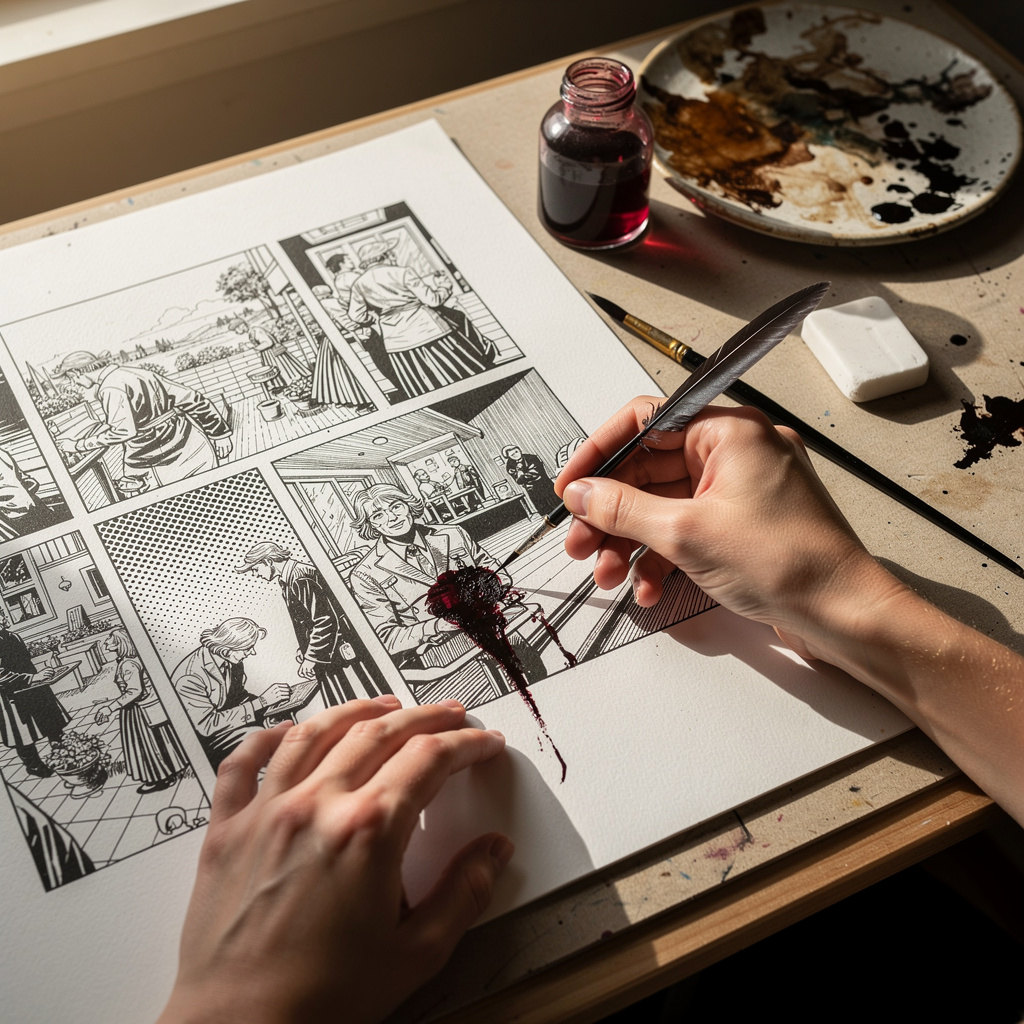
Comic art and inking is the discipline of creating sequential visual narratives, where drawing, composition, and ink application work together to tell a story panel by panel. Its scope includes figure drawing, perspective, camera angles, panel design, penciling roughs, and the specialized craft of inking with tools like nibs, brushes, and digital styluses. Core concepts include line weight variation, hatching, cross-hatching, spotting blacks, texture rendering, and value control, all of which guide the reader's eye and establish mood. Inking is not merely tracing pencils; it is an interpretive art that clarifies forms, creates depth, and adds dynamic energy to static drawings.
In today's visual culture, comic art and inking underpin not only comic books and graphic novels but also webcomics, storyboards, animation, video games, and advertising. The rise of digital inking tools and webtoon platforms has expanded opportunities for artists to publish and monetize their work independently, while traditional publishers still value strong inkers. Recent shifts include the blending of traditional and digital workflows, the growing popularity of vertical-scroll comics, and a renewed interest in high-contrast, expressive inking styles. Academic programs and online courses increasingly treat inking as a distinct, teachable skill rather than an afterthought to penciling.
Mastering comic art and inking builds a versatile skill stack that combines observational drawing, visual storytelling, composition, and precise line control. These skills translate directly into professional contexts such as comic book artist, inker, storyboard artist, concept artist, illustrator, and indie creator. Beyond career paths, the subject fosters visual literacy, creative problem-solving, and the ability to communicate complex narratives through images. Whether for personal expression or commercial work, the ability to ink a clean, dynamic page remains a hallmark of professional comic art.
Common Questions About Comic Art and Inking
Is this Comic Art and Inking course suitable for complete beginners?
How much time does the Comic Art and Inking course take each week?
Why is gesture drawing more important than clean edges in comic panels?
- Gesture first: catch the whole action in a fast, loose mark — the 30-second line that decides your panel.
- Line of action: find the single sweeping curve carrying the body's weight and direction.
- Structure second: turn that gesture into a loose mannequin of simple volumes that still appears to move.
- Contours and detail last: once the pose reads clearly, the edges have earned their attention.
How do I use one-point perspective to make comic backgrounds believable?
Why does line weight matter for readable comic book inking?
How do I choose hatching patterns for texture in comic inking?
- Parallel hatching: evenly spaced lines for calm, flat shadow.
- Cross-hatching: a second direction laid over the first for denser, darker areas.
- Contour hatching: lines that follow a form's curve to describe volume.
- Broken or random hatching: irregular marks for rough organic surfaces such as bark or stone.
Is inking just tracing over pencils in comic art production?
What Will This Course Bring You?
- Analyze visual storytelling principles to plan comic pages that communicate character, setting, and narrative beats clearly through sequential panel arrangements.
- Apply figure drawing fundamentals to construct believable comic characters with consistent anatomy, gesture, and expression across multiple panels.
- Design dynamic panel compositions using perspective grids, camera angles, and environment staging to guide reader attention and reinforce dramatic tension.
- Produce finished pencil roughs that integrate composition, lighting, and character acting into clear, production-ready comic page layouts.
- Demonstrate inking fundamentals by controlling traditional tools to create clean outlines and consistent stroke confidence on comic pages.
- Apply line weight, hatching, and spotting blacks to render dynamic figures, action, and detailed environments with controlled value and texture.
- Implement digital inking workflows to scan, refine, and export comic pages while maintaining line quality and meeting production deadlines.
- Build a portfolio-ready comic page that combines lettering, finishing techniques, and professional presentation standards for publication or review.
Curriculum
12 Units1. Foundations of Comic Art and Visual Storytelling
1 hour
2. Figure Drawing for Comic Panels
1 hour
3. Perspective, Environments, and Camera Angles
1 hour
4. Composition and Panel Design
1 hour
5. Penciling Techniques and Finished Roughs
1 hour
6. Inking Fundamentals: Tools and Line Control
1 hour
7. Line Weight, Hatching, and Texture
1 hour
8. Spotting Blacks and Value Control
1 hour
9. Inking Dynamic Figures and Action
1 hour
10. Inking Environments and Backgrounds
1 hour
11. Digital Inking and Production Workflow
1 hour
12. Lettering, Finishing, and Portfolio Presentation
1 hour
Exam – Comic Art and Inking
20 Questions • 70% Pass • 30 min
Unlock All Units for Free
Create an account, enroll in the course, and start with the first unit right away.
Exam – Comic Art and Inking
20 Questions • Pass: 70% • 30 min
Course Duration
720
Total Minutes
12
Unit
1
Final Exam
~60
Min / Unit
Comic Art and Inking Certificate Program
Document Your Skill
Those who pass the 20-question, 30-minute exam with 70% receive the Comic Art and Inking Certificate.
Stand Out on Your CV
By adding your certificate to your CV, gain a professional reference in job applications and stand out from the crowd.
Career Advantage
With the verification code, employers can check your certificate instantly — a concrete way to show your growth.
CERTIFICATE FEE
At the end of the course, an online exam consisting of 20 questions with a 30-minute time limit is given. The exam appears automatically after you complete the topics. Anyone who scores at least 70 out of 100 on the certificate exam is awarded the Comic Art and Inking Document (certificate of attendance). You can add the certificate you earn to your CV for job applications in the many sectors listed above, and use it as a reference proving that you took this interactive course.
The Certificate of Achievement you receive with the Comic Art and Inking course program holds value that proves your personal and professional development in the business world. By adding it to your CV, it can serve as an important reference in your job applications. Moreover, compared with certificates from other private training institutions, Catch Wisdom certificates are offered to our participants at a much more affordable price.
The Comic Art and Inking course certificate is a document that proves, with a unique verification code, that you completed the course. Employers can instantly check its authenticity with this code, which helps you show your development concretely in your job applications.
For more information, we recommend visiting the Support page.
Certificate in 7 Languages
Earning success certificates from our courses is now more meaningful and global. With certificates available in Turkish, English, German, French, Spanish, Arabic, and Russian, we fully unlock the potential of students worldwide.
Why Certificate in 7 Languages?
-
01
Global Skill Development
Receiving your certificates in 7 different languages strengthens your communication skills as you engage with more people worldwide. It lets you operate more confidently and capably on the international stage.
-
02
International Job Opportunities
Employers may see your certificates in multiple languages as a sign of your ability to seize global opportunities. You can open more doors to new jobs and projects.
-
03
Cultural Richness
The chance to earn certificates in different languages helps you build closer ties with various cultures and broadens your worldview. It enriches your global perspective and deepens cultural understanding.
-
04
Ability to Participate in International Projects
Multilingual certificates give you an edge to work more effectively on international projects. They boost your chances of leadership and participation in diverse projects in the business world.
-
05
Prove Yourself on the Global Stage
Certificates in multiple languages give you the opportunity to present your skills and knowledge worldwide.
Language diversity opens worldwide opportunities. If you want to prove yourself in the international arena, join our online Comic Art and Inking course program and begin this journey with us.
Frequently Asked Questions (FAQ)
Is this course paid?
How do I join the course?
Can I take the course at my own pace?
How can I get my certificate?
What are the advantages of the certificate?
Boost Your Career
Take a new career step with the Comic Art and Inking course. Add your certificate to your CV, stand out in job applications, and open the door to new opportunities in the industry.
StartStudent Reviews
No reviews yet
Enroll in this course and be the first to leave a review about your experience with Comic Art and Inking.
Start