KOJO A.
What is Commercial Kitchen Management?
Commercial Kitchen Management Training
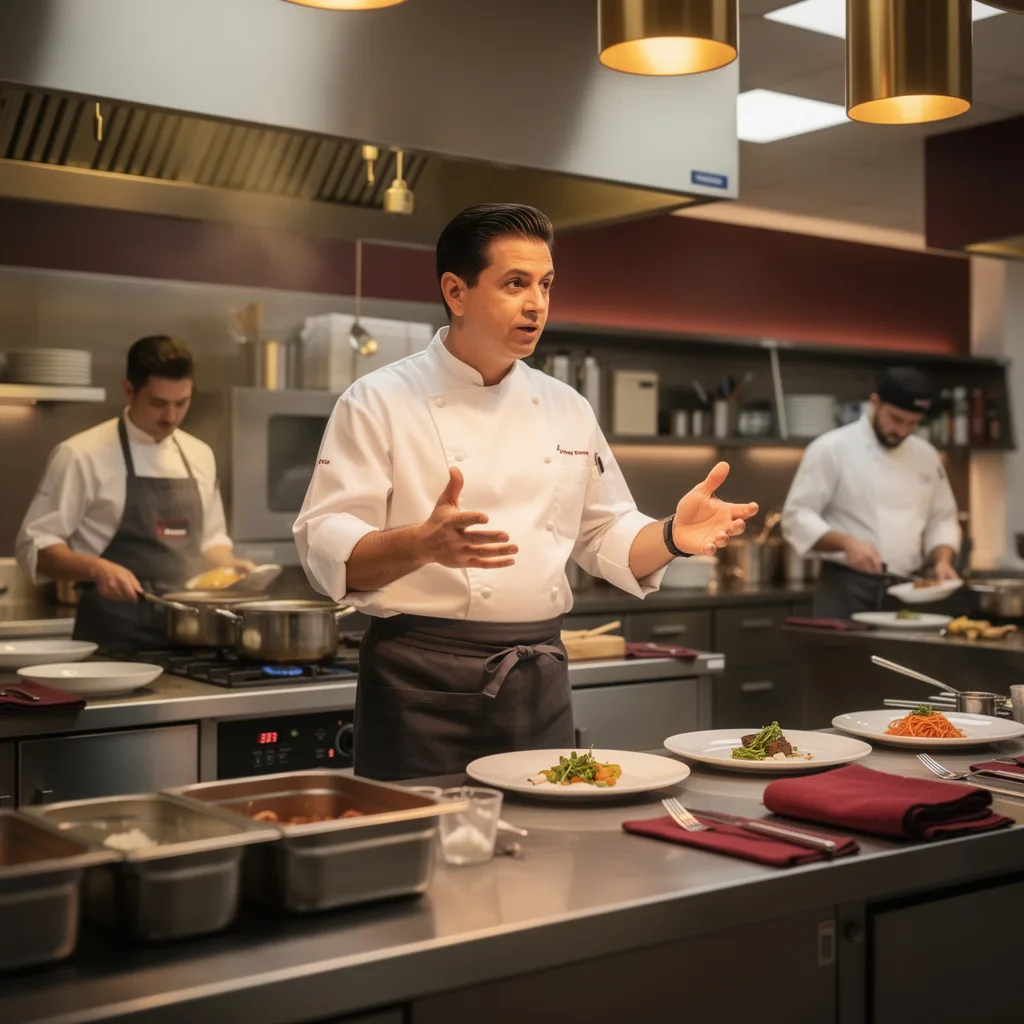
Commercial Kitchen Management certificate program equips aspiring and current kitchen leaders with the operational, financial, and people-management skills needed to run a high‑volume foodservice operation. Designed for chefs, restaurant managers, and hospitality professionals, this training delivers a practical roadmap to overseeing every aspect of a commercial kitchen—from layout and workflow to cost control and team leadership. By the end, participants will be able to design efficient kitchen spaces, enforce safety standards, manage inventory and purchasing, and lead a cohesive front‑ and back‑of‑house team.
The program follows a logical, beginner‑friendly progression that balances theoretical foundations with hands‑on application. Core modules cover kitchen design and equipment selection, food safety and sanitation regulations, staff recruitment and training, menu engineering for profitability, and procurement and inventory systems. Later units dive into batch cooking and production planning, quality assurance, customer service coordination, and sustainable practices. Each lesson builds on the previous one, ensuring that learners develop a complete, integrated skill set they can immediately apply in real‑world kitchen environments.
What is Commercial Kitchen Management?
Commercial kitchen management is the discipline of planning, organizing, and controlling all activities within a professional food‑production facility. It encompasses the physical layout of the kitchen, the flow of ingredients and finished dishes, compliance with health and safety codes, staffing and scheduling, menu design, cost analysis, and the maintenance of equipment. At its core, it is about creating a system that delivers consistent, high‑quality food while maximizing efficiency and minimizing waste—a blend of culinary art, business acumen, and operational science.
In today’s fast‑paced food industry, effective kitchen management is more critical than ever. Rising labor costs, supply chain volatility, and increasing consumer demand for transparency and sustainability have made operational excellence a competitive advantage. Commercial kitchen management principles are applied everywhere from independent restaurants and hotel banquets to institutional cafeterias, food trucks, and ghost kitchens. Recent shifts toward data‑driven decision‑making, energy‑efficient equipment, and plant‑based menu options have further expanded the skill set required of modern kitchen managers.
Mastering commercial kitchen management builds a versatile skill stack that includes financial literacy, leadership, process optimization, and regulatory knowledge. Professionals who understand these concepts can reduce food and labor costs, improve team morale, and ensure consistent product quality—outcomes that directly boost profitability and customer satisfaction. Whether you are a line cook aiming for a promotion, a restaurant owner seeking better control, or a hospitality student preparing for a career, this subject provides the practical tools to run a kitchen that is safe, efficient, and profitable.
Common Questions About Commercial Kitchen Management
Is commercial kitchen management certification useful for career switchers?
Yes, it provides a structured foundation in kitchen operations, financial management, and team leadership that is directly applicable to a new career in foodservice. For example, understanding the kitchen brigade structure helps a switcher quickly grasp how roles and responsibilities are organized in a professional kitchen. The training covers practical tools like menu engineering and cost control that build confidence even without prior industry experience.
Can this course help me run a commercial kitchen without experience?
It equips you with the essential operational, financial, and people-management knowledge needed to oversee a kitchen, but practical hands-on experience remains valuable. The curriculum introduces key models such as the one-way workflow (Marcha Hacia Adelante) for efficient kitchen design and the FIFO method for inventory rotation. You will learn to create a fiche technique cuisine for recipe standardization and apply batch cooking workflows to manage high-volume production. These concepts give you a solid roadmap to start running a kitchen effectively, while real-world practice will refine your skills.
How does HACCP influence commercial kitchen layout design?
HACCP principles require a layout that prevents cross-contamination by separating raw and cooked food zones and ensuring a logical flow from receiving to serving. The one-way workflow model directly supports HACCP by moving ingredients in a single direction—from storage through preparation, cooking, and plating—without backtracking. This design minimizes the risk of pathogens spreading and simplifies cleaning and sanitation routines. The curriculum details how to apply the seven HACCP principles to create functional zones that meet safety standards.
What is the difference between FIFO and FEFO in inventory?
FIFO (First In, First Out) rotates stock based on the order items are received, using the oldest first, while FEFO (First Expiring, First Out) prioritizes items with the earliest expiration date regardless of when they arrived. FEFO is especially useful for perishable goods with varying shelf lives, such as dairy or fresh produce. The curriculum compares these methods alongside LIFO to help you choose the best rotation strategy for your kitchen.
How to implement batch cooking in a high-volume kitchen?
Implement batch cooking by following a structured workflow that breaks large production into manageable cycles. Key steps include:
- Analyze demand: Use historical sales data to forecast quantities for each menu item.
- Schedule production: Plan cooking times so that batches are ready just before service peaks, using the batch cooking workflow model.
- Standardize recipes: Create fiche technique cuisine cards with exact yields, cooking times, and portion sizes.
- Set up holding stations: Use hot-holding equipment and proper cooling methods to maintain quality between batches.
- Monitor and adjust: Track batch output against demand and tweak schedules to reduce waste and ensure freshness.
How to calculate food cost percentage accurately?
Calculate food cost percentage by dividing the Cost of Goods Sold (COGS) by total food sales and multiplying by 100 to express it as a percentage. COGS includes the cost of all ingredients used during a specific period, adjusted for beginning and ending inventory. The curriculum introduces the food cost formula flow and explains how to track prime cost—the combination of food cost and labor cost—to see the full picture of kitchen profitability.
Is HACCP only necessary for large commercial kitchens?
No, HACCP principles are essential for any foodservice operation, regardless of size. Even a small kitchen benefits from applying the seven HACCP principles to identify critical control points, such as cooking temperatures and storage conditions. The training shows how to adapt HACCP to your specific layout and volume, making it a practical tool for ensuring food safety in any commercial setting.
What Will This Course Bring You?
- Design a commercial kitchen layout that optimizes workflow and complies with health and safety regulations.
- Implement a comprehensive sanitation plan to prevent cross-contamination and meet health code requirements.
- Develop a staffing strategy that includes recruitment, training, and scheduling to ensure operational efficiency.
- Analyze menu items using engineering techniques to maximize profitability while maintaining customer satisfaction.
- Evaluate supplier contracts and establish effective receiving procedures to ensure quality ingredients and cost control.
- Apply inventory management methods to minimize waste and maintain optimal stock levels.
- Implement batch cooking systems to maintain food quality and consistency during high-volume service periods.
- Coordinate front-of-house and back-of-house communication to enhance customer service and dining experience.
Curriculum
12 Units
01
1 hour
1. Kitchen Design and Layout
1 hour
02
1 hour
2. Safety and Sanitation Standards
1 hour
03
1 hour
3. Staffing and Training
1 hour
04
1 hour
4. Menu Planning and Engineering
1 hour
05
1 hour
5. Purchasing and Receiving
1 hour
06
1 hour
6. Inventory Management and Storage
1 hour
07
1 hour
7. Food Production and Batch Cooking
1 hour
08
1 hour
8. Quality Control and Consistency
1 hour
09
1 hour
9. Cost Control and Budgeting
1 hour
10
1 hour
10. Customer Service and Front-of-House Coordination
1 hour
11
1 hour
11. Equipment Maintenance and Energy Efficiency
1 hour
12
1 hour
12. Leadership, Trends, and Sustainability
1 hour
Exam – Commercial Kitchen Management
20 Questions • 70% Pass • 30 min
Unlock All Units for Free
Create an account, enroll in the course, and start with the first unit right away.
Exam – Commercial Kitchen Management
20 Questions • Pass: 70% • 30 min
Course Duration
720
Total Minutes
12
Unit
1
Final Exam
~60
Min / Unit
Commercial Kitchen Management Certificate Program
Document Your Skill
Those who pass the 20-question, 30-minute exam with 70% receive the Commercial Kitchen Management Certificate.
Stand Out on Your CV
By adding your certificate to your CV, gain a professional reference in job applications and stand out from the crowd.
Career Advantage
With the verification code, employers can check your certificate instantly — a concrete way to show your growth.
Sample
CERTIFICATE FEE
110 $
55 $
At the end of the course, an online exam consisting of 20 questions with a 30-minute time limit is given. The exam appears automatically after you complete the topics. Anyone who scores at least 70 out of 100 on the certificate exam is awarded the Commercial Kitchen Management Document (certificate of attendance). You can add the certificate you earn to your CV for job applications in the many sectors listed above, and use it as a reference proving that you took this interactive course.
The Certificate of Achievement you receive with the Commercial Kitchen Management course program holds value that proves your personal and professional development in the business world. By adding it to your CV, it can serve as an important reference in your job applications. Moreover, compared with certificates from other private training institutions, Catch Wisdom certificates are offered to our participants at a much more affordable price.
The Commercial Kitchen Management course certificate is a document that proves, with a unique verification code, that you completed the course. Employers can instantly check its authenticity with this code, which helps you show your development concretely in your job applications.
For more information, we recommend visiting the Support page.
Certificate in 7 Languages
Earning success certificates from our courses is now more meaningful and global. With certificates available in Turkish, English, German, French, Spanish, Arabic, and Russian, we fully unlock the potential of students worldwide.
Why Certificate in 7 Languages?
-
01
Global Skill Development
Receiving your certificates in 7 different languages strengthens your communication skills as you engage with more people worldwide. It lets you operate more confidently and capably on the international stage.
-
02
International Job Opportunities
Employers may see your certificates in multiple languages as a sign of your ability to seize global opportunities. You can open more doors to new jobs and projects.
-
03
Cultural Richness
The chance to earn certificates in different languages helps you build closer ties with various cultures and broadens your worldview. It enriches your global perspective and deepens cultural understanding.
-
04
Ability to Participate in International Projects
Multilingual certificates give you an edge to work more effectively on international projects. They boost your chances of leadership and participation in diverse projects in the business world.
-
05
Prove Yourself on the Global Stage
Certificates in multiple languages give you the opportunity to present your skills and knowledge worldwide.
Language diversity opens worldwide opportunities. If you want to prove yourself in the international arena, join our online Commercial Kitchen Management course program and begin this journey with us.
Frequently Asked Questions (FAQ)
Is this course paid?
No, participation in all courses is completely free; we believe education should be accessible to everyone. The certificate is optional and paid.
How do I join the course?
After creating an account, you can join in one click with the "Start Course" button and begin immediately from the first unit.
Can I take the course at my own pace?
Yes, all courses are designed for self-paced learning. There are no deadlines or time limits.
How can I get my certificate?
After completing the course and passing the final exam, you can order your certificate and instantly download it as PDF.
What are the advantages of the certificate?
It offers instant PDF access, download in 7 languages, a digital signature and a unique verification code. Employers can instantly check your certificate's authenticity with this code.
Boost Your Career
Take a new career step with the Commercial Kitchen Management course. Add your certificate to your CV, stand out in job applications, and open the door to new opportunities in the industry.
StartStudent Reviews
5.0
(1 reviews)
5.0
1 reviews
5
100%
4
0%
3
0%
2
0%
1
0%


