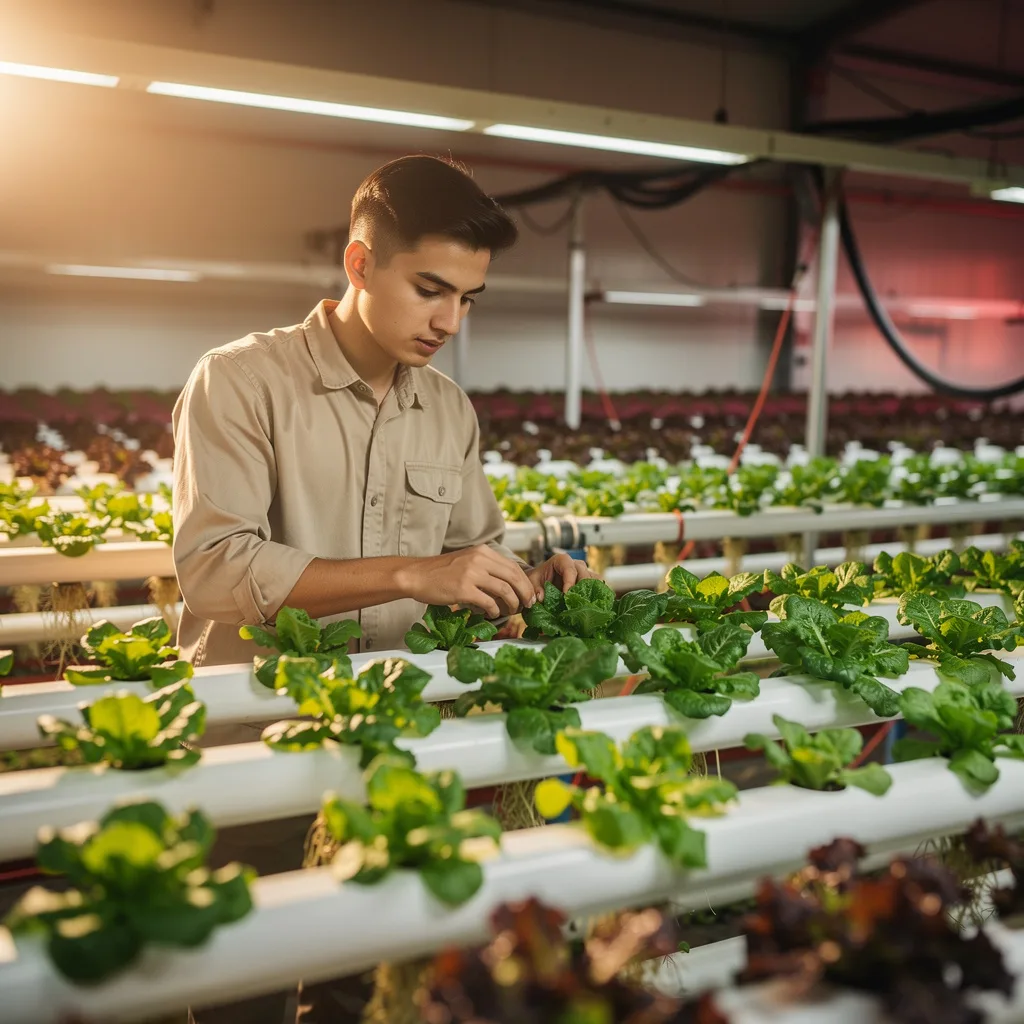
What is Hydroponic Growing?
Hydroponic Growing Certificate Program
The Hydroponic Growing certificate program provides a comprehensive foundation in soil-less cultivation, covering everything from plant biology and water chemistry to system design and pest management. This program is ideal for aspiring commercial growers, hobbyists, and agricultural entrepreneurs who want to master the science and practice of hydroponics. By the end, participants will be able to set up, maintain, and troubleshoot their own hydroponic systems, whether for personal food production or scalable business ventures.
The curriculum is structured for beginners yet progresses into advanced topics, balancing theoretical knowledge with hands-on application. Core skill areas include system types (Deep Water Culture, NFT, Ebb and Flow, Drip, Aeroponics), nutrient solution formulation, environmental control (light, air, climate), and propagation techniques. With the growing demand for local, sustainable food production and controlled-environment agriculture, this program equips learners with the expertise to thrive in a rapidly expanding industry.
What is Hydroponic Growing?
Hydroponic growing is a method of cultivating plants without soil, using mineral nutrient solutions dissolved in water to deliver essential elements directly to the root zone. Core concepts include understanding plant physiology in soilless conditions, managing water quality and pH, selecting appropriate growing media (such as rockwool, clay pebbles, or coco coir), and designing systems that optimize oxygen and nutrient uptake. It encompasses a range of techniques from simple passive setups to highly automated commercial installations.
Today, hydroponics is increasingly vital for addressing food security, urban agriculture, and climate-resilient farming. It is used in greenhouses, vertical farms, and even space exploration research to produce fresh vegetables, herbs, and fruits year-round with significantly less water and land than traditional agriculture. Recent shifts toward local food systems and controlled-environment agriculture have accelerated adoption by both small-scale growers and large enterprises, making hydroponic knowledge highly relevant.
Mastering hydroponic growing builds a skill stack that includes plant science, chemistry, engineering, and data-driven environmental management. This expertise is valuable for roles in commercial greenhouse operations, agricultural technology startups, research institutions, and community farming projects. For individuals, it empowers self-sufficiency in food production and opens pathways to innovation in sustainable agriculture.
Common Questions About Hydroponic Growing
Does the hydroponic growing certificate help in job applications?
Is this course suitable for beginners with no experience?
How does pH affect nutrient uptake in hydroponic systems?
What is the difference between DWC and NFT hydroponic systems?
Why is oxygen critical for root health in hydroponics?
How to prevent pythium root rot in hydroponic growing?
- Maintain clean system hygiene: Sterilize equipment and reservoirs between cycles to eliminate pathogens.
- Control water temperature: Keep nutrient solution between 65-70°F (18-21°C) to discourage pythium growth.
- Ensure adequate oxygen levels: Use air stones or proper system design to prevent anaerobic conditions.
- Use beneficial microbes: Introduce beneficial bacteria or fungi that compete with pythium.
- Monitor root health regularly: Early detection of slimy or discolored roots allows quick intervention.
Is hydroponic growing harder than traditional soil gardening?
What Will This Course Bring You?
- Analyze plant physiological processes to optimize growth conditions in hydroponic systems.
- Evaluate water quality parameters and adjust chemistry for optimal nutrient uptake in hydroponics.
- Design a hydroponic system by selecting appropriate type based on crop requirements and space constraints.
- Formulate customized nutrient solutions by calculating required concentrations of macro- and micronutrients.
- Implement environmental control strategies for lighting, air circulation, and climate to maximize yield.
- Apply integrated pest management techniques to prevent and treat common hydroponic diseases.
- Propagate plants through seed starting and cloning methods for continuous production cycles.
- Troubleshoot common hydroponic issues and develop scaling-up plans for commercial operations.
Curriculum
12 Units1. What Is Hydroponic Growing
1 hour
2. Plant Biology and Physiology for Hydroponics
1 hour
3. Water Quality and Chemistry
1 hour
4. Hydroponic System Types Overview
1 hour
5. Nutrient Solutions and Formulations
1 hour
6. Deep Water Culture and NFT Systems
1 hour
7. Ebb and Flow, Drip, and Aeroponics
1 hour
8. Growing Media and Substrates
1 hour
9. Environmental Control: Light, Air, and Climate
1 hour
10. Pest and Disease Management
1 hour
11. Seed Starting, Cloning, and Propagation
1 hour
12. Harvesting, Troubleshooting, and Scaling Up
1 hour
Exam – Hydroponic Growing
20 Questions • 70% Pass • 30 min
Unlock All Units for Free
Create an account, enroll in the course, and start with the first unit right away.
Exam – Hydroponic Growing
20 Questions • Pass: 70% • 30 min
Course Duration
720
Total Minutes
12
Unit
1
Final Exam
~60
Min / Unit
Hydroponic Growing Certificate Program
Document Your Skill
Those who pass the 20-question, 30-minute exam with 70% receive the Hydroponic Growing Certificate.
Stand Out on Your CV
By adding your certificate to your CV, gain a professional reference in job applications and stand out from the crowd.
Career Advantage
With the verification code, employers can check your certificate instantly — a concrete way to show your growth.
CERTIFICATE FEE
At the end of the course, an online exam consisting of 20 questions with a 30-minute time limit is given. The exam appears automatically after you complete the topics. Anyone who scores at least 70 out of 100 on the certificate exam is awarded the Hydroponic Growing Document (certificate of attendance). You can add the certificate you earn to your CV for job applications in the many sectors listed above, and use it as a reference proving that you took this interactive course.
The Certificate of Achievement you receive with the Hydroponic Growing course program holds value that proves your personal and professional development in the business world. By adding it to your CV, it can serve as an important reference in your job applications. Moreover, compared with certificates from other private training institutions, Catch Wisdom certificates are offered to our participants at a much more affordable price.
The Hydroponic Growing course certificate is a document that proves, with a unique verification code, that you completed the course. Employers can instantly check its authenticity with this code, which helps you show your development concretely in your job applications.
For more information, we recommend visiting the Support page.
Certificate in 7 Languages
Earning success certificates from our courses is now more meaningful and global. With certificates available in Turkish, English, German, French, Spanish, Arabic, and Russian, we fully unlock the potential of students worldwide.
Why Certificate in 7 Languages?
-
01
Global Skill Development
Receiving your certificates in 7 different languages strengthens your communication skills as you engage with more people worldwide. It lets you operate more confidently and capably on the international stage.
-
02
International Job Opportunities
Employers may see your certificates in multiple languages as a sign of your ability to seize global opportunities. You can open more doors to new jobs and projects.
-
03
Cultural Richness
The chance to earn certificates in different languages helps you build closer ties with various cultures and broadens your worldview. It enriches your global perspective and deepens cultural understanding.
-
04
Ability to Participate in International Projects
Multilingual certificates give you an edge to work more effectively on international projects. They boost your chances of leadership and participation in diverse projects in the business world.
-
05
Prove Yourself on the Global Stage
Certificates in multiple languages give you the opportunity to present your skills and knowledge worldwide.
Language diversity opens worldwide opportunities. If you want to prove yourself in the international arena, join our online Hydroponic Growing course program and begin this journey with us.
Frequently Asked Questions (FAQ)
Is this course paid?
How do I join the course?
Can I take the course at my own pace?
How can I get my certificate?
What are the advantages of the certificate?
Boost Your Career
Take a new career step with the Hydroponic Growing course. Add your certificate to your CV, stand out in job applications, and open the door to new opportunities in the industry.
StartStudent Reviews
No reviews yet
Enroll in this course and be the first to leave a review about your experience with Hydroponic Growing.
Start