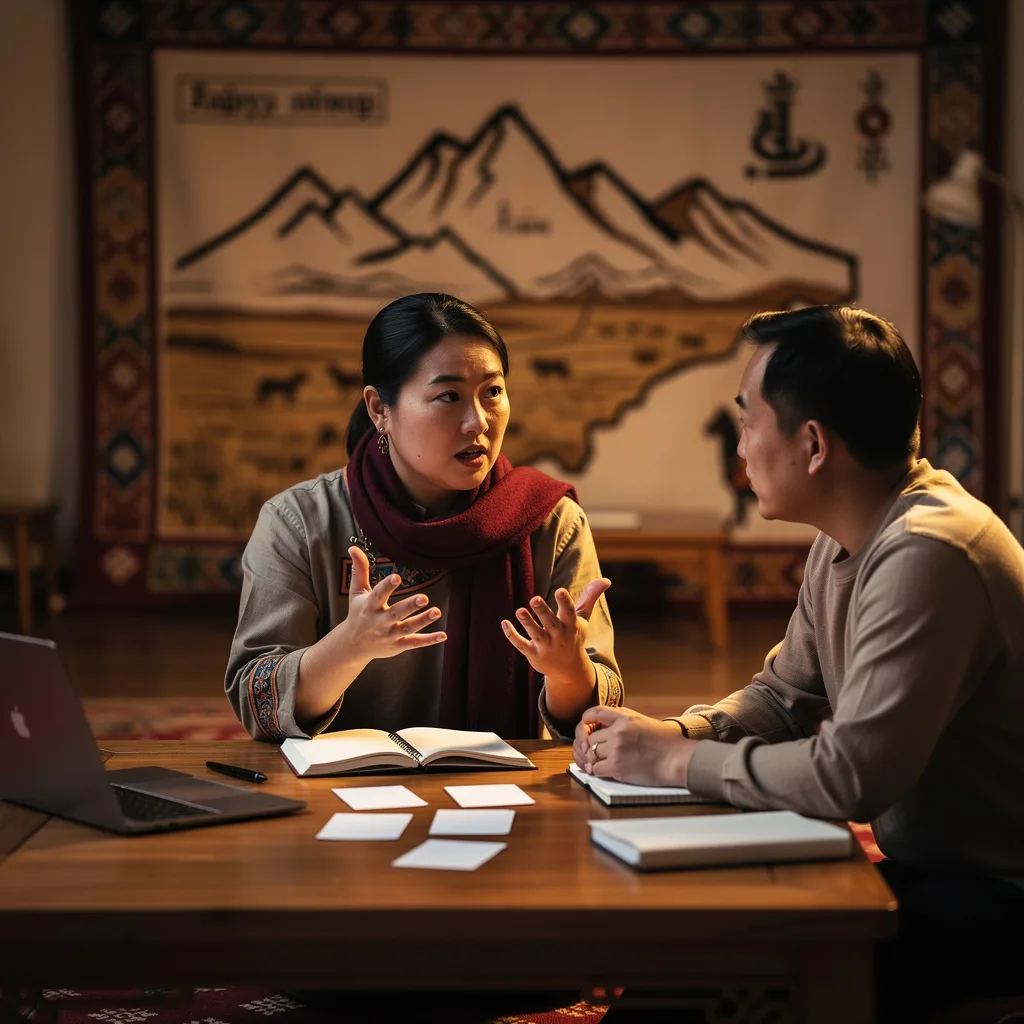
What is Mongolian Language?
Mongolian Language Training
The Mongolian Language certificate program offers a structured pathway to reading, writing, and speaking modern Mongolian with confidence. Designed for absolute beginners and those with some prior exposure, this course systematically builds your ability to handle everyday conversations, understand grammar fundamentals, and navigate real-life situations in Mongolia. By the end of the program, you will be able to introduce yourself, ask for directions, order food, and discuss daily topics using the Cyrillic script.
The curriculum follows a beginner-friendly progression that balances grammatical theory with practical application. Starting with the Mongolian Cyrillic alphabet and pronunciation, you move through essential vocabulary, noun cases, verb tenses, and postpositions, while each lesson integrates listening, speaking, reading, and writing practice. This program is ideal for travelers, business professionals, or language enthusiasts seeking a solid foundation in Mongolian now, as the country’s cultural and economic ties with the world continue to grow.
What is Mongolian Language?
Mongolian is an Altaic language spoken by over five million people, primarily in Mongolia and the Inner Mongolia Autonomous Region of China. Its core concepts include a rich system of noun cases (nominative, genitive, dative-locative, accusative, ablative, instrumental, and comitative), vowel harmony, and a flexible word order that relies heavily on suffixes to express grammatical relationships. The modern standard is written in the Cyrillic script, though the traditional Mongolian script remains in use in certain regions and cultural contexts.
Today, Mongolian is experiencing renewed relevance as Mongolia’s economy grows, driven by mining, tourism, and international partnerships. Knowledge of the language opens doors in diplomacy, business, academic research (especially in linguistics, history, and anthropology), and grassroots cultural exchange. Recent shifts include increased digital resources for learners and a growing expatriate community in Ulaanbaatar, making practical language skills more valuable than ever.
Mastering Mongolian builds a skill stack that includes grammatical precision, tonal awareness (through vowel harmony), and cultural sensitivity—abilities that transfer to learning other Altaic or agglutinative languages. Professionally, it benefits roles in international development, translation, tourism, and cross-border trade; personally, it enables deeper connections with Mongolian heritage, literature, and the warmth of everyday interactions in the country.
Common Questions About Mongolian Language
Is the Mongolian Language certificate useful for job applications?
Can a complete beginner start this Mongolian Language course?
Why does Mongolian Cyrillic have 35 letters?
How does vowel harmony affect verb suffixes in Mongolian?
What is the difference between nominative and accusative cases?
How do postpositions work in Mongolian compared to prepositions?
Is Mongolian really a hard language for English speakers?
What Will This Course Bring You?
- Apply the Mongolian Cyrillic alphabet to accurately transcribe and pronounce common words and phrases.
- Construct grammatically correct sentences using the four noun cases (nominative, genitive, dative-locative, accusative).
- Conjugate regular verbs in present, past, and future tenses to describe actions across different time frames.
- Formulate questions and negations in simple dialogues using appropriate interrogative and negative particles.
- Use postpositions to describe spatial relationships and location in sentences.
- Express needs and requests using polite imperative forms and common daily phrases.
- Evaluate cultural contexts to adjust greetings, introductions, and conversational tone appropriately.
Curriculum
12 Units1. Mongolian Cyrillic Alphabet and Pronunciation
1 hour
2. Basic Greetings and Introductions
1 hour
3. Numbers and Counting
1 hour
4. Nouns and Cases (Nominative, Genitive, Dative-Locative, Accusative)
1 hour
5. Verbs and Present Tense
1 hour
6. Adjectives and Describing Things
1 hour
7. Past and Future Tenses
1 hour
8. Postpositions and Location
1 hour
9. Questions and Negation
1 hour
10. Daily Life Vocabulary and Phrases
1 hour
11. Expressing Needs and Requests
1 hour
12. Cultural Context and Practical Conversation
1 hour
Exam – Mongolian Language
20 Questions • 70% Pass • 30 min
Unlock All Units for Free
Create an account, enroll in the course, and start with the first unit right away.
Exam – Mongolian Language
20 Questions • Pass: 70% • 30 min
Course Duration
720
Total Minutes
12
Unit
1
Final Exam
~60
Min / Unit
Mongolian Language Certificate Program
Document Your Skill
Those who pass the 20-question, 30-minute exam with 70% receive the Mongolian Language Certificate.
Stand Out on Your CV
By adding your certificate to your CV, gain a professional reference in job applications and stand out from the crowd.
Career Advantage
Catch Wisdom certificates are recognized by HR departments and increase career opportunities.
CERTIFICATE FEE
At the end of the course, an online exam consisting of 20 questions with a 30-minute time limit is given. The exam appears automatically after you complete the topics. Anyone who scores at least 70 out of 100 on the certificate exam is awarded the Mongolian Language Document (certificate of attendance). You can add the certificate you earn to your CV for job applications in the many sectors listed above, and use it as a reference proving that you took this interactive course.
The Certificate of Achievement you receive with the Mongolian Language course program holds value that proves your personal and professional development in the business world. By adding it to your CV, it can serve as an important reference in your job applications. Moreover, compared with certificates from other private training institutions, Catch Wisdom certificates are offered to our participants at a much more affordable price.
Because HR departments recognize Catch Wisdom as a reputable institution in this field, they value these certificates and may evaluate your job applications favorably. For this reason, a Mongolian Language course certificate from Catch Wisdom can make your applications more attractive and place you in an advantageous position in the business world.
For more information, we recommend visiting the Support page.
Certificate in 7 Languages
Earning success certificates from our courses is now more meaningful and global. With certificates available in Turkish, English, German, French, Spanish, Arabic, and Russian, we fully unlock the potential of students worldwide.
Why Certificate in 7 Languages?
-
01
Global Skill Development
Receiving your certificates in 7 different languages strengthens your communication skills as you engage with more people worldwide. It lets you operate more confidently and capably on the international stage.
-
02
International Job Opportunities
Employers may see your certificates in multiple languages as a sign of your ability to seize global opportunities. You can open more doors to new jobs and projects.
-
03
Cultural Richness
The chance to earn certificates in different languages helps you build closer ties with various cultures and broadens your worldview. It enriches your global perspective and deepens cultural understanding.
-
04
Ability to Participate in International Projects
Multilingual certificates give you an edge to work more effectively on international projects. They boost your chances of leadership and participation in diverse projects in the business world.
-
05
Prove Yourself on the Global Stage
Certificates in multiple languages let you showcase your skills and knowledge worldwide. You can become an internationally recognized professional.
Language diversity opens worldwide opportunities. If you want to prove yourself in the international arena, join our online Mongolian Language course program and begin this journey with us.
Frequently Asked Questions (FAQ)
Is this course paid?
How do I join the course?
Can I take the course at my own pace?
How can I get my certificate?
What are the advantages of the Certified Certificate?
Boost Your Career
Take a new career step with the Mongolian Language course. Add your certificate to your CV, stand out in job applications, and open the door to new opportunities in the industry.
StartStudent Reviews
No reviews yet
Enroll in this course and be the first to leave a review about your experience with Mongolian Language.
Start