What is Crochet Fundamentals?
Crochet Fundamentals Training
Crochet Fundamentals certificate program teaches absolute beginners how to create fabric from yarn using a hook, starting with essential tools, yarn weights, and notions before moving into the foundational slip knot, chain stitch, and foundation chain. The course then builds stitch vocabulary through single crochet, half double crochet, and double crochet, while also covering turning chains, slip stitches, and seamless joining for clean edges. It is designed for hobbyists, crafters, and anyone seeking a portable, meditative creative outlet, with no prior experience required. The main practical outcome is the ability to independently read crochet patterns, manage gauge and tension, and complete both flat and round projects such as scarves, granny squares, and simple garments.
The program follows a carefully sequenced, beginner-friendly progression that moves from tool selection and basic stitches to shaping, color changes, and finishing techniques across twelve focused lessons. Theory—such as understanding gauge, tension, and pattern abbreviations—is balanced with hands-on practice in every module, ensuring learners swatch, troubleshoot, and refine their technique rather than just watch demonstrations. It builds five core skill areas: foundation and essential stitches, stitch height and joining methods, gauge and pattern literacy, working in rows and rounds, and shaping with color and texture. Choosing this program now makes sense because crochet has surged in popularity as a mindful, screen-free hobby, a sustainable alternative to fast fashion, and a low-cost entry point into textile craft that requires only a hook and a ball of yarn.
What is Crochet Fundamentals?
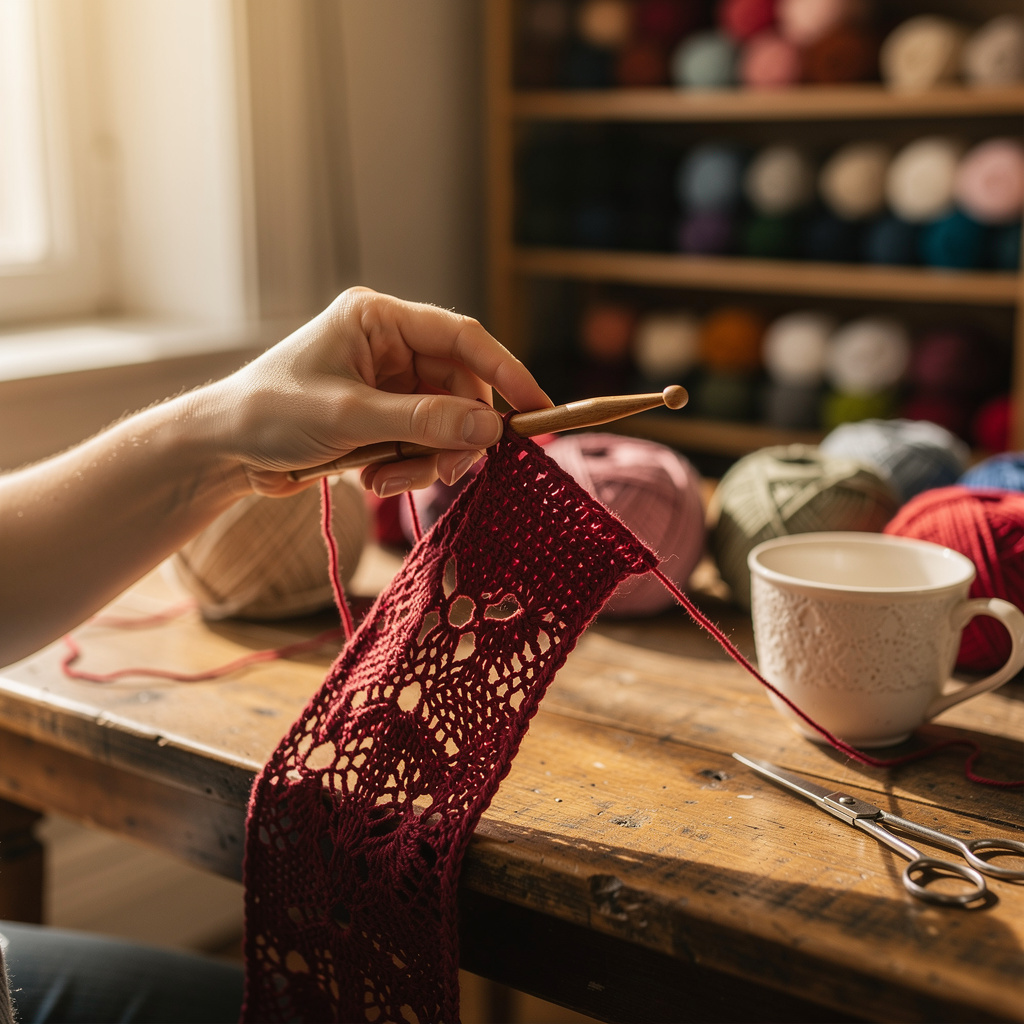
Crochet is a textile craft in which a single hook is used to interlock loops of yarn, creating fabrics that range from dense and sturdy to open and lacy. Its scope covers core concepts such as loop formation, stitch height, tension control, turning chains, and the difference between working in rows for flat fabric and working in rounds for motifs like granny squares. Additional fundamental ideas include increasing and decreasing for shaping, changing colors for stripes or patterns, and joining techniques that affect both structure and appearance. Mastery of these concepts allows a crocheter to move from simple practice swatches to wearable items, home decor, and artistic pieces.
Crochet matters today as part of the broader slow-craft and DIY movement, offering a counterpoint to mass-produced textiles and disposable fashion. It is used in real life for making garments, accessories, blankets, toys, and home goods, while in industry it informs knitwear design, textile prototyping, and small-batch production. Recent shifts include the rise of online pattern marketplaces, indie-dyed yarns, inclusive sizing in modern patterns, and a growing body of research on crochet's therapeutic benefits for stress reduction and fine motor rehabilitation. In academia, crochet appears in textile art, material studies, and occupational therapy curricula, reflecting its interdisciplinary relevance.
Mastering crochet fundamentals builds a skill stack that combines fine motor dexterity, spatial reasoning, pattern interpretation, project planning, and creative problem-solving. These skills transfer to professional contexts such as craft instruction, pattern design, sample making, textile production, and therapeutic facilitation, where clear technique and reliable gauge are essential. On a personal level, the same skill stack supports mindful making, personalized gifting, custom home decor, and a sustainable approach to clothing and accessories. Because crochet is both accessible and endlessly variable, the fundamentals serve as a durable foundation for lifelong learning, community participation, and artistic expression.
Common Questions About Crochet Fundamentals
Is Crochet Fundamentals suitable if I have never held a hook?
How is the Crochet Fundamentals course structured week by week?
- Foundations (Units 1–3): tools, yarn and notions, then the slip knot, chain stitch and single crochet with turning chains.
- Stitch vocabulary (Units 4–6): half double and double crochet, slip stitch and seamless joining, then gauge, tension and swatching.
- Application (Units 7–12): reading patterns and abbreviations, working in rows and rounds, shaping with increases and decreases, colour changes, and finishing techniques with first projects.
How snug should a slip knot be before you start chaining?
Why does my single crochet row curve despite a turning chain?
When should I use half double crochet instead of double crochet?
Why does my gauge swatch keep changing after washing?
Do you really need perfect tension to learn crochet basics?
What Will This Course Bring You?
- Select appropriate crochet hooks, yarn weights, and notions for a beginner project by matching tool sizes and fiber characteristics to pattern requirements.
- Demonstrate forming a slip knot, foundation chain, and consistent chain stitches while maintaining even tension across the starting row.
- Execute single crochet, half double crochet, and double crochet stitches with correct turning chains to build uniform flat fabric rows.
- Apply slip stitch joining and seamless finishing methods to connect rounds without visible gaps in motifs or granny squares.
- Evaluate gauge and tension by creating and measuring a swatch, then adjusting hook size to match a pattern's specified stitch count.
- Interpret crochet pattern abbreviations, symbols, and row/round instructions to follow written patterns accurately for flat and circular projects.
- Implement increases, decreases, color changes, and simple textured stitches to shape and customize crochet pieces.
- Complete a first crochet project by applying finishing techniques such as weaving in ends, edging, and assembling motifs.
Curriculum
12 Units1. Crochet Essentials: Tools, Yarn, and Notions
1 hour
2. Slip Knot, Chain Stitch, and Foundation Chain
1 hour
3. Single Crochet and Turning Chains
1 hour
4. Half Double Crochet and Double Crochet
1 hour
5. Slip Stitch and Seamless Joining
1 hour
6. Gauge, Tension, and Swatching
1 hour
7. Reading Crochet Patterns and Abbreviations
1 hour
8. Working in Rows: Flat Fabric
1 hour
9. Working in Rounds: Granny Squares and Motifs
1 hour
10. Shaping: Increases and Decreases
1 hour
11. Color Changes, Stripes, and Simple Textures
1 hour
12. Finishing Techniques and First Projects
1 hour
Exam – Crochet Fundamentals
20 Questions • 70% Pass • 30 min
Unlock All Units for Free
Create an account, enroll in the course, and start with the first unit right away.
Exam – Crochet Fundamentals
20 Questions • Pass: 70% • 30 min
Course Duration
720
Total Minutes
12
Unit
1
Final Exam
~60
Min / Unit
Crochet Fundamentals Certificate Program
Document Your Skill
Those who pass the 20-question, 30-minute exam with 70% receive the Crochet Fundamentals Certificate.
Stand Out on Your CV
By adding your certificate to your CV, gain a professional reference in job applications and stand out from the crowd.
Career Advantage
With the verification code, employers can check your certificate instantly — a concrete way to show your growth.
CERTIFICATE FEE
At the end of the course, an online exam consisting of 20 questions with a 30-minute time limit is given. The exam appears automatically after you complete the topics. Anyone who scores at least 70 out of 100 on the certificate exam is awarded the Crochet Fundamentals Document (certificate of attendance). You can add the certificate you earn to your CV for job applications in the many sectors listed above, and use it as a reference proving that you took this interactive course.
The Certificate of Achievement you receive with the Crochet Fundamentals course program holds value that proves your personal and professional development in the business world. By adding it to your CV, it can serve as an important reference in your job applications. Moreover, compared with certificates from other private training institutions, Catch Wisdom certificates are offered to our participants at a much more affordable price.
The Crochet Fundamentals course certificate is a document that proves, with a unique verification code, that you completed the course. Employers can instantly check its authenticity with this code, which helps you show your development concretely in your job applications.
For more information, we recommend visiting the Support page.
Certificate in 7 Languages
Earning success certificates from our courses is now more meaningful and global. With certificates available in Turkish, English, German, French, Spanish, Arabic, and Russian, we fully unlock the potential of students worldwide.
Why Certificate in 7 Languages?
-
01
Global Skill Development
Receiving your certificates in 7 different languages strengthens your communication skills as you engage with more people worldwide. It lets you operate more confidently and capably on the international stage.
-
02
International Job Opportunities
Employers may see your certificates in multiple languages as a sign of your ability to seize global opportunities. You can open more doors to new jobs and projects.
-
03
Cultural Richness
The chance to earn certificates in different languages helps you build closer ties with various cultures and broadens your worldview. It enriches your global perspective and deepens cultural understanding.
-
04
Ability to Participate in International Projects
Multilingual certificates give you an edge to work more effectively on international projects. They boost your chances of leadership and participation in diverse projects in the business world.
-
05
Prove Yourself on the Global Stage
Certificates in multiple languages give you the opportunity to present your skills and knowledge worldwide.
Language diversity opens worldwide opportunities. If you want to prove yourself in the international arena, join our online Crochet Fundamentals course program and begin this journey with us.
Frequently Asked Questions (FAQ)
Is this course paid?
How do I join the course?
Can I take the course at my own pace?
How can I get my certificate?
What are the advantages of the certificate?
Boost Your Career
Take a new career step with the Crochet Fundamentals course. Add your certificate to your CV, stand out in job applications, and open the door to new opportunities in the industry.
StartStudent Reviews
No reviews yet
Enroll in this course and be the first to leave a review about your experience with Crochet Fundamentals.
Start