What is Croissants and Laminated Dough?
Croissants and Laminated Dough Training
The Croissants and Laminated Dough certificate program is a comprehensive professional training pathway designed for bakers, pastry chefs, and culinary enthusiasts who want to master the art of creating flaky, golden, perfectly layered viennoiserie. This course takes you from the foundational science of dough lamination through advanced techniques like inverted puff pastry and multi-day fermentation schedules, ensuring you leave with both confidence and technical precision. Whether you are a home baker seeking to elevate your weekend baking or a professional looking to refine your craft, the program delivers practical, immediately applicable skills for producing bakery-quality croissants, pain au chocolat, and Danish pastries.
The program is structured as a beginner-friendly progression that balances hands-on practice with the underlying theory of gluten development, butter plasticity, and enzymatic activity during fermentation. Across twelve focused lessons, you will build five core skill areas: dough formulation and mixing, butter block preparation, rolling and folding techniques, proofing and baking control, and troubleshooting for consistent results. With the rise of specialty bakeries and the growing consumer demand for artisanal viennoiserie, there has never been a better moment to invest in this craft — and this program gives you the structured, repeatable methods used by professional pastry kitchens worldwide.
What is Croissants and Laminated Dough?
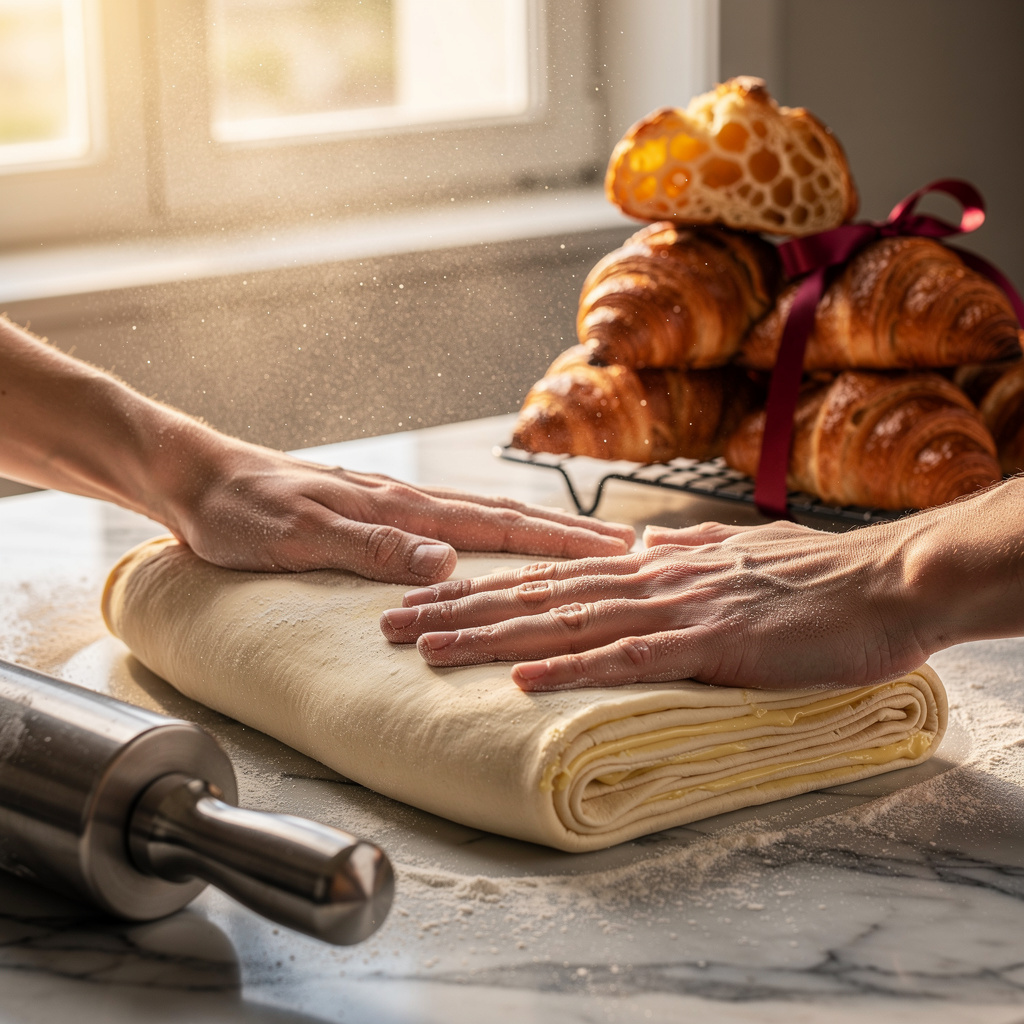
Croissants and laminated dough represent one of the most technically demanding yet rewarding disciplines in the baking world. Lamination is the process of creating hundreds of alternating layers of dough and butter through repeated rolling and folding, known as turns, which produce the characteristic flaky, airy texture when baked. The subject encompasses the science of gluten networks, the selection of high-fat European-style butters, the precise control of dough temperature, and the enzymatic and microbial activity that drives fermentation and proofing — all of which must work in harmony to achieve the perfect honeycomb crumb and shattering crust.
Today, the craft of laminated dough has experienced a renaissance, driven by the specialty coffee movement and the global rise of artisan bakeries that treat viennoiserie as a centerpiece of their offerings. From Parisian pâtisseries to third-wave coffee shops in Seoul, New York, and Melbourne, the demand for expertly crafted croissants and their variations — kouign-amann, cruffins, and laminated brioche — continues to grow. Recent shifts toward long-fermentation techniques and the use of specialty flours and cultured butters have also elevated the subject from a traditional craft to a field of active innovation, where pastry chefs are constantly pushing the boundaries of texture and flavor.
Mastering croissants and laminated dough builds a skill stack that goes far beyond a single recipe: it develops your understanding of dough rheology, temperature management, and precision timing, all of which transfer directly to other pastry and bread-making disciplines. For professionals, this expertise opens doors to positions in high-end bakeries, hotels, and R&D kitchens, while for entrepreneurs it provides the technical foundation to launch a competitive viennoiserie brand. For home bakers, the knowledge gained transforms baking from a hobby into a craft, enabling you to produce results that rival professional patisseries and to troubleshoot any issue with confidence.
Common Questions About Croissants and Laminated Dough
How does the croissant course certificate help with bakery job applications?
Is this laminated dough course suitable for a complete beginner?
What exactly is a détrempe in croissant dough?
- Flour – the structural backbone that holds the layers.
- Water – hydrates the flour and activates gluten.
- Salt – strengthens gluten and controls fermentation.
- Sugar – adds flavor and promotes browning.
- Yeast – produces gas for fermentation and lift.
How do you find the gluten sweet spot in laminated dough?
Why does butter need to behave like clay for the butter block?
How many single turns create the classic croissant layers?
Is it a myth that you can use any butter for croissant lamination?
What Will This Course Bring You?
- Analyze the role of gluten development and butter plasticity in creating distinct layers in laminated dough.
- Evaluate ingredient selection criteria for flour, butter, and yeast to optimize croissant flavor and texture.
- Build a proper détrempe with correct hydration and mixing time to ensure extensibility and strength.
- Construct a butter block with uniform consistency and dimensions for even lamination.
- Apply the technique of rolling and folding to execute single and double turns while maintaining dough temperature.
- Assess fermentation and proofing stages to achieve optimal volume and flavor development.
- Design shaping methods for classic croissants and variations like pain au chocolat and almond croissants.
- Implement troubleshooting strategies to diagnose and correct common defects such as butter leakage, dense crumb, or uneven layers.
Curriculum
12 Units1. Foundations of Laminated Dough
1 hour
2. Ingredient Selection and Mise en Place
1 hour
3. The Détrempe: Mixing and First Rest
1 hour
4. Butter Block Preparation and Lamination Principles
1 hour
5. Rolling and Folding: The Art of Turns
1 hour
6. Fermentation and Proofing
1 hour
7. Shaping Croissants and Variations
1 hour
8. Egg Wash and Baking
1 hour
9. Troubleshooting and Quality Control
1 hour
10. Variations and Enriched Doughs
1 hour
11. Advanced Lamination Techniques
1 hour
12. Production Planning and Scaling
1 hour
Exam – Croissants and Laminated Dough
20 Questions • 70% Pass • 30 min
Unlock All Units for Free
Create an account, enroll in the course, and start with the first unit right away.
Exam – Croissants and Laminated Dough
20 Questions • Pass: 70% • 30 min
Course Duration
720
Total Minutes
12
Unit
1
Final Exam
~60
Min / Unit
Croissants and Laminated Dough Certificate Program
Document Your Skill
Those who pass the 20-question, 30-minute exam with 70% receive the Croissants and Laminated Dough Certificate.
Stand Out on Your CV
By adding your certificate to your CV, gain a professional reference in job applications and stand out from the crowd.
Career Advantage
Catch Wisdom certificates are recognized by HR departments and increase career opportunities.
CERTIFICATE FEE
At the end of the course, an online exam consisting of 20 questions with a 30-minute time limit is given. The exam appears automatically after you complete the topics. Anyone who scores at least 70 out of 100 on the certificate exam is awarded the Croissants and Laminated Dough Document (certificate of attendance). You can add the certificate you earn to your CV for job applications in the many sectors listed above, and use it as a reference proving that you took this interactive course.
The Certificate of Achievement you receive with the Croissants and Laminated Dough course program holds value that proves your personal and professional development in the business world. By adding it to your CV, it can serve as an important reference in your job applications. Moreover, compared with certificates from other private training institutions, Catch Wisdom certificates are offered to our participants at a much more affordable price.
Because HR departments recognize Catch Wisdom as a reputable institution in this field, they value these certificates and may evaluate your job applications favorably. For this reason, a Croissants and Laminated Dough course certificate from Catch Wisdom can make your applications more attractive and place you in an advantageous position in the business world.
For more information, we recommend visiting the Support page.
Certificate in 7 Languages
Earning success certificates from our courses is now more meaningful and global. With certificates available in Turkish, English, German, French, Spanish, Arabic, and Russian, we fully unlock the potential of students worldwide.
Why Certificate in 7 Languages?
-
01
Global Skill Development
Receiving your certificates in 7 different languages strengthens your communication skills as you engage with more people worldwide. It lets you operate more confidently and capably on the international stage.
-
02
International Job Opportunities
Employers may see your certificates in multiple languages as a sign of your ability to seize global opportunities. You can open more doors to new jobs and projects.
-
03
Cultural Richness
The chance to earn certificates in different languages helps you build closer ties with various cultures and broadens your worldview. It enriches your global perspective and deepens cultural understanding.
-
04
Ability to Participate in International Projects
Multilingual certificates give you an edge to work more effectively on international projects. They boost your chances of leadership and participation in diverse projects in the business world.
-
05
Prove Yourself on the Global Stage
Certificates in multiple languages let you showcase your skills and knowledge worldwide. You can become an internationally recognized professional.
Language diversity opens worldwide opportunities. If you want to prove yourself in the international arena, join our online Croissants and Laminated Dough course program and begin this journey with us.
Frequently Asked Questions (FAQ)
Is this course paid?
How do I join the course?
Can I take the course at my own pace?
How can I get my certificate?
What are the advantages of the Certified Certificate?
Boost Your Career
Take a new career step with the Croissants and Laminated Dough course. Add your certificate to your CV, stand out in job applications, and open the door to new opportunities in the industry.
StartStudent Reviews
No reviews yet
Enroll in this course and be the first to leave a review about your experience with Croissants and Laminated Dough.
Start