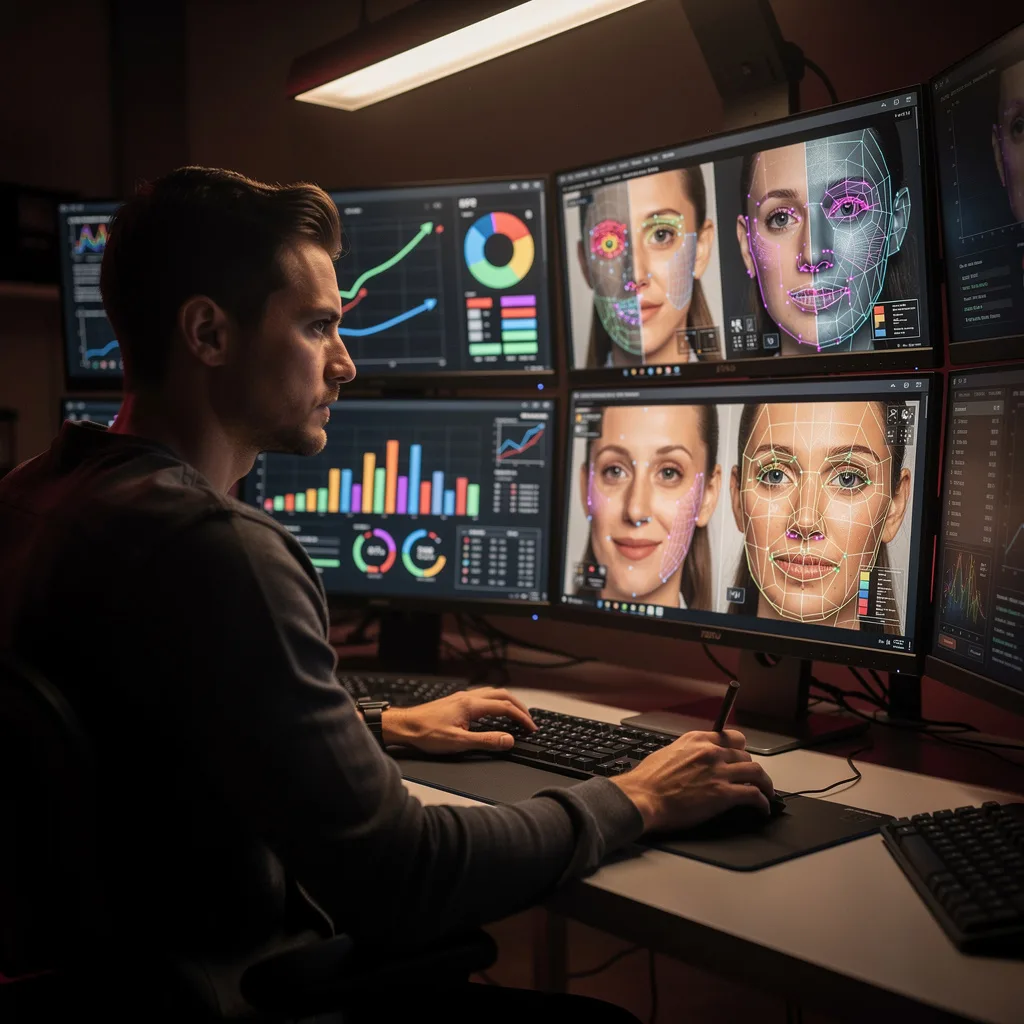
What is Deepfake Detection Methods?
Deepfake Detection Methods Training
The Deepfake Detection Methods certificate program equips learners with the technical and analytical skills needed to identify manipulated media across images, video, and audio. Designed for cybersecurity professionals, forensic analysts, data scientists, and media investigators, this course delivers a practical outcome: the ability to deploy robust detection pipelines that can distinguish real content from synthetic forgeries. Participants will move from understanding what deepfakes are to implementing state-of-the-art detection systems ready for real-world deployment.
The program follows a beginner-friendly progression, starting with human perception limits and dataset benchmarks, then advancing through signal-level artifacts, handcrafted features, and classical machine learning before diving into deep learning architectures such as CNNs, transformers, and attention-based detectors. It builds four core skill areas: statistical artifact analysis, neural network design for detection, temporal and audio-visual fusion, and adversarial robustness. With deepfake technology evolving rapidly—especially generative adversarial networks and diffusion models—this training is essential for anyone who needs to stay ahead of emerging threats and deploy practical countermeasures today.
What is Deepfake Detection Methods?
Deepfake detection methods encompass the techniques and algorithms used to identify synthetic or manipulated media created by artificial intelligence, particularly deep learning models. The core concepts include analyzing signal-level inconsistencies (e.g., pixel statistics, frequency domain anomalies), leveraging handcrafted features and classical machine learning classifiers, and employing advanced neural architectures like convolutional neural networks, transformers, and attention mechanisms to spot subtle forgeries. The field also covers temporal artifacts in video sequences, audio-visual mismatches, and the unique fingerprints left by different generative models such as GANs and diffusion models.
Today, deepfake detection is critical as synthetic media becomes indistinguishable from authentic content, threatening trust in journalism, legal evidence, financial transactions, and personal communications. Governments, social media platforms, and forensic labs rely on detection tools to combat disinformation, fraud, and identity theft. Recent shifts include the rise of diffusion model–generated deepfakes, which introduce new artifact patterns, and the growing need for detectors that are robust against adversarial evasion techniques—making this a fast-moving, high-stakes domain at the intersection of computer vision, cybersecurity, and ethics.
Mastering deepfake detection builds a skill stack that includes image and video forensics, machine learning model evaluation, signal processing, and adversarial machine learning. Professionals in digital forensics, intelligence analysis, content moderation, and AI safety benefit directly, as do researchers pushing the boundaries of generative model accountability. The subject also empowers individuals to critically assess media authenticity in personal and professional contexts, fostering a deeper understanding of how AI can both create and protect truth in the digital age.
Common Questions About Deepfake Detection Methods
Is this deepfake detection course suitable for beginners?
Do I need prior machine learning experience for this course?
How do Fourier-based methods detect deepfake artifacts?
- Fourier Transform: Reveals periodic patterns; deepfakes often lack natural high-frequency details.
- DCT Pipeline: Extracts statistical features like coefficient distributions that differ between real and fake images.
- GAN Fingerprints: Specific frequency signatures persist even after compression or resizing.
Why are GAN fingerprints persistent across transformations?
How do Vision Transformers compare to CNNs for deepfake detection?
What is the role of temporal analysis in video deepfake detection?
Can deepfake detectors achieve 100% accuracy?
What Will This Course Bring You?
- Analyze the limitations of human perception in identifying deepfakes and their impact on detection accuracy.
- Apply signal-level artifact analysis to detect statistical anomalies in deepfake media, such as frequency domain inconsistencies.
- Implement handcrafted feature extraction combined with classical machine learning classifiers for deepfake detection.
- Design a convolutional neural network architecture optimized for detecting visual deepfake artifacts.
- Evaluate temporal inconsistencies and audio-visual mismatches in deepfake videos using multimodal analysis.
- Build a transformer-based attention detector to identify spatial and temporal forgery patterns.
- Assess adversarial robustness techniques to defend detection systems against evasion attacks and propose countermeasures.
Curriculum
12 Units1. What Are Deepfakes?
1 hour
2. Human Perception and Its Limits
1 hour
3. Datasets and Benchmarks for Detection
1 hour
4. Signal-Level Artifacts and Statistical Analysis
1 hour
5. Handcrafted Features and Classical Machine Learning
1 hour
6. Convolutional Neural Networks for Detection
1 hour
7. Temporal and Audio-Visual Analysis
1 hour
8. Transformers and Attention-Based Detectors
1 hour
9. Detecting GAN and Diffusion Model Fingerprints
1 hour
10. Adversarial Robustness and Evasion Techniques
1 hour
11. Deploying Detection Systems in Practice
1 hour
12. Future Challenges and Emerging Research
1 hour
Exam – Deepfake Detection Methods
20 Questions • 70% Pass • 30 min
Unlock All Units for Free
Create an account, enroll in the course, and start with the first unit right away.
Exam – Deepfake Detection Methods
20 Questions • Pass: 70% • 30 min
Course Duration
720
Total Minutes
12
Unit
1
Final Exam
~60
Min / Unit
Deepfake Detection Methods Certificate Program
Document Your Skill
Those who pass the 20-question, 30-minute exam with 70% receive the Deepfake Detection Methods Certificate.
Stand Out on Your CV
By adding your certificate to your CV, gain a professional reference in job applications and stand out from the crowd.
Career Advantage
With the verification code, employers can check your certificate instantly — a concrete way to show your growth.
CERTIFICATE FEE
At the end of the course, an online exam consisting of 20 questions with a 30-minute time limit is given. The exam appears automatically after you complete the topics. Anyone who scores at least 70 out of 100 on the certificate exam is awarded the Deepfake Detection Methods Document (certificate of attendance). You can add the certificate you earn to your CV for job applications in the many sectors listed above, and use it as a reference proving that you took this interactive course.
The Certificate of Achievement you receive with the Deepfake Detection Methods course program holds value that proves your personal and professional development in the business world. By adding it to your CV, it can serve as an important reference in your job applications. Moreover, compared with certificates from other private training institutions, Catch Wisdom certificates are offered to our participants at a much more affordable price.
The Deepfake Detection Methods course certificate is a document that proves, with a unique verification code, that you completed the course. Employers can instantly check its authenticity with this code, which helps you show your development concretely in your job applications.
For more information, we recommend visiting the Support page.
Certificate in 7 Languages
Earning success certificates from our courses is now more meaningful and global. With certificates available in Turkish, English, German, French, Spanish, Arabic, and Russian, we fully unlock the potential of students worldwide.
Why Certificate in 7 Languages?
-
01
Global Skill Development
Receiving your certificates in 7 different languages strengthens your communication skills as you engage with more people worldwide. It lets you operate more confidently and capably on the international stage.
-
02
International Job Opportunities
Employers may see your certificates in multiple languages as a sign of your ability to seize global opportunities. You can open more doors to new jobs and projects.
-
03
Cultural Richness
The chance to earn certificates in different languages helps you build closer ties with various cultures and broadens your worldview. It enriches your global perspective and deepens cultural understanding.
-
04
Ability to Participate in International Projects
Multilingual certificates give you an edge to work more effectively on international projects. They boost your chances of leadership and participation in diverse projects in the business world.
-
05
Prove Yourself on the Global Stage
Certificates in multiple languages give you the opportunity to present your skills and knowledge worldwide.
Language diversity opens worldwide opportunities. If you want to prove yourself in the international arena, join our online Deepfake Detection Methods course program and begin this journey with us.
Frequently Asked Questions (FAQ)
Is this course paid?
How do I join the course?
Can I take the course at my own pace?
How can I get my certificate?
What are the advantages of the certificate?
Boost Your Career
Take a new career step with the Deepfake Detection Methods course. Add your certificate to your CV, stand out in job applications, and open the door to new opportunities in the industry.
StartStudent Reviews
No reviews yet
Enroll in this course and be the first to leave a review about your experience with Deepfake Detection Methods.
Start