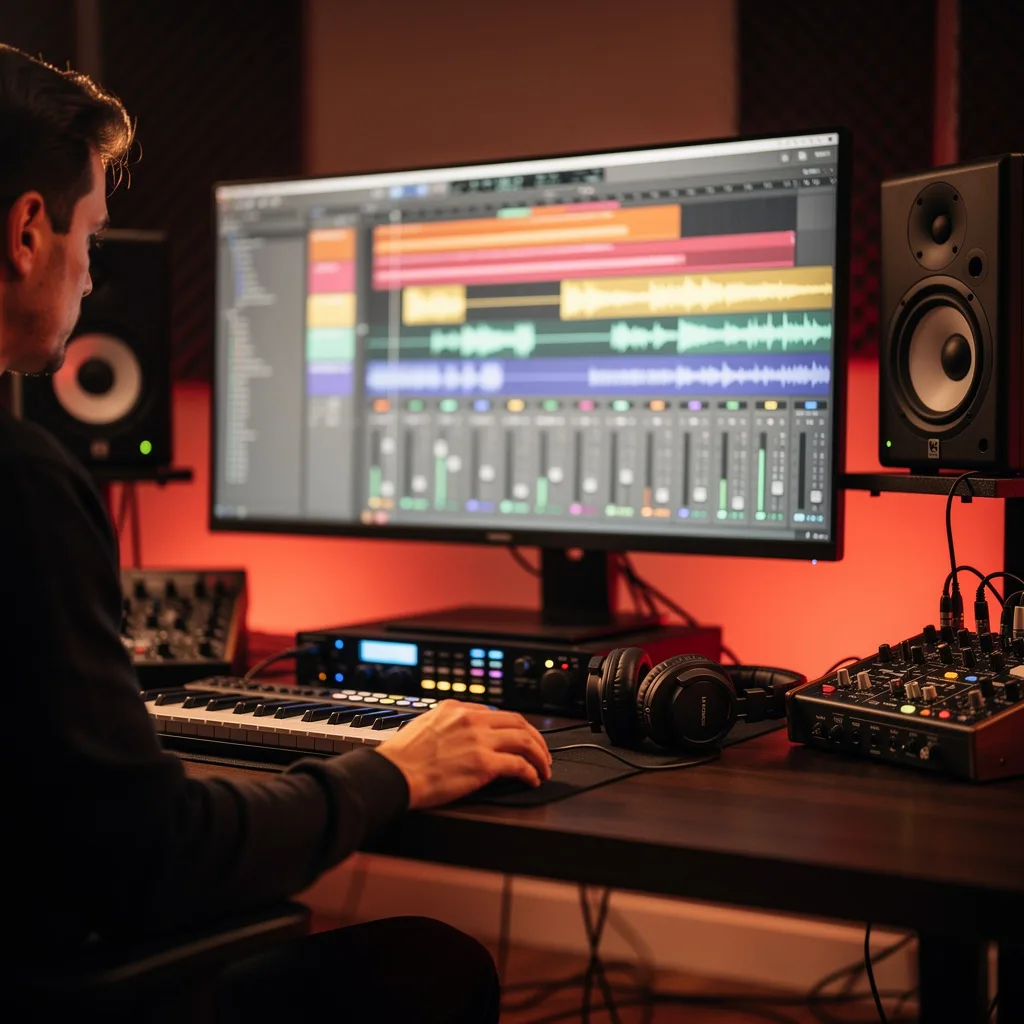
What is Electronic Music Production?
Electronic Music Production Training
Electronic Music Production certificate program provides a comprehensive, hands-on education in creating, shaping, and finishing electronic music using modern digital tools. It covers the full production chain, from understanding sound and signal flow to programming drums, designing synths, editing samples, writing harmonies, mixing, mastering, and releasing tracks. The course is built for aspiring producers, DJs, songwriters, and hobbyists who want to move from scattered ideas to polished, release-ready music. By the end, learners complete original tracks that demonstrate technical control and creative identity across genres like house, techno, hip-hop, and ambient.
The program follows a deliberate beginner-friendly progression across twelve units, starting with digital audio foundations and DAW navigation before advancing to rhythm, synthesis, sampling, and music theory. Each unit balances theoretical explanation with practical studio tasks, so concepts like EQ, dynamics, and spatial processing are immediately applied to real projects. The curriculum builds five core skill areas: technical audio literacy, sound design, composition and arrangement, mixing and mastering, and release strategy. Choosing this program now makes sense because electronic music production has become more accessible than ever, yet the gap between bedroom experiments and professional-quality output still requires structured, up-to-date training.
What is Electronic Music Production?
Electronic music production is the art and science of creating music primarily through electronic instruments, software, and digital audio workstations. Its scope spans sound synthesis, sampling, rhythm programming, audio editing, mixing, and mastering, along with the compositional principles that give tracks structure and emotion. Core concepts include signal flow, frequency balance, dynamic range, groove, timbre, and spatial depth. Unlike traditional music production, it often treats the studio itself as an instrument, where every parameter can be automated and every sound can be designed from scratch.
Today, electronic music production sits at the center of mainstream pop, film scoring, game audio, advertising, and live performance, not just club culture. Streaming platforms and social media have created a massive demand for original beats, remixes, and sound design, while affordable software and powerful laptops have lowered the barrier to entry. Recent shifts include AI-assisted composition tools, immersive spatial audio formats, and the rise of remote collaboration, which change how producers work and distribute music. Academic programs increasingly treat electronic production as a legitimate field of study, blending music technology, acoustics, and creative practice.
Mastering electronic music production builds a versatile skill stack: critical listening, technical troubleshooting, creative problem-solving, and project management. These skills translate directly into careers as recording artists, mix engineers, sound designers, game audio implementers, and live performers, as well as into personal fulfillment for hobbyists who want to express themselves sonically. The ability to take a musical idea from a blank session to a finished, distributed track is valuable in any context where audio quality and originality matter. Because the field rewards both technical precision and artistic risk-taking, it offers continuous room for growth and reinvention.
What Will This Course Bring You?
- Analyze signal flow from sound source through digital audio conversion to identify gain-staging and latency issues in an electronic music production setup.
- Configure a digital audio workstation project with track routing, templates, and keyboard shortcuts to support an efficient electronic music production workflow.
- Program rhythmic patterns and design custom drum sounds using velocity, swing, and micro-timing to create groove in electronic music.
- Build synthesizer patches by adjusting oscillators, filters, envelopes, and modulation to design original electronic timbres.
- Edit and resample audio clips using slicing, time-stretching, and pitch-shifting techniques to integrate sampled material into electronic tracks.
- Apply music theory concepts and layering techniques to compose harmonic sections, basslines, and lead lines for electronic music productions.
- Evaluate arrangement and mix balance by mapping energy curves and applying EQ and dynamics to sustain listener engagement in electronic tracks.
- Implement creative effects, spatial processing, and mastering techniques to finalize and deliver electronic tracks for release and performance.
Curriculum
12 Units1. Unit 1: Sound, Signal Flow, and Digital Audio Foundations
1 hour
2. Unit 2: DAW Setup, Navigation, and Production Workflow
1 hour
3. Unit 3: Rhythm Programming, Drum Design, and Groove
1 hour
4. Unit 4: Synthesis and Sound Design Fundamentals
1 hour
5. Unit 5: Sampling, Audio Editing, and Resampling
1 hour
6. Unit 6: Music theory and Harmonic Writing for Electronic Music
1 hour
7. Unit 7: Basslines, Leads, and Layering
1 hour
8. Unit 8: Arrangement and Energy Management
1 hour
9. Unit 9: Mixing Fundamentals: Balance, EQ, and Dynamics
1 hour
10. Unit 10: Creative Effects and Spatial Processing
1 hour
11. Unit 11: Mastering and Final Delivery
1 hour
12. Unit 12: Finishing, Releasing, and Performing Electronic Music
1 hour
Exam – Electronic Music Production
20 Questions • 70% Pass • 30 min
Unlock All Units for Free
Create an account, enroll in the course, and start with the first unit right away.
Exam – Electronic Music Production
20 Questions • Pass: 70% • 30 min
Course Duration
720
Total Minutes
12
Unit
1
Final Exam
~60
Min / Unit
Electronic Music Production Certificate Program
Document Your Skill
Those who pass the 20-question, 30-minute exam with 70% receive the Electronic Music Production Certificate.
Stand Out on Your CV
By adding your certificate to your CV, gain a professional reference in job applications and stand out from the crowd.
Career Advantage
Catch Wisdom certificates are recognized by HR departments and increase career opportunities.
CERTIFICATE FEE
At the end of the course, an online exam consisting of 20 questions with a 30-minute time limit is given. The exam appears automatically after you complete the topics. Anyone who scores at least 70 out of 100 on the certificate exam is awarded the Electronic Music Production Document (certificate of attendance). You can add the certificate you earn to your CV for job applications in the many sectors listed above, and use it as a reference proving that you took this interactive course.
The Certificate of Achievement you receive with the Electronic Music Production course program holds value that proves your personal and professional development in the business world. By adding it to your CV, it can serve as an important reference in your job applications. Moreover, compared with certificates from other private training institutions, Catch Wisdom certificates are offered to our participants at a much more affordable price.
Because HR departments recognize Catch Wisdom as a reputable institution in this field, they value these certificates and may evaluate your job applications favorably. For this reason, a Electronic Music Production course certificate from Catch Wisdom can make your applications more attractive and place you in an advantageous position in the business world.
For more information, we recommend visiting the Support page.
Certificate in 7 Languages
Earning success certificates from our courses is now more meaningful and global. With certificates available in Turkish, English, German, French, Spanish, Arabic, and Russian, we fully unlock the potential of students worldwide.
Why Certificate in 7 Languages?
-
01
Global Skill Development
Receiving your certificates in 7 different languages strengthens your communication skills as you engage with more people worldwide. It lets you operate more confidently and capably on the international stage.
-
02
International Job Opportunities
Employers may see your certificates in multiple languages as a sign of your ability to seize global opportunities. You can open more doors to new jobs and projects.
-
03
Cultural Richness
The chance to earn certificates in different languages helps you build closer ties with various cultures and broadens your worldview. It enriches your global perspective and deepens cultural understanding.
-
04
Ability to Participate in International Projects
Multilingual certificates give you an edge to work more effectively on international projects. They boost your chances of leadership and participation in diverse projects in the business world.
-
05
Prove Yourself on the Global Stage
Certificates in multiple languages let you showcase your skills and knowledge worldwide. You can become an internationally recognized professional.
Language diversity opens worldwide opportunities. If you want to prove yourself in the international arena, join our online Electronic Music Production course program and begin this journey with us.
Frequently Asked Questions (FAQ)
Is this course paid?
How do I join the course?
Can I take the course at my own pace?
How can I get my certificate?
What are the advantages of the Certified Certificate?
Boost Your Career
Take a new career step with the Electronic Music Production course. Add your certificate to your CV, stand out in job applications, and open the door to new opportunities in the industry.
StartStudent Reviews
No reviews yet
Enroll in this course and be the first to leave a review about your experience with Electronic Music Production.
Start