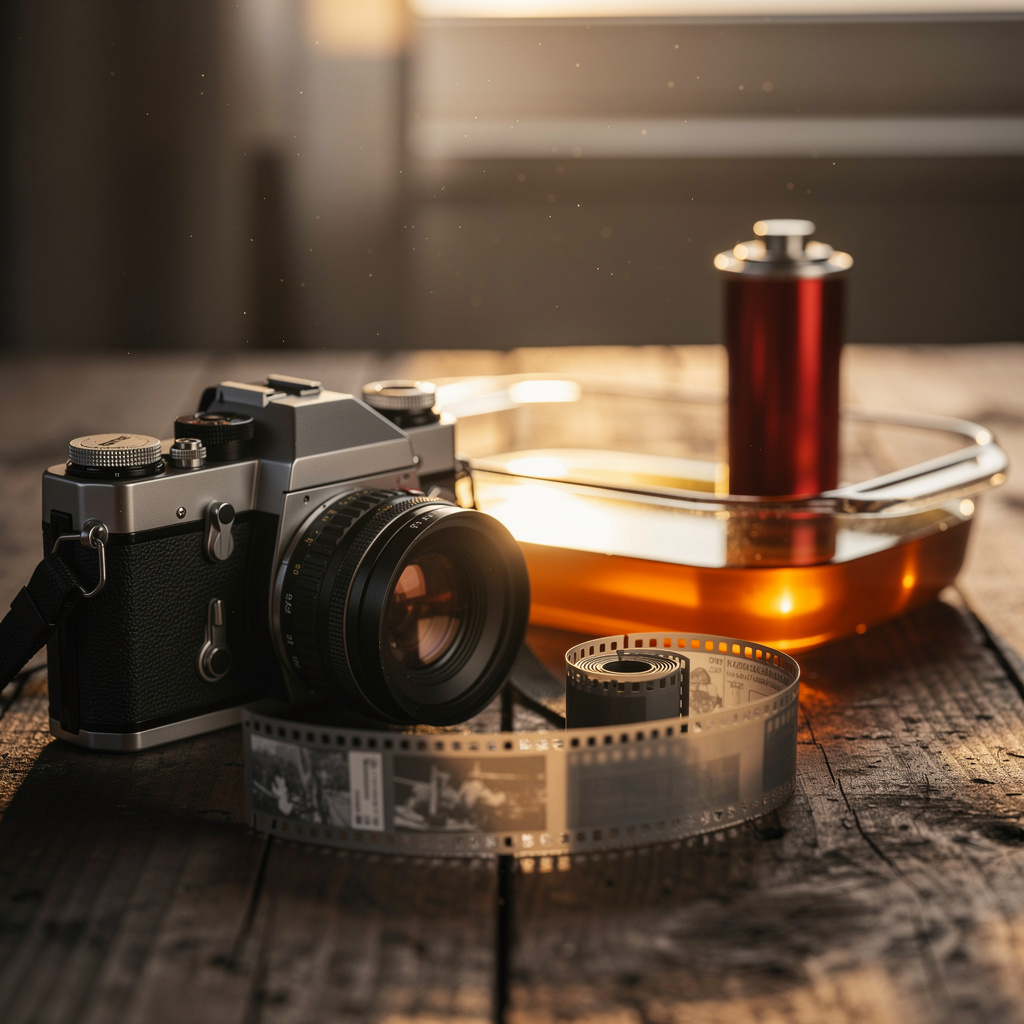
What is Film Photography?
Film Photography Training
The Film Photography certificate program is a comprehensive, hands-on course designed for beginners and enthusiasts who want to master the art and science of analog photography. It teaches everything from camera controls and film types to exposure fundamentals, darkroom development, and digital scanning, culminating in the ability to produce and share high-quality film photographs. The main practical outcome is that you will confidently shoot, develop, and print your own black-and-white and color film, while also learning to digitize and archive your work for modern use.
The program is structured to be beginner-friendly, starting with core camera mechanics and film selection, then progressing through exposure theory, composition, and lighting, before diving into hands-on darkroom techniques and advanced processes like alternative printing. It builds five core skill areas: technical camera operation, film handling and development, darkroom printing, digitization, and creative composition. This course is especially relevant now because film photography is experiencing a major revival, with artists, collectors, and even digital photographers seeking the unique textures, colors, and intentionality that only analog can offer.
What is Film Photography?
Film photography is the practice of capturing images using light-sensitive film rather than digital sensors. It encompasses a range of processes, from selecting the right film stock and setting aperture, shutter speed, and ISO, to developing the exposed film in chemical baths and printing the resulting negatives onto photographic paper. Core concepts include the exposure triangle, reciprocity, grain structure, and the unique color and tonal characteristics of different film emulsions. Unlike digital photography, film requires a deliberate, methodical approach because each frame is a physical resource that cannot be instantly reviewed or deleted.
Today, film photography is experiencing a powerful resurgence among artists, fashion photographers, and hobbyists who value its tactile, unpredictable qualities and the discipline it imposes. It is widely used in fine art, documentary, and editorial work, and many universities still teach film as a foundational medium for understanding light, composition, and the photographic process. Recent shifts include the reintroduction of classic film stocks, the growth of community darkrooms, and the integration of film with digital workflows through high-resolution scanning, making analog more accessible than ever.
Mastering film photography builds a deep, intuitive understanding of exposure, composition, and light that transfers directly to any photographic practice. The skill stack includes technical precision in camera operation, chemical and darkroom safety, print evaluation, and archival methods. These competencies are valuable for professional photographers, visual artists, educators, and anyone seeking a hands-on creative outlet that rewards patience and craft. Whether you aim to exhibit prints, sell scans, or simply enjoy a slower, more intentional way of making images, film photography offers a rich, enduring medium.
Common Questions About Film Photography
Is this film photography course suitable for complete beginners?
Can I learn film photography without owning a darkroom?
How does the f-stop scale change light in film photography?
What is the correct way to load 120 roll film into a medium format camera?
How do aperture and distance affect depth of field in film photography?
What is the chemical sequence for developing black-and-white film?
- Developer: Converts exposed silver halide crystals into metallic silver, creating the visible image.
- Stop bath: Halts the development process by neutralizing the alkaline developer.
- Fixer: Removes unexposed silver halide, making the image permanent and light-safe.
- Wash: Removes residual chemicals to ensure long-term stability.
- Dry: Hanging the film in a dust-free area until completely dry.
Do you need an expensive camera to start film photography?
What Will This Course Bring You?
- Operate a manual film camera by adjusting aperture, shutter speed, and ISO to achieve correct exposure.
- Select appropriate film types based on ISO, grain, and color characteristics for specific shooting conditions.
- Load and handle 35mm and medium format film in daylight without exposing it to light.
- Apply principles of composition and natural light to frame compelling photographs.
- Control depth of field and motion blur through aperture and shutter speed settings to achieve creative effects.
- Develop black-and-white film using a standard chemical process to produce high-quality negatives.
- Print black-and-white photographs in a darkroom using an enlarger and chemical baths to create final prints.
- Digitize film negatives using a scanner and software to create high-resolution digital files.
Curriculum
12 Units1. The Camera and Its Controls
1 hour
2. Film Types and Characteristics
1 hour
3. Exposure: Aperture, Shutter Speed, and ISO
1 hour
4. Loading and Handling Film
1 hour
5. Composition and Light
1 hour
6. Shooting Techniques: Depth of Field and Motion
1 hour
7. Developing Black-and-White Film
1 hour
8. Printing Black-and-White Photographs
1 hour
9. Color Film Development and Printing
1 hour
10. Scanning and Digitizing Film
1 hour
11. Advanced Techniques and Alternative Processes
1 hour
12. Archiving, Sharing, and the Film Community
1 hour
Exam – Film Photography
20 Questions • 70% Pass • 30 min
Unlock All Units for Free
Create an account, enroll in the course, and start with the first unit right away.
Exam – Film Photography
20 Questions • Pass: 70% • 30 min
Course Duration
720
Total Minutes
12
Unit
1
Final Exam
~60
Min / Unit
Film Photography Certificate Program
Document Your Skill
Those who pass the 20-question, 30-minute exam with 70% receive the Film Photography Certificate.
Stand Out on Your CV
By adding your certificate to your CV, gain a professional reference in job applications and stand out from the crowd.
Career Advantage
With the verification code, employers can check your certificate instantly — a concrete way to show your growth.
CERTIFICATE FEE
At the end of the course, an online exam consisting of 20 questions with a 30-minute time limit is given. The exam appears automatically after you complete the topics. Anyone who scores at least 70 out of 100 on the certificate exam is awarded the Film Photography Document (certificate of attendance). You can add the certificate you earn to your CV for job applications in the many sectors listed above, and use it as a reference proving that you took this interactive course.
The Certificate of Achievement you receive with the Film Photography course program holds value that proves your personal and professional development in the business world. By adding it to your CV, it can serve as an important reference in your job applications. Moreover, compared with certificates from other private training institutions, Catch Wisdom certificates are offered to our participants at a much more affordable price.
The Film Photography course certificate is a document that proves, with a unique verification code, that you completed the course. Employers can instantly check its authenticity with this code, which helps you show your development concretely in your job applications.
For more information, we recommend visiting the Support page.
Certificate in 7 Languages
Earning success certificates from our courses is now more meaningful and global. With certificates available in Turkish, English, German, French, Spanish, Arabic, and Russian, we fully unlock the potential of students worldwide.
Why Certificate in 7 Languages?
-
01
Global Skill Development
Receiving your certificates in 7 different languages strengthens your communication skills as you engage with more people worldwide. It lets you operate more confidently and capably on the international stage.
-
02
International Job Opportunities
Employers may see your certificates in multiple languages as a sign of your ability to seize global opportunities. You can open more doors to new jobs and projects.
-
03
Cultural Richness
The chance to earn certificates in different languages helps you build closer ties with various cultures and broadens your worldview. It enriches your global perspective and deepens cultural understanding.
-
04
Ability to Participate in International Projects
Multilingual certificates give you an edge to work more effectively on international projects. They boost your chances of leadership and participation in diverse projects in the business world.
-
05
Prove Yourself on the Global Stage
Certificates in multiple languages give you the opportunity to present your skills and knowledge worldwide.
Language diversity opens worldwide opportunities. If you want to prove yourself in the international arena, join our online Film Photography course program and begin this journey with us.
Frequently Asked Questions (FAQ)
Is this course paid?
How do I join the course?
Can I take the course at my own pace?
How can I get my certificate?
What are the advantages of the certificate?
Boost Your Career
Take a new career step with the Film Photography course. Add your certificate to your CV, stand out in job applications, and open the door to new opportunities in the industry.
StartStudent Reviews
No reviews yet
Enroll in this course and be the first to leave a review about your experience with Film Photography.
Start