What is Finite Element Analysis Fundamentals?
Finite Element Analysis Fundamentals Certificate Program
The Finite Element Analysis Fundamentals certificate program teaches engineers and technical professionals how to translate physical problems into reliable finite element models, from strong and weak formulations to element stiffness assembly and global solution strategies. It is designed for mechanical, civil, aerospace, and structural analysts, as well as graduate students and CAD users who need a rigorous foundation rather than a software-only workflow. Participants examine discretization and shape functions, boundary conditions, convergence and mesh quality, and element families spanning truss, beam, frame, 2D continuum, 3D continuum, and shell idealizations. The main practical outcome is the ability to build, interpret, and verify linear and selected nonlinear finite element models with justified assumptions and defensible results.
The program progresses from first principles to applied model building: it opens with how finite element analysis works and the mathematical foundations, then develops strong and weak formulation, discretization, shape functions, element stiffness matrices, and assembly before moving into boundary conditions, convergence, error estimation, and mesh quality. Learners then apply these foundations to truss, beam, and frame elements, two-dimensional continuum elements, and three-dimensional continuum and shell elements, before extending into thermal, modal, and buckling analysis plus nonlinear analysis and model verification. This beginner-friendly sequence balances theory with practice so that each lesson's mathematics is tied to modeling decisions and result interpretation rather than left as abstract derivation. The program builds five core skill areas—formulation, discretization, element selection, solution setup, and verification—and it is a strong choice now because simulation credibility, mesh independence, and nonlinear model validation are increasingly expected in design reviews and research.
What is Finite Element Analysis Fundamentals?
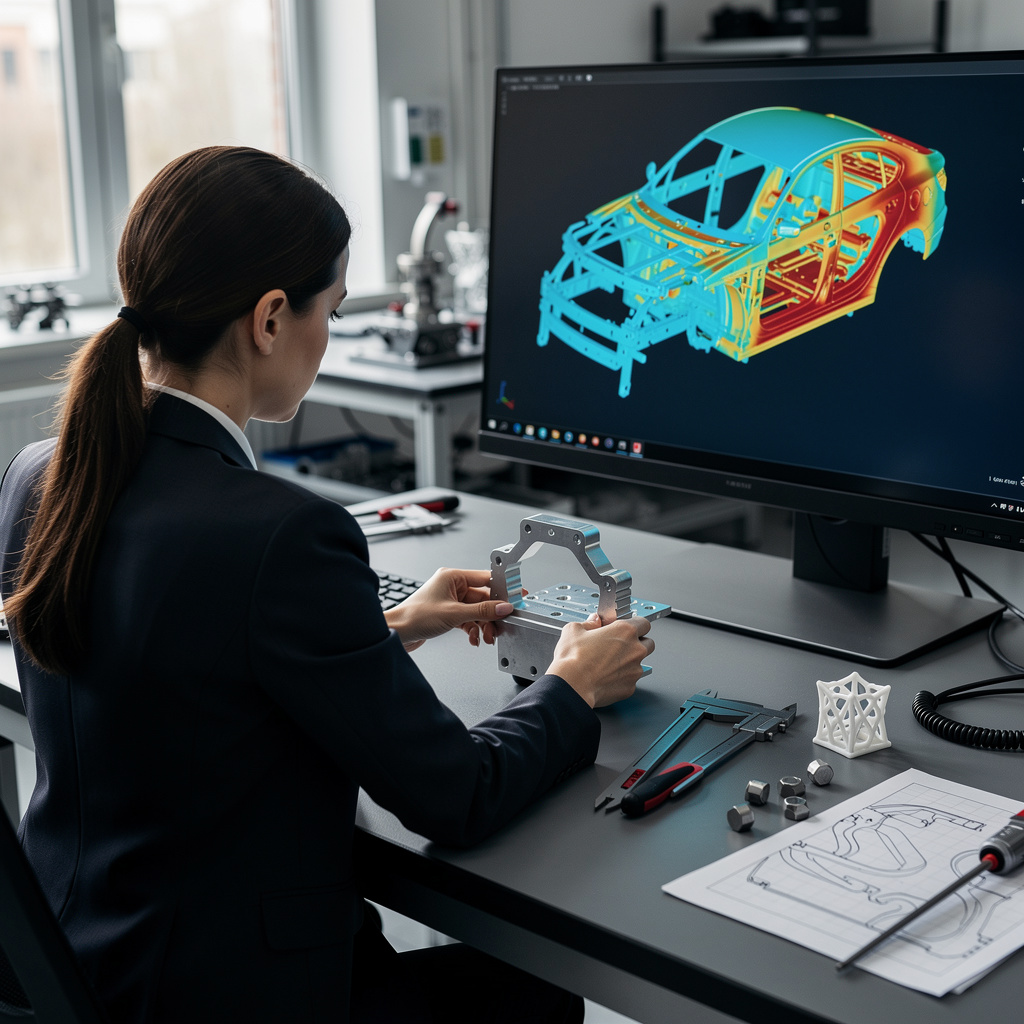
Finite element analysis fundamentals is the study of how continuous physical domains are approximated by discrete elements so that governing equations can be solved numerically under realistic boundary and loading conditions. Its scope covers the variational and weighted-residual roots of the method, strong and weak forms, discretization, interpolation and shape functions, element stiffness and assembly, global solution procedures, and the interpretation of convergence, error, and mesh quality. Core concepts include the principle of virtual work, minimum potential energy, isoparametric mapping, numerical integration, and the distinction between essential and natural boundary conditions. The subject also spans element technologies—truss, beam, frame, plane stress and plane strain, axisymmetric, solid, and shell elements—along with thermal, modal, buckling, and nonlinear extensions that determine when a linear elastic idealization is adequate.
Finite element analysis fundamentals matter today because engineering decisions increasingly depend on simulation evidence, from lightweight automotive structures and aerospace components to civil infrastructure, medical devices, and consumer electronics. In industry, analysts use these principles to justify mesh refinement, select element types, diagnose singularities, and defend safety margins in design reviews, while academia relies on them to develop new element formulations, multiscale models, and verification benchmarks. Recent shifts toward automated meshing, cloud-based solvers, digital twins, and simulation governance have raised rather than lowered the need for fundamental understanding, since automation cannot reliably catch ill-posed boundary conditions, poor aspect ratios, or unconverged nonlinear iterations. The growing use of coupled thermal-structural, modal, buckling, and nonlinear analyses also means practitioners must understand formulation-level assumptions rather than treating solvers as black boxes.
Mastering this subject builds a durable skill stack: mathematical modeling, variational reasoning, element formulation literacy, mesh design, boundary-condition specification, solution diagnostics, and verification against analytical or experimental benchmarks. These skills transfer to roles in structural analysis, product design, CAE engineering, research and development, and technical review, where professionals must explain not only what a solver reported but why the model is credible. Personal projects, thesis work, and interdisciplinary collaborations also benefit because the same foundation supports thermal management studies, vibration and buckling assessments, and nonlinear contact or material problems. The subject ultimately equips learners to move between software platforms and problem classes with confidence, using fundamentals as the stable reference point for judgment.
What Will This Course Bring You?
- Explain the finite element analysis workflow from preprocessing through postprocessing, identifying how weak formulations, discretization, assembly, and solution stages connect in practical models.
- Derive weak formulations from governing differential equations by applying weighted residuals and integration by parts to one-dimensional boundary value problems.
- Construct linear and quadratic shape functions for line and plane elements, then verify partition of unity and nodal interpolation properties.
- Assemble global stiffness matrices from element matrices using connectivity data and apply essential and natural boundary conditions to solve static finite element systems.
- Evaluate mesh convergence and element quality metrics to separate discretization error from modeling error when interpreting finite element stress and displacement results.
- Formulate truss, beam, and frame element stiffness matrices and select appropriate elements for axial, bending, and combined loading structural models.
- Build two- and three-dimensional continuum and shell models, choosing element types and integration schemes for solid and thin-walled geometries.
- Set up thermal, modal, buckling, and nonlinear analyses and verify predictions through mesh sensitivity checks, equilibrium residuals, and analytical benchmarks.
Curriculum
12 Units1. How Finite Element Analysis Works
1 hour
2. Mathematical Foundations for Finite Element Analysis
1 hour
3. Strong and Weak Formulation
1 hour
4. Discretization and Shape Functions
1 hour
5. Element Stiffness Matrices and Assembly
1 hour
6. Boundary Conditions and Global Solution
1 hour
7. Convergence, Error, and Mesh Quality
1 hour
8. Truss, Beam, and Frame Elements
1 hour
9. Two-Dimensional Continuum Elements
1 hour
10. Three-Dimensional Continuum and Shell Elements
1 hour
11. Thermal, Modal, and Buckling Analysis
1 hour
12. Nonlinear Analysis and Model Verification
1 hour
Exam – Finite Element Analysis Fundamentals
20 Questions • 70% Pass • 30 min
Unlock All Units for Free
Create an account, enroll in the course, and start with the first unit right away.
Exam – Finite Element Analysis Fundamentals
20 Questions • Pass: 70% • 30 min
Course Duration
720
Total Minutes
12
Unit
1
Final Exam
~60
Min / Unit
Finite Element Analysis Fundamentals Certificate Program
Document Your Skill
Those who pass the 20-question, 30-minute exam with 70% receive the Finite Element Analysis Fundamentals Certificate.
Stand Out on Your CV
By adding your certificate to your CV, gain a professional reference in job applications and stand out from the crowd.
Career Advantage
With the verification code, employers can check your certificate instantly — a concrete way to show your growth.
CERTIFICATE FEE
At the end of the course, an online exam consisting of 20 questions with a 30-minute time limit is given. The exam appears automatically after you complete the topics. Anyone who scores at least 70 out of 100 on the certificate exam is awarded the Finite Element Analysis Fundamentals Document (certificate of attendance). You can add the certificate you earn to your CV for job applications in the many sectors listed above, and use it as a reference proving that you took this interactive course.
The Certificate of Achievement you receive with the Finite Element Analysis Fundamentals course program holds value that proves your personal and professional development in the business world. By adding it to your CV, it can serve as an important reference in your job applications. Moreover, compared with certificates from other private training institutions, Catch Wisdom certificates are offered to our participants at a much more affordable price.
The Finite Element Analysis Fundamentals course certificate is a document that proves, with a unique verification code, that you completed the course. Employers can instantly check its authenticity with this code, which helps you show your development concretely in your job applications.
For more information, we recommend visiting the Support page.
Certificate in 7 Languages
Earning success certificates from our courses is now more meaningful and global. With certificates available in Turkish, English, German, French, Spanish, Arabic, and Russian, we fully unlock the potential of students worldwide.
Why Certificate in 7 Languages?
-
01
Global Skill Development
Receiving your certificates in 7 different languages strengthens your communication skills as you engage with more people worldwide. It lets you operate more confidently and capably on the international stage.
-
02
International Job Opportunities
Employers may see your certificates in multiple languages as a sign of your ability to seize global opportunities. You can open more doors to new jobs and projects.
-
03
Cultural Richness
The chance to earn certificates in different languages helps you build closer ties with various cultures and broadens your worldview. It enriches your global perspective and deepens cultural understanding.
-
04
Ability to Participate in International Projects
Multilingual certificates give you an edge to work more effectively on international projects. They boost your chances of leadership and participation in diverse projects in the business world.
-
05
Prove Yourself on the Global Stage
Certificates in multiple languages give you the opportunity to present your skills and knowledge worldwide.
Language diversity opens worldwide opportunities. If you want to prove yourself in the international arena, join our online Finite Element Analysis Fundamentals course program and begin this journey with us.
Frequently Asked Questions (FAQ)
Is this course paid?
How do I join the course?
Can I take the course at my own pace?
How can I get my certificate?
What are the advantages of the certificate?
Boost Your Career
Take a new career step with the Finite Element Analysis Fundamentals course. Add your certificate to your CV, stand out in job applications, and open the door to new opportunities in the industry.
StartStudent Reviews
No reviews yet
Enroll in this course and be the first to leave a review about your experience with Finite Element Analysis Fundamentals.
Start