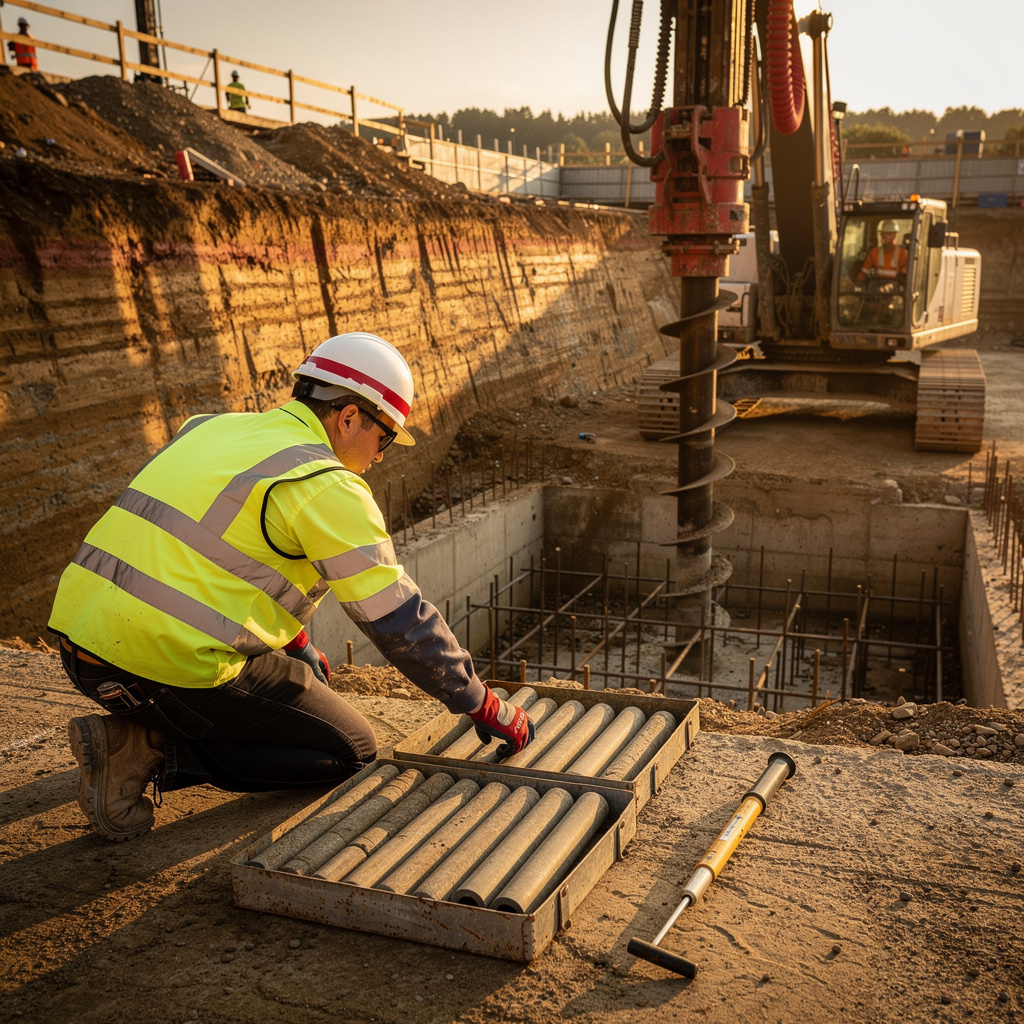
What is Geotechnical Engineering Fundamentals?
Geotechnical Engineering Fundamentals Certificate Program
Geotechnical Engineering Fundamentals certificate program equips learners with the core principles needed to understand how soils and geological conditions influence civil engineering works, from subsurface investigation and soil classification through compaction control, seepage, effective stress, consolidation, shear strength, lateral earth pressures, bearing capacity, deep foundations, slope stability, and ground improvement. It is designed for early-career civil engineers, site engineers, construction professionals, engineering technicians, and graduates who need a structured foundation in geotechnical practice rather than isolated formulas. Participants examine real soil data, sampling methods, index properties, field density checks, settlement potential, stress-strain behavior, and foundation and slope performance so they can connect field observations with design assumptions. The main practical outcome is the ability to interpret geotechnical information and make preliminary assessments that support safer foundations, retaining structures, slopes, and construction decisions.
The program follows a beginner-friendly progression that begins with engineering geology and soil formation, moves into subsurface investigation and soil sampling, then builds through phase relationships, classification, compaction, permeability, seepage, effective stress, consolidation, and shear strength before advancing to lateral earth pressures, shallow and deep foundations, slope stability, and ground improvement. Theory is balanced with practice through applied interpretation of soil properties, field density control, settlement analysis, stress-strain behavior, pile capacity, and design integration, so learners see how each concept supports engineering judgment. Learners build five core skill areas: soil characterization and site investigation; seepage, effective stress, and consolidation; shear strength and lateral earth pressures; bearing capacity and foundation design; and slope stability with ground improvement and design integration. This structure makes the program relevant now, as urban densification, infrastructure renewal, climate resilience, and demand for safer earthworks require professionals who can link field data, laboratory results, and geotechnical design decisions.
What is Geotechnical Engineering Fundamentals?
Geotechnical Engineering Fundamentals is the study of the physical, hydraulic, and mechanical behavior of soils and geological materials as they relate to civil engineering construction and design. Its scope spans the formation and composition of soils, subsurface exploration, soil classification, compaction, permeability and seepage, effective stress, consolidation and settlement, shear strength, lateral earth pressures, foundations, slope stability, and ground improvement. Core concepts include the effective stress principle, soil phase relationships, stress-strain behavior, consolidation theory, seepage forces, bearing capacity, and mass movement mechanisms. The subject provides the analytical language and practical judgement needed to understand how ground conditions affect the safety, serviceability, and cost of structures and earthworks.
This subject matters today because nearly every civil infrastructure decision depends on ground behavior, including buildings, bridges, embankments, retaining walls, tunnels, dams, roads, and industrial facilities. In industry, geotechnical fundamentals are used to interpret site investigation reports, assess settlement and bearing capacity, control compaction and field density, evaluate slope stability, and select ground improvement methods. Recent shifts toward urban densification, infrastructure renewal, climate resilience, and risk-based asset management have increased the need for professionals who can connect field observations, laboratory data, and design assumptions. Academia and practice also rely on these fundamentals to address changing groundwater conditions, reuse of marginal sites, and the performance of existing earth structures.
The bridge from this subject to learner outcomes is a skill stack built on soil characterization, site investigation interpretation, simplified geotechnical analysis, design judgement, and clear communication of risk and uncertainty. Mastering the subject develops the ability to read ground conditions, select relevant soil parameters, evaluate seepage, settlement, strength, and stability issues, and recognize when advanced analysis or specialist input is needed. These skills benefit civil and construction professionals, engineering technicians, architects, environmental practitioners, and project managers who must make or review decisions involving foundations, retaining systems, slopes, and earthworks. The subject also supports personal and professional growth by giving learners a durable conceptual framework for interpreting geotechnical reports, construction observations, and design recommendations across varied ground conditions.
What Will This Course Bring You?
- Evaluate geological processes and parent material to predict soil profile development and site-specific geotechnical implications.
- Design a subsurface investigation program including boring layouts, sampling methods, and in-situ tests for a given site.
- Calculate phase relationships and classify soils using gradation and plasticity indices to interpret engineering behavior.
- Evaluate laboratory compaction test results and specify field density control procedures to achieve project compaction specifications.
- Apply Darcy's law and flow net analysis to compute seepage rates, pore pressures, and effective stresses beneath geotechnical structures.
- Analyze consolidation test data to estimate primary consolidation settlement and time rates for shallow foundation design.
- Interpret shear strength results to evaluate lateral earth pressures and slope stability using Mohr-Coulomb parameters and limit equilibrium methods.
- Design shallow foundations, deep pile foundations, and ground improvement schemes by applying bearing capacity, axial capacity, and soil stabilization principles.
Curriculum
12 Units1. Engineering Geology and Soil Formation
1 hour
2. Subsurface Investigation and Soil Sampling
1 hour
3. Soil Phase Relationships, Index Properties, and Classification
1 hour
4. Soil Compaction and Field Density Control
1 hour
5. Permeability, Seepage, and Effective Stress
1 hour
6. Consolidation and Settlement Analysis
1 hour
7. Shear Strength and Stress-Strain Behavior of Soils
1 hour
8. Lateral Earth Pressures and Retaining Walls
1 hour
9. Bearing Capacity and Shallow Foundation Design
1 hour
10. Deep Foundations and Axial Pile Capacity
1 hour
11. Slope Stability and Mass Movement
1 hour
12. Ground Improvement and Design Integration
1 hour
Exam – Geotechnical Engineering Fundamentals
20 Questions • 70% Pass • 30 min
Unlock All Units for Free
Create an account, enroll in the course, and start with the first unit right away.
Exam – Geotechnical Engineering Fundamentals
20 Questions • Pass: 70% • 30 min
Course Duration
720
Total Minutes
12
Unit
1
Final Exam
~60
Min / Unit
Geotechnical Engineering Fundamentals Certificate Program
Document Your Skill
Those who pass the 20-question, 30-minute exam with 70% receive the Geotechnical Engineering Fundamentals Certificate.
Stand Out on Your CV
By adding your certificate to your CV, gain a professional reference in job applications and stand out from the crowd.
Career Advantage
With the verification code, employers can check your certificate instantly — a concrete way to show your growth.
CERTIFICATE FEE
At the end of the course, an online exam consisting of 20 questions with a 30-minute time limit is given. The exam appears automatically after you complete the topics. Anyone who scores at least 70 out of 100 on the certificate exam is awarded the Geotechnical Engineering Fundamentals Document (certificate of attendance). You can add the certificate you earn to your CV for job applications in the many sectors listed above, and use it as a reference proving that you took this interactive course.
The Certificate of Achievement you receive with the Geotechnical Engineering Fundamentals course program holds value that proves your personal and professional development in the business world. By adding it to your CV, it can serve as an important reference in your job applications. Moreover, compared with certificates from other private training institutions, Catch Wisdom certificates are offered to our participants at a much more affordable price.
The Geotechnical Engineering Fundamentals course certificate is a document that proves, with a unique verification code, that you completed the course. Employers can instantly check its authenticity with this code, which helps you show your development concretely in your job applications.
For more information, we recommend visiting the Support page.
Certificate in 7 Languages
Earning success certificates from our courses is now more meaningful and global. With certificates available in Turkish, English, German, French, Spanish, Arabic, and Russian, we fully unlock the potential of students worldwide.
Why Certificate in 7 Languages?
-
01
Global Skill Development
Receiving your certificates in 7 different languages strengthens your communication skills as you engage with more people worldwide. It lets you operate more confidently and capably on the international stage.
-
02
International Job Opportunities
Employers may see your certificates in multiple languages as a sign of your ability to seize global opportunities. You can open more doors to new jobs and projects.
-
03
Cultural Richness
The chance to earn certificates in different languages helps you build closer ties with various cultures and broadens your worldview. It enriches your global perspective and deepens cultural understanding.
-
04
Ability to Participate in International Projects
Multilingual certificates give you an edge to work more effectively on international projects. They boost your chances of leadership and participation in diverse projects in the business world.
-
05
Prove Yourself on the Global Stage
Certificates in multiple languages give you the opportunity to present your skills and knowledge worldwide.
Language diversity opens worldwide opportunities. If you want to prove yourself in the international arena, join our online Geotechnical Engineering Fundamentals course program and begin this journey with us.
Frequently Asked Questions (FAQ)
Is this course paid?
How do I join the course?
Can I take the course at my own pace?
How can I get my certificate?
What are the advantages of the certificate?
Boost Your Career
Take a new career step with the Geotechnical Engineering Fundamentals course. Add your certificate to your CV, stand out in job applications, and open the door to new opportunities in the industry.
StartStudent Reviews
No reviews yet
Enroll in this course and be the first to leave a review about your experience with Geotechnical Engineering Fundamentals.
Start