What is Gymnastics Flexibility Training?
Gymnastics Flexibility Training Certificate Program
The Gymnastics Flexibility Training certificate program teaches athletes, coaches, and fitness enthusiasts how to systematically improve range of motion for gymnastics skills. Designed for beginners through advanced practitioners, the program delivers a practical outcome: the ability to safely achieve full splits, deep backbends, and dynamic flexibility for leaps and turns. You will learn to assess your own flexibility, apply targeted stretching protocols, and integrate active flexibility with strength to prevent injury and enhance performance.
The program is structured as a beginner-friendly progression that balances theoretical foundations with hands-on practice. Starting with principles of safe stretching and self-assessment, it builds core skills in lower body, hip, upper body, and spinal flexibility before advancing to split and bridge progressions. Later modules cover PNF and partner techniques, active flexibility, and long-term program design. This comprehensive approach ensures you develop the specific flexibility required for gymnastics while avoiding common pitfalls, making it the ideal choice for anyone serious about improving their gymnastic range of motion now.
What is Gymnastics Flexibility Training?
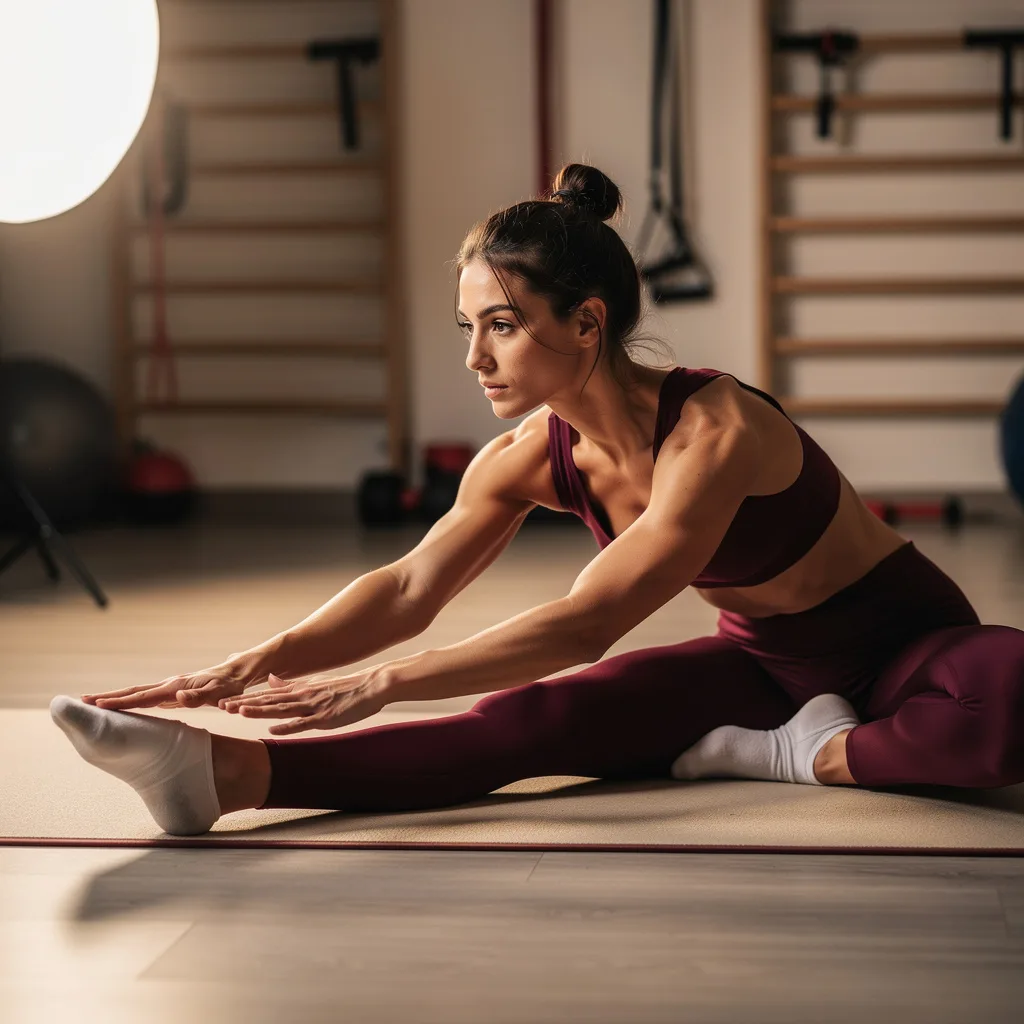
Gymnastics flexibility training is a specialized discipline focused on developing the extreme ranges of motion required for gymnastic skills such as splits, leaps, jumps, backbends, and handstands. It encompasses static, dynamic, and active flexibility methods, along with proprioceptive neuromuscular facilitation (PNF) and strength integration. Core concepts include joint mobility, muscle elasticity, neural adaptation, and the balance between flexibility and stability to support high-impact movements.
Today, gymnastics flexibility training matters beyond competitive gymnastics—it is widely used in dance, cheerleading, martial arts, and general athletic conditioning. Recent shifts emphasize evidence-based stretching protocols that reduce injury risk and improve performance, moving away from outdated “no pain, no gain” approaches. Coaches and therapists now recognize that systematic flexibility work enhances movement quality and longevity, making it a cornerstone of modern athletic development.
Mastering gymnastics flexibility training builds a skill stack that includes precise body awareness, injury prevention strategies, and the ability to design progressive stretching routines. This knowledge benefits gymnastics coaches, physical therapists, personal trainers, and dedicated athletes seeking to unlock higher skill levels. Whether you aim to compete, teach, or simply move better, understanding the science and practice of gymnastics flexibility transforms how you approach training and recovery.
Common Questions About Gymnastics Flexibility Training
Is this gymnastics flexibility training suitable for absolute beginners?
How does this course help improve my splits for gymnastics?
What is the difference between active and passive flexibility in gymnastics?
Why is dynamic stretching preferred before gymnastics practice?
What are the key muscle groups for lower body flexibility in gymnastics?
- Hamstrings: Control pike and straddle positions; essential for forward bends and leg lifts.
- Quadriceps: Crucial for landings, leaps, and maintaining straight legs in skills.
- Calves: Contribute to ankle mobility for jumps and pointed toes.
- Glutes: Support hip extension for backbends and powerful leaps.
How does the three-phase progression model work for splits?
- Phase 1 – Passive Flexibility: Focus on static holds and partner stretching to increase range of motion without active muscle engagement.
- Phase 2 – Active Flexibility: Learn to engage muscles to hold the split position independently, building control and strength within the new range.
- Phase 3 – Dynamic Integration: Apply the split in gymnastics skills like leaps, jumps, and turns, ensuring the flexibility transfers to performance.
Is flexibility purely genetic or can it be trained?
What Will This Course Bring You?
- Analyze the physiological principles of flexibility and their specific application to gymnastics movements.
- Conduct a comprehensive flexibility assessment using standardized tests to identify personal strengths and limitations.
- Apply the principles of safe stretching, including proper warm-up and technique, to prevent injury during flexibility training.
- Design a targeted lower body flexibility routine to improve hamstring, quad, calf, and glute range of motion for gymnastics skills.
- Implement hip mobility drills to enhance the depth and control of splits and leaps.
- Evaluate your current shoulder flexibility and prescribe exercises to increase range of motion for handstands and supports.
- Build a progressive sequence of spinal flexibility exercises to safely achieve a full backbend.
- Design a long-term flexibility program that incorporates periodization and progressive overload for sustained improvement.
Curriculum
12 Units1. Foundations of Flexibility for Gymnastics
1 hour
2. Assessing Your Current Flexibility
1 hour
3. Principles of Safe Stretching
1 hour
4. Lower Body Flexibility: Hamstrings, Quads, Calves, and Glutes
1 hour
5. Hip Flexibility and Mobility for Splits and Leaps
1 hour
6. Upper Body and Shoulder Flexibility
1 hour
7. Spinal Flexibility and Back Bends
1 hour
8. Splits Progression: Front, Side, and Straddle
1 hour
9. Bridge and Backbend Progression
1 hour
10. Active Flexibility and Strength Integration
1 hour
11. PNF and Partner Stretching Techniques
1 hour
12. Creating a Long-Term Flexibility Program
1 hour
Exam – Gymnastics Flexibility Training
20 Questions • 70% Pass • 30 min
Unlock All Units for Free
Create an account, enroll in the course, and start with the first unit right away.
Exam – Gymnastics Flexibility Training
20 Questions • Pass: 70% • 30 min
Course Duration
720
Total Minutes
12
Unit
1
Final Exam
~60
Min / Unit
Gymnastics Flexibility Training Certificate Program
Document Your Skill
Those who pass the 20-question, 30-minute exam with 70% receive the Gymnastics Flexibility Training Certificate.
Stand Out on Your CV
By adding your certificate to your CV, gain a professional reference in job applications and stand out from the crowd.
Career Advantage
With the verification code, employers can check your certificate instantly — a concrete way to show your growth.
CERTIFICATE FEE
At the end of the course, an online exam consisting of 20 questions with a 30-minute time limit is given. The exam appears automatically after you complete the topics. Anyone who scores at least 70 out of 100 on the certificate exam is awarded the Gymnastics Flexibility Training Document (certificate of attendance). You can add the certificate you earn to your CV for job applications in the many sectors listed above, and use it as a reference proving that you took this interactive course.
The Certificate of Achievement you receive with the Gymnastics Flexibility Training course program holds value that proves your personal and professional development in the business world. By adding it to your CV, it can serve as an important reference in your job applications. Moreover, compared with certificates from other private training institutions, Catch Wisdom certificates are offered to our participants at a much more affordable price.
The Gymnastics Flexibility Training course certificate is a document that proves, with a unique verification code, that you completed the course. Employers can instantly check its authenticity with this code, which helps you show your development concretely in your job applications.
For more information, we recommend visiting the Support page.
Certificate in 7 Languages
Earning success certificates from our courses is now more meaningful and global. With certificates available in Turkish, English, German, French, Spanish, Arabic, and Russian, we fully unlock the potential of students worldwide.
Why Certificate in 7 Languages?
-
01
Global Skill Development
Receiving your certificates in 7 different languages strengthens your communication skills as you engage with more people worldwide. It lets you operate more confidently and capably on the international stage.
-
02
International Job Opportunities
Employers may see your certificates in multiple languages as a sign of your ability to seize global opportunities. You can open more doors to new jobs and projects.
-
03
Cultural Richness
The chance to earn certificates in different languages helps you build closer ties with various cultures and broadens your worldview. It enriches your global perspective and deepens cultural understanding.
-
04
Ability to Participate in International Projects
Multilingual certificates give you an edge to work more effectively on international projects. They boost your chances of leadership and participation in diverse projects in the business world.
-
05
Prove Yourself on the Global Stage
Certificates in multiple languages give you the opportunity to present your skills and knowledge worldwide.
Language diversity opens worldwide opportunities. If you want to prove yourself in the international arena, join our online Gymnastics Flexibility Training course program and begin this journey with us.
Frequently Asked Questions (FAQ)
Is this course paid?
How do I join the course?
Can I take the course at my own pace?
How can I get my certificate?
What are the advantages of the certificate?
Boost Your Career
Take a new career step with the Gymnastics Flexibility Training course. Add your certificate to your CV, stand out in job applications, and open the door to new opportunities in the industry.
StartStudent Reviews
No reviews yet
Enroll in this course and be the first to leave a review about your experience with Gymnastics Flexibility Training.
Start