What is Hand Weaving?
Hand Weaving Course
This Hand Weaving certificate program is a comprehensive journey from fiber to finished fabric, designed for absolute beginners and experienced makers alike who want to master the full creative and technical spectrum of hand weaving. You will learn to select and prepare yarns, dress a loom using both direct and indirect warping methods, and execute a wide range of weave structures including plain weave, twill, and lace weaves. The main practical outcome is the ability to independently design, draft, and produce beautiful, structurally sound handwoven textiles—from scarves and table runners to complex multi-shaft patterns—with professional-level finishing techniques.
The program follows a carefully scaffolded progression, beginning with foundational tool use and terminology before advancing through core weave structures, color theory, and design principles. You will build skills across four essential areas: loom mechanics and warping, pattern drafting and reading, weave structure execution, and finishing processes. Lessons balance hands-on technique with creative exploration, moving from rigid heddle weaving to multi-shaft looms so you gain versatility across equipment types. With the growing appreciation for slow fashion, sustainable textiles, and artisanal craftsmanship, this course offers a timely opportunity to develop a meditative, high-demand skill set that bridges traditional craft and contemporary design.
What is Hand Weaving?
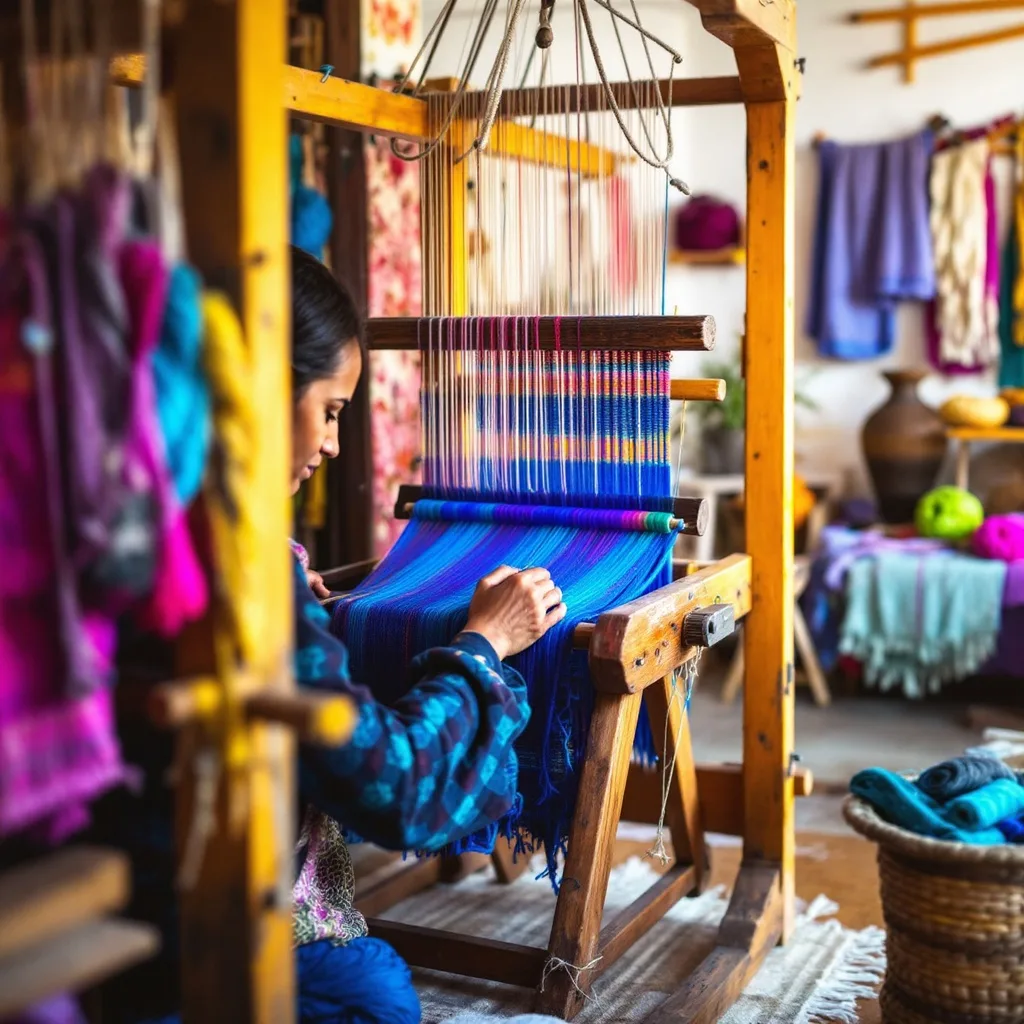
Hand weaving is the ancient craft of interlacing threads or yarns at right angles on a loom to create cloth, but its scope extends far beyond simple over-under patterns. It encompasses a rich vocabulary of structures—plain weave, twill, lace, and countless textured variations—each produced by manipulating the sequence in which warp threads are raised and lowered. Core concepts include understanding sett (thread spacing), tension, and the interplay of fiber, color, and pattern. From rigid heddle looms to multi-shaft floor looms, hand weaving is both a functional skill for producing garments and home goods and a sophisticated medium for artistic expression.
In today’s world, hand weaving holds renewed relevance as part of the broader maker movement and a counterbalance to mass production. It is practiced in fine art studios, sustainable fashion ateliers, and community textile guilds, while also informing industrial textile design through an intimate understanding of structure and material behavior. Recent shifts toward slow fashion, ethical production, and mindfulness have elevated hand weaving from a niche hobby to a respected craft with economic and therapeutic value. Digital tools now complement traditional techniques, allowing weavers to design complex drafts and share patterns globally, yet the tactile, meditative process of working directly with fiber remains irreplaceable.
Mastering hand weaving builds a unique stack of skills: spatial reasoning through reading and writing drafts, material intelligence in fiber selection, color theory in warp and weft interaction, and fine motor precision in loom operation. This knowledge benefits not only those pursuing careers in textile design, fashion, or studio arts, but also educators, therapists, and anyone seeking a deeply satisfying creative practice. The craft cultivates patience and problem-solving, offering a tangible connection to cultural heritage while empowering individuals to produce heirloom-quality pieces that stand apart from disposable consumer culture.
Common Questions About Hand Weaving
Is the hand weaving course suitable for absolute beginners?
Will I get a certificate after finishing the hand weaving course?
What is the difference between direct and indirect warping methods?
- Direct warping: faster, suitable for rigid heddle looms, measures and threads simultaneously.
- Indirect warping: uses a warping board, better for multi-shaft looms, allows even tension across many threads.
How do I read a weaving draft with four quadrants?
Why is reed dent selection important for yarn spacing?
What is the weaving cycle: shed, pick, beat?
Is hand weaving only for experienced textile artists?
What Will This Course Bring You?
- Identify and describe the function of essential hand weaving tools and loom components, using correct terminology.
- Evaluate yarn properties such as fiber content, twist, and weight to select appropriate materials for specific weaving projects.
- Implement direct and indirect warping methods to prepare a loom with accurate tension and alignment.
- Interpret and create weaving drafts to plan and execute pattern structures, including threading, tie-up, and treadling sequences.
- Design and weave twill patterns by manipulating tie-up and treadling sequences to produce diagonal structures.
- Apply principles of color theory and design to create visually cohesive handwoven textiles.
- Apply appropriate finishing techniques, including wet finishing and hemming, to transform woven cloth into a completed fabric.
Curriculum
12 Units1. The Weaver's Toolkit: Looms, Tools, and Terminology
1 hour
2. Yarn Selection and Preparation
1 hour
3. Warping the Loom: Direct and Indirect Methods
1 hour
4. Plain Weave and Its Variations
1 hour
5. Twill Weaves: Creating Diagonal Patterns
1 hour
6. Reading and Writing Weaving Drafts
1 hour
7. Color and Design in Hand Weaving
1 hour
8. Weaving on a Rigid Heddle Loom
1 hour
9. Weaving on Multi-Shaft Looms
1 hour
10. Lace Weaves and Textured Structures
1 hour
11. Finishing Techniques: From Loom to Final Fabric
1 hour
12. Designing Your Own Handwoven Projects
1 hour
Exam – Hand Weaving
20 Questions • 70% Pass • 30 min
Unlock All Units for Free
Create an account, enroll in the course, and start with the first unit right away.
Exam – Hand Weaving
20 Questions • Pass: 70% • 30 min
Course Duration
720
Total Minutes
12
Unit
1
Final Exam
~60
Min / Unit
Hand Weaving Certificate Program
Document Your Skill
Those who pass the 20-question, 30-minute exam with 70% receive the Hand Weaving Certificate.
Stand Out on Your CV
By adding your certificate to your CV, gain a professional reference in job applications and stand out from the crowd.
Career Advantage
Catch Wisdom certificates are recognized by HR departments and increase career opportunities.
CERTIFICATE FEE
At the end of the course, an online exam consisting of 20 questions with a 30-minute time limit is given. The exam appears automatically after you complete the topics. Anyone who scores at least 70 out of 100 on the certificate exam is awarded the Hand Weaving Document (certificate of attendance). You can add the certificate you earn to your CV for job applications in the many sectors listed above, and use it as a reference proving that you took this interactive course.
The Certificate of Achievement you receive with the Hand Weaving course program holds value that proves your personal and professional development in the business world. By adding it to your CV, it can serve as an important reference in your job applications. Moreover, compared with certificates from other private training institutions, Catch Wisdom certificates are offered to our participants at a much more affordable price.
Because HR departments recognize Catch Wisdom as a reputable institution in this field, they value these certificates and may evaluate your job applications favorably. For this reason, a Hand Weaving course certificate from Catch Wisdom can make your applications more attractive and place you in an advantageous position in the business world.
For more information, we recommend visiting the Support page.
Certificate in 7 Languages
Earning success certificates from our courses is now more meaningful and global. With certificates available in Turkish, English, German, French, Spanish, Arabic, and Russian, we fully unlock the potential of students worldwide.
Why Certificate in 7 Languages?
-
01
Global Skill Development
Receiving your certificates in 7 different languages strengthens your communication skills as you engage with more people worldwide. It lets you operate more confidently and capably on the international stage.
-
02
International Job Opportunities
Employers may see your certificates in multiple languages as a sign of your ability to seize global opportunities. You can open more doors to new jobs and projects.
-
03
Cultural Richness
The chance to earn certificates in different languages helps you build closer ties with various cultures and broadens your worldview. It enriches your global perspective and deepens cultural understanding.
-
04
Ability to Participate in International Projects
Multilingual certificates give you an edge to work more effectively on international projects. They boost your chances of leadership and participation in diverse projects in the business world.
-
05
Prove Yourself on the Global Stage
Certificates in multiple languages let you showcase your skills and knowledge worldwide. You can become an internationally recognized professional.
Language diversity opens worldwide opportunities. If you want to prove yourself in the international arena, join our online Hand Weaving course program and begin this journey with us.
Frequently Asked Questions (FAQ)
Is this course paid?
How do I join the course?
Can I take the course at my own pace?
How can I get my certificate?
What are the advantages of the Certified Certificate?
Boost Your Career
Take a new career step with the Hand Weaving course. Add your certificate to your CV, stand out in job applications, and open the door to new opportunities in the industry.
StartStudent Reviews
No reviews yet
Enroll in this course and be the first to leave a review about your experience with Hand Weaving.
Start