What is Heraldry?
Heraldry Certificate Program
The Heraldry certificate program teaches the systematic reading, interpretation, and design of coats of arms, from the anatomy of a shield and the historical development of armory to tinctures, field divisions, blazon, charges, cadency, marshalling, and the full achievement of crest, helm, mantling, and supporters. It is intended for genealogists, historians, archivists, museum and heritage professionals, designers, writers, and family historians who need to work with heraldic material accurately rather than rely on casual visual impressions. The main practical outcome is the ability to identify and describe a coat of arms in correct blazon, assess its structural components, and produce a defensible design brief or research note for a new or inherited armorial project. Learners also examine grants, regulation, and offices of arms so that interpretation is grounded in real institutional practice.
The program is structured as a beginner-friendly progression: it begins with foundations and anatomy, establishes historical context and the rule of tincture, then moves through field divisions, ordinaries, blazon, charges, cadency, and marshalling before addressing crests, regulation, research, and commissioning. Theory is balanced with practical exercises in blazon reading, charge description, structural analysis, and design critique, so that abstract rules become working habits rather than memorized trivia. Across the lessons it builds five core skill areas: heraldic vocabulary, visual-structural analysis, historical contextualization, regulatory awareness, and applied design judgment. This program is worth choosing now because digitized armorials, genealogy platforms, heritage interpretation, and identity-conscious design have made accurate heraldic literacy more visible and more useful, while also making loose symbolic guesswork easier to spot.
What is Heraldry?
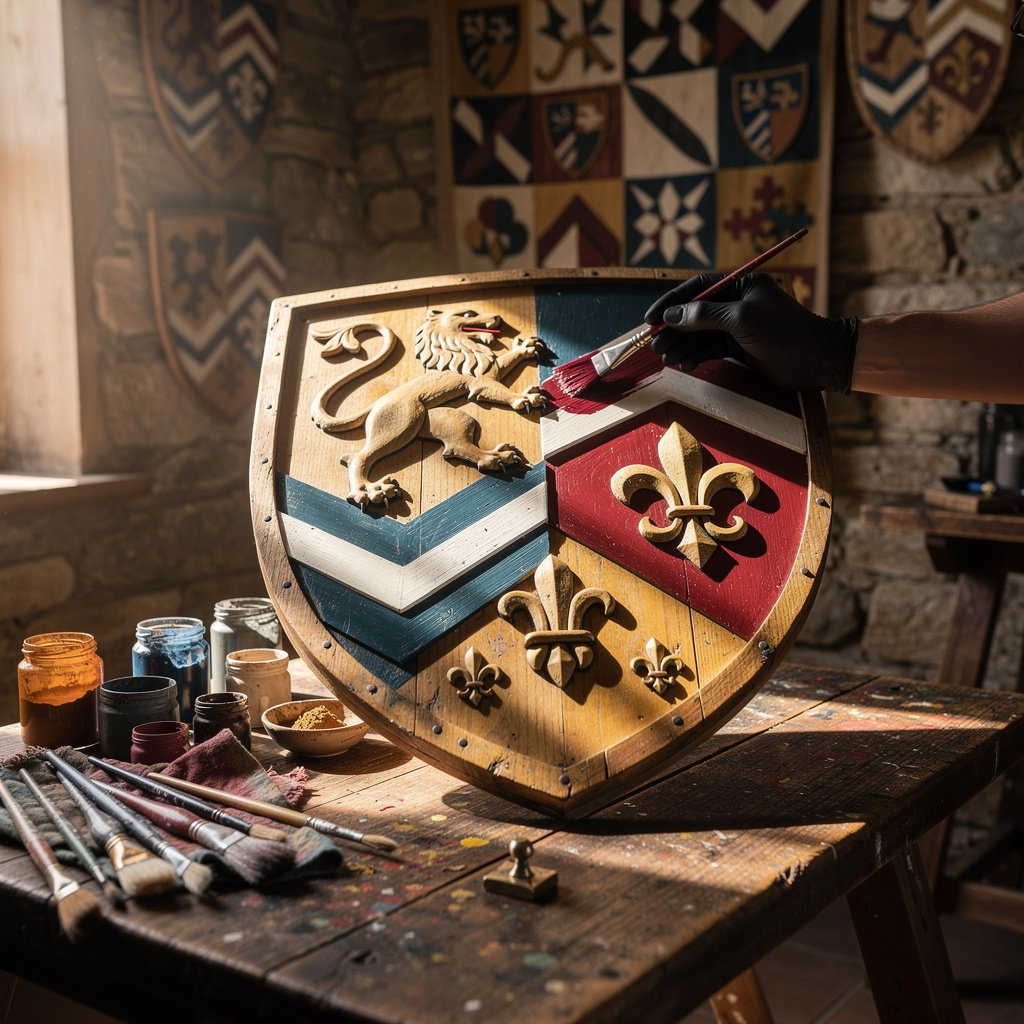
Heraldry is the system of visual identification built around the coat of arms, a design traditionally borne on a shield and often accompanied by a crest, helm, mantling, and supporters. Its scope includes the grammar of tinctures, metals, furs, and the rule of tincture; the geometry of field divisions and ordinaries; the classification and arrangement of charges; and the precise descriptive language of blazon. Core concepts also include cadency and differencing, which distinguish branches within a family, and marshalling, which combines arms through impalement and quartering. Heraldry is therefore both an art of visual composition and a documentary system governed by conventions, records, and offices of arms.
Today heraldry remains active in genealogical research, museum and archival cataloguing, civic ceremony, institutional identity, publishing, and design for families, schools, clubs, and corporate marks. Historians use armorial records to trace kinship, property, and patronage, while heritage bodies and local governments rely on coats of arms as durable symbols of place and authority. Recent shifts toward digitized armorials, open genealogical databases, and online image collections have made heraldic evidence easier to compare but also easier to misattribute, raising the value of disciplined interpretation. At the same time, contemporary branding, game design, and fantasy worldbuilding borrow heraldic conventions, which increases demand for people who can distinguish authentic historical usage from decorative pastiche.
Mastering heraldry builds a distinctive skill stack: close visual analysis, historical reasoning, precise verbal description, design composition, and awareness of legal and institutional protocol. These skills transfer to archival description, exhibition interpretation, genealogical consulting, heritage management, editorial and illustration work, and any design context where symbols must carry meaning without ambiguity. They also support personal research into family arms, allowing enthusiasts to read a grant or armorial entry with more confidence and to approach new commissions with clearer questions. Because heraldry sits between art, law, history, and language, it rewards learners who want a subject that is both concrete in its rules and expansive in its cultural reach.
What Will This Course Bring You?
- Identify the core components of a coat of arms, including shield, helm, crest, mantling, and supporters, using correct heraldic terminology.
- Trace the historical development of heraldry from medieval tournaments and seals to modern regulatory systems, citing key shifts in armorial practice.
- Apply the rule of tincture to evaluate whether proposed arms use metals, colours, and furs with sufficient contrast and heraldic correctness.
- Construct a shield layout by selecting appropriate field divisions and ordinaries that establish a coherent geometric structure for a given armorial design.
- Compose accurate blazons that describe field, tinctures, charges, and arrangement in the conventional sequence and vocabulary of heraldic description.
- Classify charges by type, attitude, and arrangement, then position them correctly on the field according to heraldic conventions.
- Apply cadency marks to distinguish family members and implement impalement or quartering to marshal combined coats of arms correctly.
- Research and design a new coat of arms by consulting grant regulations and offices of arms, selecting crest, helm, mantling, and supporters, and drafting a commission-ready specification.
Curriculum
12 Units1. Foundations and Anatomy of a CoatofArms
1 hour
2. Origins and Historical Development of Heraldry
1 hour
3. Tinctures, Metals, Furs, and the Rule of Tincture
1 hour
4. Field Divisions, Ordinaries, and Geometric Structure
1 hour
5. Blazon: The Language of Arms Description
1 hour
6. Charges: Types, Attitudes, and Arrangement
1 hour
7. Cadency and Differencing for Family Arms
1 hour
8. Marshalling: Impalement, Quartering, and Combined Arms
1 hour
9. Crests, Helms, Mantling, and Supporters
1 hour
10. Grants, Regulation, and Offices of Arms
1 hour
11. Reading and Researching Coats of Arms
1 hour
12. Designing and Commissioning a New Coat of Arms
1 hour
Exam – Heraldry
20 Questions • 70% Pass • 30 min
Unlock All Units for Free
Create an account, enroll in the course, and start with the first unit right away.
Exam – Heraldry
20 Questions • Pass: 70% • 30 min
Course Duration
720
Total Minutes
12
Unit
1
Final Exam
~60
Min / Unit
Heraldry Certificate Program
Document Your Skill
Those who pass the 20-question, 30-minute exam with 70% receive the Heraldry Certificate.
Stand Out on Your CV
By adding your certificate to your CV, gain a professional reference in job applications and stand out from the crowd.
Career Advantage
With the verification code, employers can check your certificate instantly — a concrete way to show your growth.
CERTIFICATE FEE
At the end of the course, an online exam consisting of 20 questions with a 30-minute time limit is given. The exam appears automatically after you complete the topics. Anyone who scores at least 70 out of 100 on the certificate exam is awarded the Heraldry Document (certificate of attendance). You can add the certificate you earn to your CV for job applications in the many sectors listed above, and use it as a reference proving that you took this interactive course.
The Certificate of Achievement you receive with the Heraldry course program holds value that proves your personal and professional development in the business world. By adding it to your CV, it can serve as an important reference in your job applications. Moreover, compared with certificates from other private training institutions, Catch Wisdom certificates are offered to our participants at a much more affordable price.
The Heraldry course certificate is a document that proves, with a unique verification code, that you completed the course. Employers can instantly check its authenticity with this code, which helps you show your development concretely in your job applications.
For more information, we recommend visiting the Support page.
Certificate in 7 Languages
Earning success certificates from our courses is now more meaningful and global. With certificates available in Turkish, English, German, French, Spanish, Arabic, and Russian, we fully unlock the potential of students worldwide.
Why Certificate in 7 Languages?
-
01
Global Skill Development
Receiving your certificates in 7 different languages strengthens your communication skills as you engage with more people worldwide. It lets you operate more confidently and capably on the international stage.
-
02
International Job Opportunities
Employers may see your certificates in multiple languages as a sign of your ability to seize global opportunities. You can open more doors to new jobs and projects.
-
03
Cultural Richness
The chance to earn certificates in different languages helps you build closer ties with various cultures and broadens your worldview. It enriches your global perspective and deepens cultural understanding.
-
04
Ability to Participate in International Projects
Multilingual certificates give you an edge to work more effectively on international projects. They boost your chances of leadership and participation in diverse projects in the business world.
-
05
Prove Yourself on the Global Stage
Certificates in multiple languages give you the opportunity to present your skills and knowledge worldwide.
Language diversity opens worldwide opportunities. If you want to prove yourself in the international arena, join our online Heraldry course program and begin this journey with us.
Frequently Asked Questions (FAQ)
Is this course paid?
How do I join the course?
Can I take the course at my own pace?
How can I get my certificate?
What are the advantages of the certificate?
Boost Your Career
Take a new career step with the Heraldry course. Add your certificate to your CV, stand out in job applications, and open the door to new opportunities in the industry.
StartStudent Reviews
No reviews yet
Enroll in this course and be the first to leave a review about your experience with Heraldry.
Start