What is Home Cheese Making?
Home Cheese Making Training
The Home Cheese Making certificate program teaches you the complete craft of transforming milk into a wide variety of artisan cheeses, from simple fresh cheeses to complex aged varieties. Designed for absolute beginners and passionate home cooks alike, this program provides the hands-on knowledge needed to produce delicious, preservative-free cheese in your own kitchen. By the end of the course, you will confidently make ricotta, mozzarella, brie, cheddar, and blue cheeses, while understanding the science behind each style.
The program follows a beginner-friendly progression, starting with milk science and essential sanitation, then moving through fresh, cultured, stretched, soft-ripened, semi-hard, hard, blue, and washed-rind cheeses. Each lesson balances theory with practical technique, building core skills in curd handling, culturing, pressing, aging, and troubleshooting. With the recent surge in home food crafting and artisanal food movements, this is the perfect time to master a timeless skill that saves money, reduces waste, and impresses friends and family.
What is Home Cheese Making?
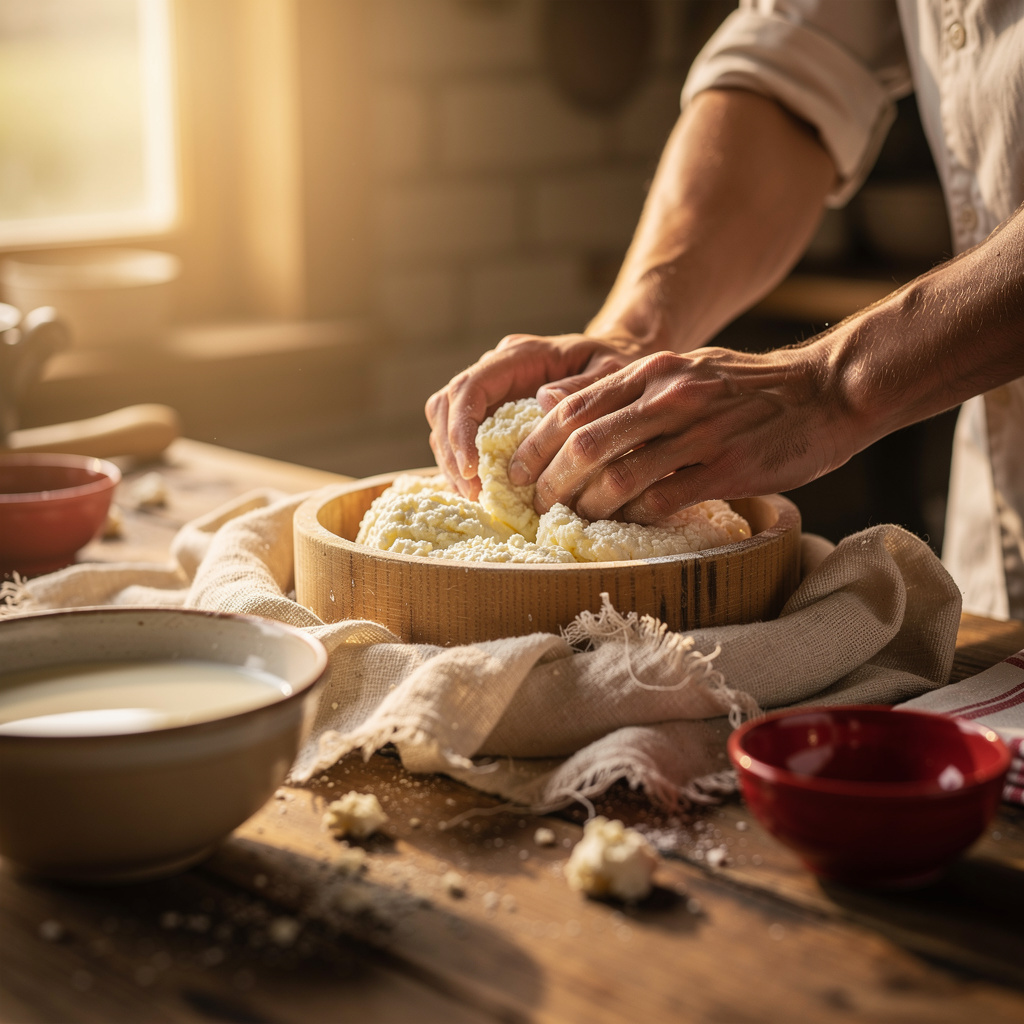
Home cheese making is the art and science of converting milk into cheese using natural cultures, rennet, salt, and time. It encompasses a wide range of techniques, from simple acid-set cheeses like ricotta and paneer to complex aged cheeses that require careful control of temperature, humidity, and microbial activity. Core concepts include understanding milk composition, the role of starter cultures, coagulation methods, curd cutting and cooking, pressing, brining, and aging — each step influencing the final texture, flavor, and shelf life of the cheese.
Today, home cheese making matters more than ever as consumers seek transparency in their food, reduce reliance on industrial dairy products, and embrace sustainable, artisanal practices. It is used by hobbyists, homesteaders, and small-scale producers to create custom flavors, avoid additives, and utilize local milk. Recent shifts toward food sovereignty, farm-to-table movements, and the popularity of DIY fermentation have made cheese making a practical and rewarding skill for anyone interested in self-sufficiency and culinary creativity.
Mastering home cheese making builds a versatile skill stack that includes food microbiology, kitchen chemistry, sensory evaluation, and hands-on craftsmanship. These skills benefit home cooks looking to elevate their cooking, food bloggers and educators seeking authentic content, and aspiring small-batch producers exploring a potential business. Whether for personal enjoyment, gifting, or entrepreneurial ventures, the ability to craft your own cheese opens a world of flavor possibilities and deepens your connection to the food you eat.
Common Questions About Home Cheese Making
Is home cheese making course suitable for complete beginners?
Can I learn to make mozzarella without any prior experience?
What is the difference between ricotta and paneer in cheese making?
- Milk source: Ricotta is traditionally made from whey or whole milk, while paneer uses whole milk only.
- Texture: Ricotta is creamy and grainy; paneer is firm and dense, holding its shape when cooked.
- Use: Ricotta is often spread or used in lasagna; paneer is cubed and fried in curries.
How does the pasta filata process stretch mozzarella curd?
- Acidification: The curd is allowed to reach a specific pH (around 5.2) which dissolves calcium phosphate, making the casein proteins mobile.
- Heating: Curd is cut into strips and heated in hot water (around 80°C) to soften the fat and denature proteins.
- Stretching: The hot curd is pulled and folded repeatedly, aligning the protein fibers into a shiny, stretchable mass.
- Cooling: The stretched curd is shaped and cooled to set the structure.
Why do you wash curds for Gouda and Edam cheeses?
What causes blue veins in Gorgonzola and Stilton?
Do you need a cheese cave to make hard cheeses at home?
What Will This Course Bring You?
- Apply the principles of milk coagulation and acidification to produce fresh ricotta and paneer.
- Design a sanitation protocol for cheese-making equipment to prevent unwanted microbial contamination.
- Evaluate the role of starter cultures and rennet in developing texture and flavor in cultured cheeses like chèvre.
- Demonstrate the stretching technique to produce fresh mozzarella with a smooth, elastic texture.
- Analyze the impact of pressing time and brine concentration on the final moisture and salt content of semi-hard cheeses like Gouda.
- Implement a controlled aging environment to develop the characteristic crystals and sharpness in hard cheeses like Cheddar.
- Assess the effect of piercing and oxygen exposure on the blue veining and flavor development in Gorgonzola-style cheeses.
- Design a personalized cheese recipe by selecting appropriate milk type, culture, and aging conditions based on desired flavor and texture.
Curriculum
12 Units1. The Science of Milk and Cheese
1 hour
2. Essential Equipment and Sanitation
1 hour
3. Simple Fresh Cheeses: Ricotta, Paneer, and Queso Fresco
1 hour
4. Cultured Fresh Cheeses: Chèvre, Fromage Blanc, and Yogurt Cheese
1 hour
5. Stretching and Pasta Filata Cheeses: Mozzarella, Burrata, and Provolone
1 hour
6. Soft-Ripened Cheeses: Camembert and Brie
1 hour
7. Semi-Hard Cheeses: Gouda and Edam
1 hour
8. Hard Cheeses: Cheddar and Parmesan-Style
1 hour
9. Blue Cheeses: Gorgonzola and Stilton
1 hour
10. Washed-Rind Cheeses: Taleggio and Munster
1 hour
11. Troubleshooting and Flavor Development
1 hour
12. Designing Your Own Cheese
1 hour
Exam – Home Cheese Making
20 Questions • 70% Pass • 30 min
Unlock All Units for Free
Create an account, enroll in the course, and start with the first unit right away.
Exam – Home Cheese Making
20 Questions • Pass: 70% • 30 min
Course Duration
720
Total Minutes
12
Unit
1
Final Exam
~60
Min / Unit
Home Cheese Making Certificate Program
Document Your Skill
Those who pass the 20-question, 30-minute exam with 70% receive the Home Cheese Making Certificate.
Stand Out on Your CV
By adding your certificate to your CV, gain a professional reference in job applications and stand out from the crowd.
Career Advantage
With the verification code, employers can check your certificate instantly — a concrete way to show your growth.
CERTIFICATE FEE
At the end of the course, an online exam consisting of 20 questions with a 30-minute time limit is given. The exam appears automatically after you complete the topics. Anyone who scores at least 70 out of 100 on the certificate exam is awarded the Home Cheese Making Document (certificate of attendance). You can add the certificate you earn to your CV for job applications in the many sectors listed above, and use it as a reference proving that you took this interactive course.
The Certificate of Achievement you receive with the Home Cheese Making course program holds value that proves your personal and professional development in the business world. By adding it to your CV, it can serve as an important reference in your job applications. Moreover, compared with certificates from other private training institutions, Catch Wisdom certificates are offered to our participants at a much more affordable price.
The Home Cheese Making course certificate is a document that proves, with a unique verification code, that you completed the course. Employers can instantly check its authenticity with this code, which helps you show your development concretely in your job applications.
For more information, we recommend visiting the Support page.
Certificate in 7 Languages
Earning success certificates from our courses is now more meaningful and global. With certificates available in Turkish, English, German, French, Spanish, Arabic, and Russian, we fully unlock the potential of students worldwide.
Why Certificate in 7 Languages?
-
01
Global Skill Development
Receiving your certificates in 7 different languages strengthens your communication skills as you engage with more people worldwide. It lets you operate more confidently and capably on the international stage.
-
02
International Job Opportunities
Employers may see your certificates in multiple languages as a sign of your ability to seize global opportunities. You can open more doors to new jobs and projects.
-
03
Cultural Richness
The chance to earn certificates in different languages helps you build closer ties with various cultures and broadens your worldview. It enriches your global perspective and deepens cultural understanding.
-
04
Ability to Participate in International Projects
Multilingual certificates give you an edge to work more effectively on international projects. They boost your chances of leadership and participation in diverse projects in the business world.
-
05
Prove Yourself on the Global Stage
Certificates in multiple languages give you the opportunity to present your skills and knowledge worldwide.
Language diversity opens worldwide opportunities. If you want to prove yourself in the international arena, join our online Home Cheese Making course program and begin this journey with us.
Frequently Asked Questions (FAQ)
Is this course paid?
How do I join the course?
Can I take the course at my own pace?
How can I get my certificate?
What are the advantages of the certificate?
Boost Your Career
Take a new career step with the Home Cheese Making course. Add your certificate to your CV, stand out in job applications, and open the door to new opportunities in the industry.
StartStudent Reviews
No reviews yet
Enroll in this course and be the first to leave a review about your experience with Home Cheese Making.
Start