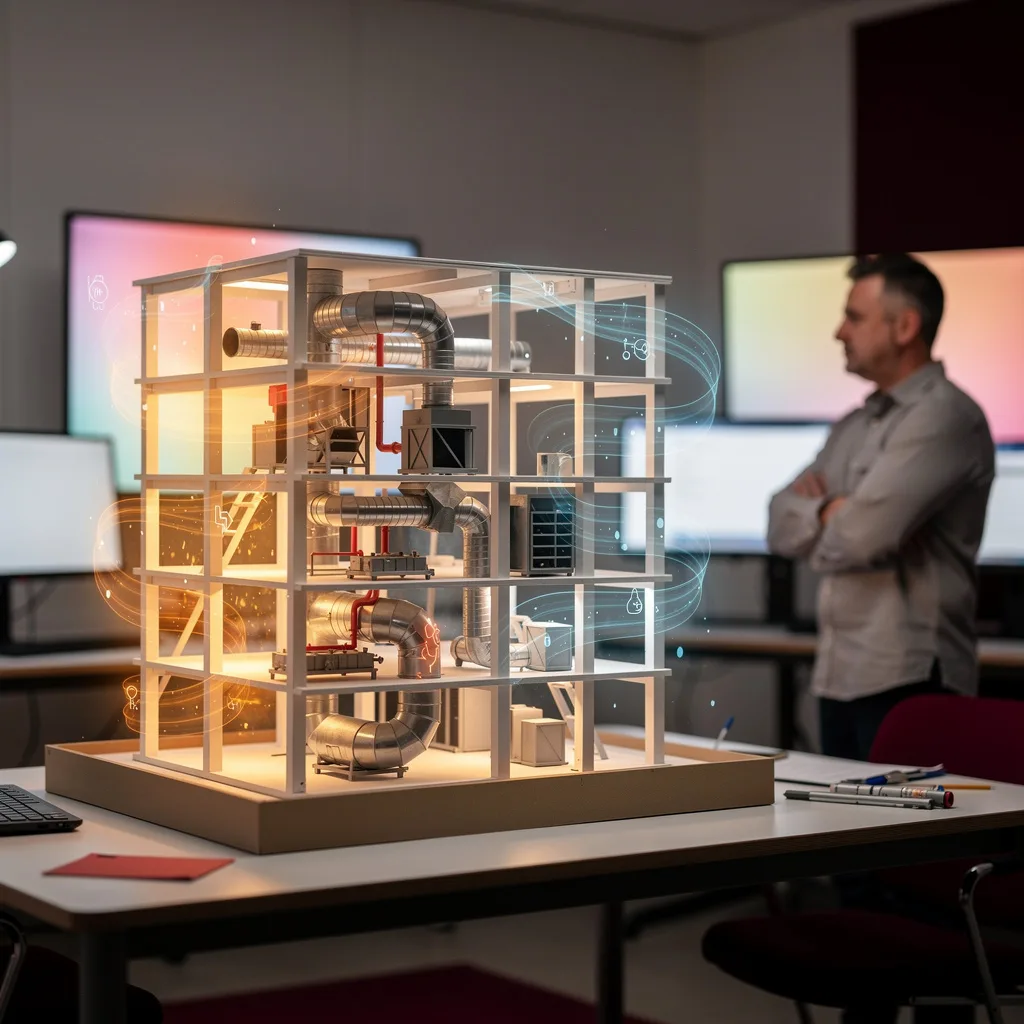
What is HVAC Load Calculation?
HVAC Load Calculation Training
The HVAC Load Calculation certificate program teaches the systematic process of determining heating and cooling loads for residential and light commercial buildings. It is designed for HVAC technicians, engineers, architects, and energy auditors who need to size equipment accurately and comply with industry standards. By the end of the program, participants will be able to perform a complete Manual J load calculation, interpret psychrometric data, and account for duct losses and solar gain.
The program progresses from heat transfer fundamentals and building envelope analysis to infiltration, internal gains, and fenestration effects. It builds four core skill areas: understanding thermal dynamics, applying Manual J methodology, using load calculation software, and performing a final comprehensive project. This training is especially relevant now because energy codes are tightening, and improper sizing leads to comfort complaints, higher utility bills, and equipment failure—making accurate load calculations a critical professional differentiator.
What is HVAC Load Calculation?
HVAC load calculation is the engineering process of quantifying the amount of heat that must be added or removed from a space to maintain desired indoor conditions. It accounts for heat transfer through walls, roofs, windows, and floors; air leakage and ventilation; internal heat gains from occupants, lighting, and appliances; and solar radiation. The core concepts include conduction, convection, radiation, latent and sensible heat, and the psychrometric properties of moist air.
Today, load calculation is more critical than ever due to stricter building codes, high-performance construction, and the rise of heat pumps and variable-speed equipment. It is used in residential design (Manual J), commercial applications (Manual N), and retrofit projects to ensure comfort, efficiency, and durability. Recent shifts toward electrification and net-zero buildings demand precise load analysis to avoid oversizing or undersizing systems.
Mastering load calculation builds a skill stack that includes thermal physics, data collection, software proficiency, and code compliance. This knowledge is essential for HVAC designers, energy auditors, building science consultants, and contractors who want to deliver reliable, cost-effective systems. It also benefits architects and home builders seeking to optimize building envelopes and meet certification programs like ENERGY STAR or Passive House.
Common Questions About HVAC Load Calculation
Is this HVAC load calculation course suitable for beginners with no experience?
Will this certificate help me get a job in HVAC design?
How does Manual J methodology differ from Manual N for commercial loads?
- Scope: Manual J applies to single-family homes and townhouses; Manual N covers commercial buildings like offices and retail spaces.
- Internal loads: Manual N places greater emphasis on internal heat gains from lighting, equipment, and occupancy.
- Methodology: Manual J uses Heat Transfer Multipliers (HTMs); Manual N requires more detailed zone-by-zone analysis.
What is the impact of solar heat gain coefficient on cooling load?
Why is psychrometrics important for HVAC load calculations?
How do you calculate infiltration and ventilation loads accurately?
Is it true that rules of thumb are sufficient for residential HVAC sizing?
What Will This Course Bring You?
- Analyze heat transfer mechanisms to quantify building envelope heat loss and gain.
- Calculate infiltration and ventilation loads using appropriate air change rates.
- Determine internal heat gains from occupants, lighting, and equipment for residential loads.
- Evaluate solar heat gain through fenestration using shading coefficients and factors.
- Apply Manual J methodology to complete load calculation forms for a dwelling.
- Use psychrometric charts to analyze air properties and determine sensible and latent loads.
- Implement load calculation software to perform a complete residential load calculation.
Curriculum
12 Units1. Why Load Calculations Matter
1 hour
2. Heat Transfer Fundamentals for HVAC
1 hour
3. Building Envelope and Construction
1 hour
4. Infiltration and Ventilation Loads
1 hour
5. Internal Heat Gains
1 hour
6. Solar Heat Gain and Fenestration
1 hour
7. Manual J Methodology and Load Calculation Forms
1 hour
8. Psychrometrics and Air Properties
1 hour
9. Duct Losses and System Effects
1 hour
10. Commercial Load Calculations (Manual N Overview)
1 hour
11. Using Load Calculation Software
1 hour
12. Final Project: Complete Load Calculation
1 hour
Exam – HVAC Load Calculation
20 Questions • 70% Pass • 30 min
Unlock All Units for Free
Create an account, enroll in the course, and start with the first unit right away.
Exam – HVAC Load Calculation
20 Questions • Pass: 70% • 30 min
Course Duration
720
Total Minutes
12
Unit
1
Final Exam
~60
Min / Unit
HVAC Load Calculation Certificate Program
Document Your Skill
Those who pass the 20-question, 30-minute exam with 70% receive the HVAC Load Calculation Certificate.
Stand Out on Your CV
By adding your certificate to your CV, gain a professional reference in job applications and stand out from the crowd.
Career Advantage
With the verification code, employers can check your certificate instantly — a concrete way to show your growth.
CERTIFICATE FEE
At the end of the course, an online exam consisting of 20 questions with a 30-minute time limit is given. The exam appears automatically after you complete the topics. Anyone who scores at least 70 out of 100 on the certificate exam is awarded the HVAC Load Calculation Document (certificate of attendance). You can add the certificate you earn to your CV for job applications in the many sectors listed above, and use it as a reference proving that you took this interactive course.
The Certificate of Achievement you receive with the HVAC Load Calculation course program holds value that proves your personal and professional development in the business world. By adding it to your CV, it can serve as an important reference in your job applications. Moreover, compared with certificates from other private training institutions, Catch Wisdom certificates are offered to our participants at a much more affordable price.
The HVAC Load Calculation course certificate is a document that proves, with a unique verification code, that you completed the course. Employers can instantly check its authenticity with this code, which helps you show your development concretely in your job applications.
For more information, we recommend visiting the Support page.
Certificate in 7 Languages
Earning success certificates from our courses is now more meaningful and global. With certificates available in Turkish, English, German, French, Spanish, Arabic, and Russian, we fully unlock the potential of students worldwide.
Why Certificate in 7 Languages?
-
01
Global Skill Development
Receiving your certificates in 7 different languages strengthens your communication skills as you engage with more people worldwide. It lets you operate more confidently and capably on the international stage.
-
02
International Job Opportunities
Employers may see your certificates in multiple languages as a sign of your ability to seize global opportunities. You can open more doors to new jobs and projects.
-
03
Cultural Richness
The chance to earn certificates in different languages helps you build closer ties with various cultures and broadens your worldview. It enriches your global perspective and deepens cultural understanding.
-
04
Ability to Participate in International Projects
Multilingual certificates give you an edge to work more effectively on international projects. They boost your chances of leadership and participation in diverse projects in the business world.
-
05
Prove Yourself on the Global Stage
Certificates in multiple languages give you the opportunity to present your skills and knowledge worldwide.
Language diversity opens worldwide opportunities. If you want to prove yourself in the international arena, join our online HVAC Load Calculation course program and begin this journey with us.
Frequently Asked Questions (FAQ)
Is this course paid?
How do I join the course?
Can I take the course at my own pace?
How can I get my certificate?
What are the advantages of the certificate?
Boost Your Career
Take a new career step with the HVAC Load Calculation course. Add your certificate to your CV, stand out in job applications, and open the door to new opportunities in the industry.
StartStudent Reviews
No reviews yet
Enroll in this course and be the first to leave a review about your experience with HVAC Load Calculation.
Start