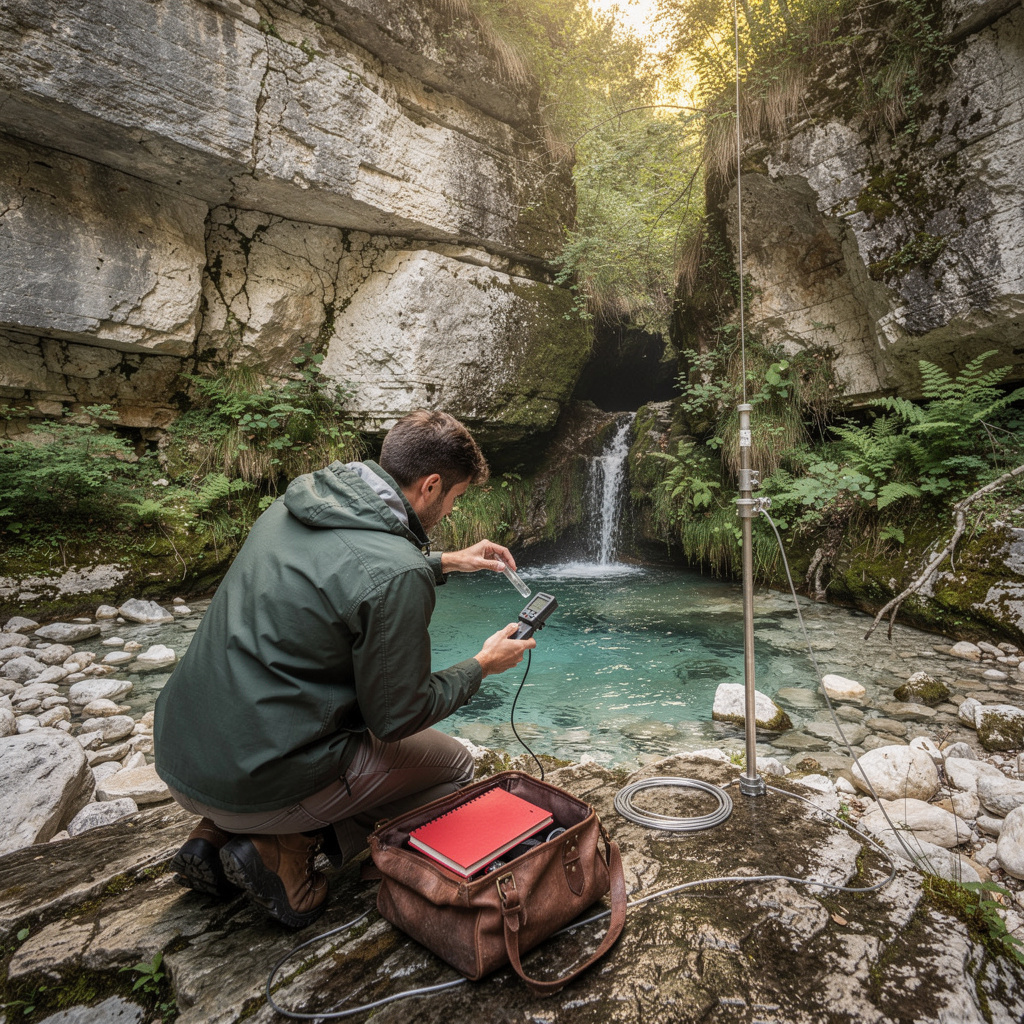
What is Hydrogeology Fundamentals?
Hydrogeology Fundamentals Training Program
Hydrogeology Fundamentals certificate program introduces the scientific principles and practical methods used to understand groundwater occurrence, movement, storage, chemistry, and management. It is designed for early-career geoscientists, environmental engineers, water-resource planners, field technicians, and policy professionals who need a rigorous foundation in subsurface water systems. The curriculum moves from the role of groundwater in the hydrologic cycle and aquifer properties through Darcy’s law, flow nets, well hydraulics, pumping-test analysis, recharge and discharge budgets, groundwater chemistry, contaminant transport, modeling concepts, remediation, and sustainable management. The main practical outcome is the ability to interpret hydrogeologic data and communicate defensible groundwater assessments for planning, permitting, investigation, and protection decisions.
The program is structured as a beginner-friendly progression: it starts with physical concepts and geological controls, builds quantitative skills step by step, and then applies them to wells, budgets, contamination, modeling, and management. Theory is balanced with practice through worked calculations, field-style problem interpretation, pumping-test reasoning, flow-net reading, and scenario-based groundwater quality and remediation discussions. Across the sequence, learners develop five core skill areas: hydrogeologic characterization, groundwater flow analysis, well and aquifer testing, groundwater quality and contaminant assessment, and modeling-informed sustainable management. This program is relevant now because communities, industries, and regulators face intensifying pressure on groundwater from scarcity, contamination, climate variability, and competing land and water uses.
What is Hydrogeology Fundamentals?
Hydrogeology is the study of groundwater as a geological and hydrological system: where it occurs, how it moves through porous and fractured media, how it is stored and released, and how its chemistry evolves along flow paths. Its scope links geology, hydrology, physics, chemistry, and engineering, with core concepts such as porosity, permeability, hydraulic head, hydraulic gradient, aquifer type, recharge, discharge, and Darcy’s law. Hydrogeologists also examine flow equations and flow nets, well hydraulics and pumping tests, groundwater budgets, water-quality controls, contaminant transport, and the conceptual foundations of numerical modeling. The field therefore combines descriptive earth science with quantitative analysis and practical problem-solving.
Groundwater matters today because it supplies drinking water, irrigation, industry, and ecosystem baseflow in many regions, while aquifers are increasingly stressed by overabstraction, drought, land-use change, and contamination. Real-world applications range from municipal wellfield design and source-water protection to mining dewatering, construction groundwater control, agricultural water management, remediation of contaminated sites, and climate-resilience planning. Recent shifts include greater use of numerical models and data-driven monitoring, managed aquifer recharge, contaminant fate-and-transport assessment, and policies that treat groundwater as a connected, finite, and shared resource. These developments make hydrogeologic literacy essential for avoiding depletion, protecting water quality, and resolving conflicts among water users.
Mastering the subject builds a skill stack that connects geological interpretation with quantitative flow analysis, well-test evaluation, geochemical reasoning, contaminant assessment, model conceptualization, and management judgment. These skills are used in environmental consulting, water utilities, regulatory agencies, mining and energy projects, construction, agriculture, NGOs, and academic research, where professionals must diagnose subsurface conditions and justify decisions under uncertainty. The value of hydrogeology lies in integrating field evidence, analytical calculations, and policy constraints into defensible groundwater strategies. That integrated perspective supports both professional practice and informed personal engagement with water issues.
What Will This Course Bring You?
- Apply Darcy's law to calculate groundwater flow rates and hydraulic gradients from field measurements.
- Analyze porosity, permeability, and aquifer properties to classify geologic materials and estimate storage and transmission capacity.
- Evaluate pumping test data using well hydraulics methods to estimate aquifer transmissivity, storativity, and hydraulic conductivity.
- Construct groundwater budgets that quantify recharge, discharge, and storage changes for a specified aquifer system.
- Interpret groundwater chemistry data to assess water quality suitability and identify likely geochemical or contamination sources.
- Analyze contaminant transport processes to predict plume movement and evaluate groundwater contamination risks at a site.
- Design a conceptual groundwater model and select appropriate boundary conditions for simulating flow in a representative aquifer.
- Evaluate remediation and aquifer protection strategies to recommend sustainable groundwater management actions for a prescribed hydrogeologic setting.
Curriculum
12 Units1. The Role of Groundwater in the Hydrologic Cycle
1 hour
2. Porosity, Permeability, and Aquifer Properties
1 hour
3. Aquifer Types and Geological Controls
1 hour
4. Hydraulic Head, Gradient, and Darcy's Law
1 hour
5. Groundwater Flow Equations and Flow Nets
1 hour
6. Well Hydraulics and Pumping Test Analysis
1 hour
7. Recharge, Discharge, and Groundwater Budgets
1 hour
8. Groundwater Chemistry and Water Quality
1 hour
9. Contaminant Transport and Groundwater Contamination
1 hour
10. Groundwater Modeling Concepts and Applications
1 hour
11. Groundwater Remediation and Aquifer Protection
1 hour
12. Sustainable Groundwater Management and Policy
1 hour
Exam – Hydrogeology Fundamentals
20 Questions • 70% Pass • 30 min
Unlock All Units for Free
Create an account, enroll in the course, and start with the first unit right away.
Exam – Hydrogeology Fundamentals
20 Questions • Pass: 70% • 30 min
Course Duration
720
Total Minutes
12
Unit
1
Final Exam
~60
Min / Unit
Hydrogeology Fundamentals Certificate Program
Document Your Skill
Those who pass the 20-question, 30-minute exam with 70% receive the Hydrogeology Fundamentals Certificate.
Stand Out on Your CV
By adding your certificate to your CV, gain a professional reference in job applications and stand out from the crowd.
Career Advantage
With the verification code, employers can check your certificate instantly — a concrete way to show your growth.
CERTIFICATE FEE
At the end of the course, an online exam consisting of 20 questions with a 30-minute time limit is given. The exam appears automatically after you complete the topics. Anyone who scores at least 70 out of 100 on the certificate exam is awarded the Hydrogeology Fundamentals Document (certificate of attendance). You can add the certificate you earn to your CV for job applications in the many sectors listed above, and use it as a reference proving that you took this interactive course.
The Certificate of Achievement you receive with the Hydrogeology Fundamentals course program holds value that proves your personal and professional development in the business world. By adding it to your CV, it can serve as an important reference in your job applications. Moreover, compared with certificates from other private training institutions, Catch Wisdom certificates are offered to our participants at a much more affordable price.
The Hydrogeology Fundamentals course certificate is a document that proves, with a unique verification code, that you completed the course. Employers can instantly check its authenticity with this code, which helps you show your development concretely in your job applications.
For more information, we recommend visiting the Support page.
Certificate in 7 Languages
Earning success certificates from our courses is now more meaningful and global. With certificates available in Turkish, English, German, French, Spanish, Arabic, and Russian, we fully unlock the potential of students worldwide.
Why Certificate in 7 Languages?
-
01
Global Skill Development
Receiving your certificates in 7 different languages strengthens your communication skills as you engage with more people worldwide. It lets you operate more confidently and capably on the international stage.
-
02
International Job Opportunities
Employers may see your certificates in multiple languages as a sign of your ability to seize global opportunities. You can open more doors to new jobs and projects.
-
03
Cultural Richness
The chance to earn certificates in different languages helps you build closer ties with various cultures and broadens your worldview. It enriches your global perspective and deepens cultural understanding.
-
04
Ability to Participate in International Projects
Multilingual certificates give you an edge to work more effectively on international projects. They boost your chances of leadership and participation in diverse projects in the business world.
-
05
Prove Yourself on the Global Stage
Certificates in multiple languages give you the opportunity to present your skills and knowledge worldwide.
Language diversity opens worldwide opportunities. If you want to prove yourself in the international arena, join our online Hydrogeology Fundamentals course program and begin this journey with us.
Frequently Asked Questions (FAQ)
Is this course paid?
How do I join the course?
Can I take the course at my own pace?
How can I get my certificate?
What are the advantages of the certificate?
Boost Your Career
Take a new career step with the Hydrogeology Fundamentals course. Add your certificate to your CV, stand out in job applications, and open the door to new opportunities in the industry.
StartStudent Reviews
No reviews yet
Enroll in this course and be the first to leave a review about your experience with Hydrogeology Fundamentals.
Start