What is Hydroponic Green Fodder Production?
Hydroponic Green Fodder Production Certificate Program
Hydroponic Green Fodder Production certificate program equips learners with the practical and technical skills to grow reliable, high-quality green fodder in soilless tray systems. The curriculum covers seed selection and quality testing, germination biology, production system types and tray design, site layout and infrastructure planning, water quality and irrigation management, and environmental control for temperature, humidity, light, and airflow. It also addresses sowing and production scheduling, crop monitoring and harvest timing, mold and pest prevention, post-harvest handling, feed use, and the economics of scaling up. This program is designed for livestock producers, agripreneurs, farm managers, extension officers, and urban agriculture practitioners who want a dependable, low-water fodder supply.
The program follows a beginner-friendly progression that starts with hydroponic green fodder production fundamentals and builds toward troubleshooting and scale-up decisions. Theory is paired with practical routines across five core skill areas: seed and germination management, system and infrastructure design, water and climate control, production scheduling and monitoring, and harvest-to-feed operations with economic analysis. Learners move from understanding fodder growth biology to planning tray layouts, managing irrigation and airflow, and timing harvests for consistent feed quality. This program is timely because feed costs, water scarcity, and land constraints are pushing producers toward more resource-efficient fodder solutions that can be integrated into existing livestock operations.
What is Hydroponic Green Fodder Production?
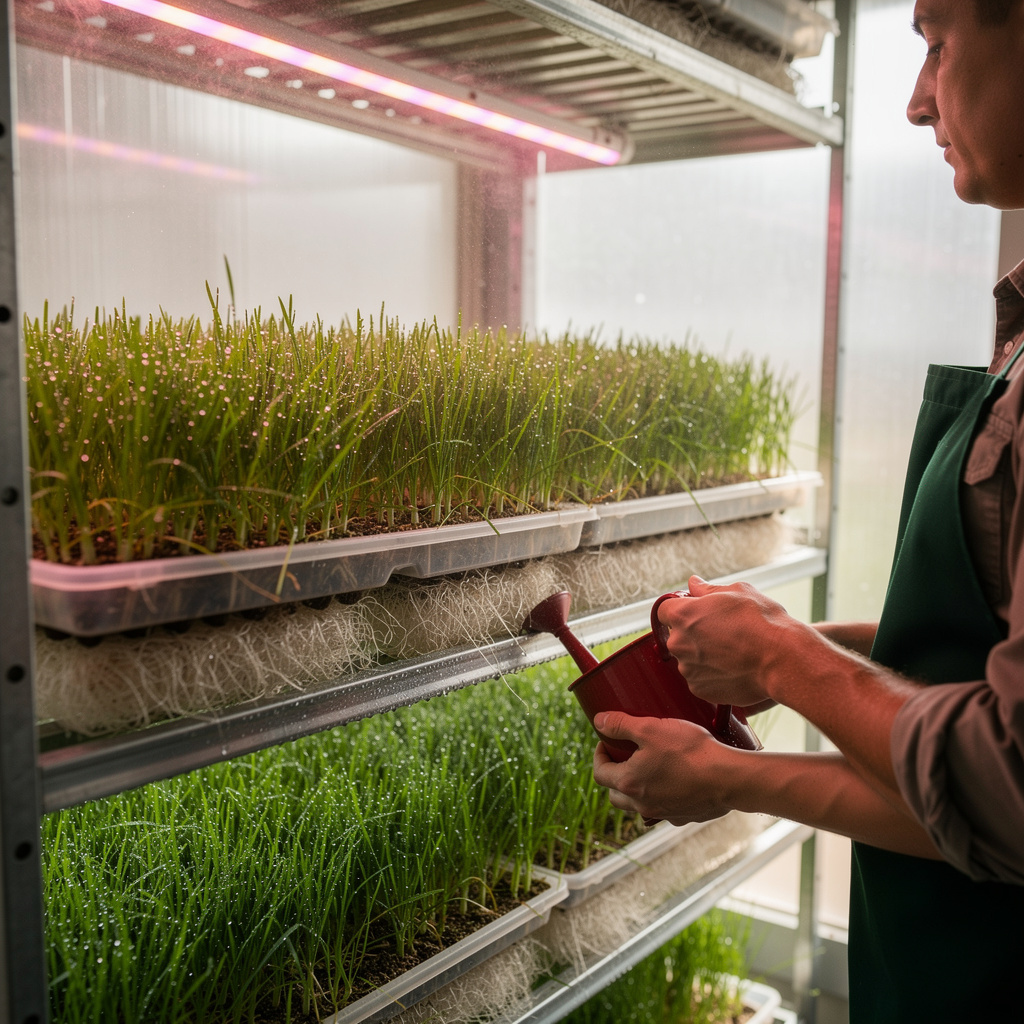
Hydroponic green fodder production is the practice of growing cereal grains such as barley, wheat, oats, or maize in shallow trays without soil, using water and a controlled environment to produce a dense mat of sprouted green feed within a short cycle. Its core concepts include seed germination biology, soilless growing media and tray systems, irrigation and nutrient delivery, environmental control for temperature, humidity, light, and airflow, and harvest timing based on growth stage. The subject encompasses seed germination and quality assessment, soilless tray systems, irrigation and nutrient delivery, environmental control, crop monitoring, and harvest and feed handling. It also incorporates economic analysis and troubleshooting because successful fodder production depends on consistent output and cost control.
Hydroponic green fodder matters today because livestock producers face volatile feed prices, limited arable land, and increasing pressure to use water efficiently. The method can produce fresh fodder in days rather than months, making it relevant for dairy, poultry, and small ruminant operations, as well as for urban and peri-urban farms. Recent shifts toward precision environmental control, automated irrigation, and data-informed scheduling are making hydroponic fodder systems more reliable and scalable. It is also used in research and extension contexts to demonstrate resource-efficient livestock feed production.
Mastering this subject builds a skill stack that combines seed quality assessment, system design, water and climate management, production scheduling, crop health monitoring, and economic evaluation. These skills are valuable for farm owners and managers who want to reduce dependence on purchased feed, for agribusiness entrepreneurs developing fodder enterprises, and for consultants and extension workers advising livestock producers. The same knowledge supports personal or community-scale food and feed projects where land and water are limited. Professionals who understand the full production chain—from seed testing to feed use—can make better decisions about system investment, operational reliability, and scale-up.
What Will This Course Bring You?
- Explain hydroponic green fodder production fundamentals by comparing it with conventional fodder systems and identifying key growth inputs and operational constraints.
- Analyze seed germination and fodder growth biology to predict how seed quality, moisture, and temperature affect uniform sprout development in trays.
- Evaluate seed sourcing and quality-testing methods by selecting viable seed lots that meet germination rate, purity, and contamination criteria for fodder production.
- Design a tray-based hydroponic fodder production system and site layout by specifying tray dimensions, shelving, drainage, and workflow zones for target daily output.
- Apply water quality, irrigation, and nutrient management practices by testing water parameters and adjusting delivery schedules to maintain consistent fodder growth.
- Implement temperature, humidity, light, and airflow controls by calibrating environmental settings to reduce mold, pest, and disease risk in fodder trays.
- Create a production schedule that sequences sowing, tray loading, monitoring, and harvest timing to maintain continuous fodder output and meet feed demand.
- Evaluate harvesting, post-harvest handling, feed-use, and basic economic indicators to troubleshoot losses and plan responsible scale-up of fodder production.
Curriculum
12 Units1. Hydroponic Green Fodder Production Fundamentals
1 hour
2. Seed Germination and Fodder Growth Biology
1 hour
3. Seed Selection, Sourcing, and Quality Testing
1 hour
4. Production System Types and Tray Design
1 hour
5. Site Layout and Infrastructure Planning
1 hour
6. Water Quality, Irrigation, and Nutrient Management
1 hour
7. Temperature, Humidity, Light, and Airflow Control
1 hour
8. Sowing, Tray Loading, and Production Scheduling
1 hour
9. Crop Monitoring, Growth Stages, and Harvest Timing
1 hour
10. Mold, Pest, and Disease Prevention
1 hour
11. Harvesting, Post-Harvest Handling, and Feed Use
1 hour
12. Economics, Troubleshooting, and Scale-Up
1 hour
Exam – Hydroponic Green Fodder Production
20 Questions • 70% Pass • 30 min
Unlock All Units for Free
Create an account, enroll in the course, and start with the first unit right away.
Exam – Hydroponic Green Fodder Production
20 Questions • Pass: 70% • 30 min
Course Duration
720
Total Minutes
12
Unit
1
Final Exam
~60
Min / Unit
Hydroponic Green Fodder Production Certificate Program
Document Your Skill
Those who pass the 20-question, 30-minute exam with 70% receive the Hydroponic Green Fodder Production Certificate.
Stand Out on Your CV
By adding your certificate to your CV, gain a professional reference in job applications and stand out from the crowd.
Career Advantage
With the verification code, employers can check your certificate instantly — a concrete way to show your growth.
CERTIFICATE FEE
At the end of the course, an online exam consisting of 20 questions with a 30-minute time limit is given. The exam appears automatically after you complete the topics. Anyone who scores at least 70 out of 100 on the certificate exam is awarded the Hydroponic Green Fodder Production Document (certificate of attendance). You can add the certificate you earn to your CV for job applications in the many sectors listed above, and use it as a reference proving that you took this interactive course.
The Certificate of Achievement you receive with the Hydroponic Green Fodder Production course program holds value that proves your personal and professional development in the business world. By adding it to your CV, it can serve as an important reference in your job applications. Moreover, compared with certificates from other private training institutions, Catch Wisdom certificates are offered to our participants at a much more affordable price.
The Hydroponic Green Fodder Production course certificate is a document that proves, with a unique verification code, that you completed the course. Employers can instantly check its authenticity with this code, which helps you show your development concretely in your job applications.
For more information, we recommend visiting the Support page.
Certificate in 7 Languages
Earning success certificates from our courses is now more meaningful and global. With certificates available in Turkish, English, German, French, Spanish, Arabic, and Russian, we fully unlock the potential of students worldwide.
Why Certificate in 7 Languages?
-
01
Global Skill Development
Receiving your certificates in 7 different languages strengthens your communication skills as you engage with more people worldwide. It lets you operate more confidently and capably on the international stage.
-
02
International Job Opportunities
Employers may see your certificates in multiple languages as a sign of your ability to seize global opportunities. You can open more doors to new jobs and projects.
-
03
Cultural Richness
The chance to earn certificates in different languages helps you build closer ties with various cultures and broadens your worldview. It enriches your global perspective and deepens cultural understanding.
-
04
Ability to Participate in International Projects
Multilingual certificates give you an edge to work more effectively on international projects. They boost your chances of leadership and participation in diverse projects in the business world.
-
05
Prove Yourself on the Global Stage
Certificates in multiple languages give you the opportunity to present your skills and knowledge worldwide.
Language diversity opens worldwide opportunities. If you want to prove yourself in the international arena, join our online Hydroponic Green Fodder Production course program and begin this journey with us.
Frequently Asked Questions (FAQ)
Is this course paid?
How do I join the course?
Can I take the course at my own pace?
How can I get my certificate?
What are the advantages of the certificate?
Boost Your Career
Take a new career step with the Hydroponic Green Fodder Production course. Add your certificate to your CV, stand out in job applications, and open the door to new opportunities in the industry.
StartStudent Reviews
No reviews yet
Enroll in this course and be the first to leave a review about your experience with Hydroponic Green Fodder Production.
Start