What is Infrared Thermography?
Infrared Thermography Training
Infrared Thermography certificate program provides a comprehensive grounding in the science, technology, and practical application of thermal imaging for diagnostic inspections. It is designed for electrical and mechanical technicians, building inspectors, energy auditors, maintenance engineers, safety and quality professionals, and anyone responsible for detecting hidden faults before they cause failures. Participants examine thermal physics and heat transfer, infrared camera specifications, radiometric calibration, and the critical effects of emissivity, reflectivity, and material properties on temperature measurement. The main practical outcome is the ability to plan and execute reliable inspections, interpret thermal images with confidence, and produce standards-based reports that support maintenance, safety, and energy decisions.
The program progresses in a beginner-friendly sequence, moving from foundations of infrared thermography and thermal physics through camera technology, calibration, and material effects before advancing to image acquisition, analysis, and application-specific inspections. It balances theory with practice so that learners understand why a thermal pattern appears and how to adjust settings, control environmental conditions, and avoid common measurement errors. Across the lessons, the curriculum builds five core skill areas: thermal science and camera operation; radiometric measurement and material-aware interpretation; disciplined image acquisition and environmental control; diagnostic image analysis; and application-specific inspection, reporting, and program implementation. This structure makes the program relevant now, as organizations increasingly rely on thermography for predictive maintenance, electrical safety, building envelope diagnostics, and energy efficiency, and as standards and reporting expectations continue to mature.
What is Infrared Thermography?
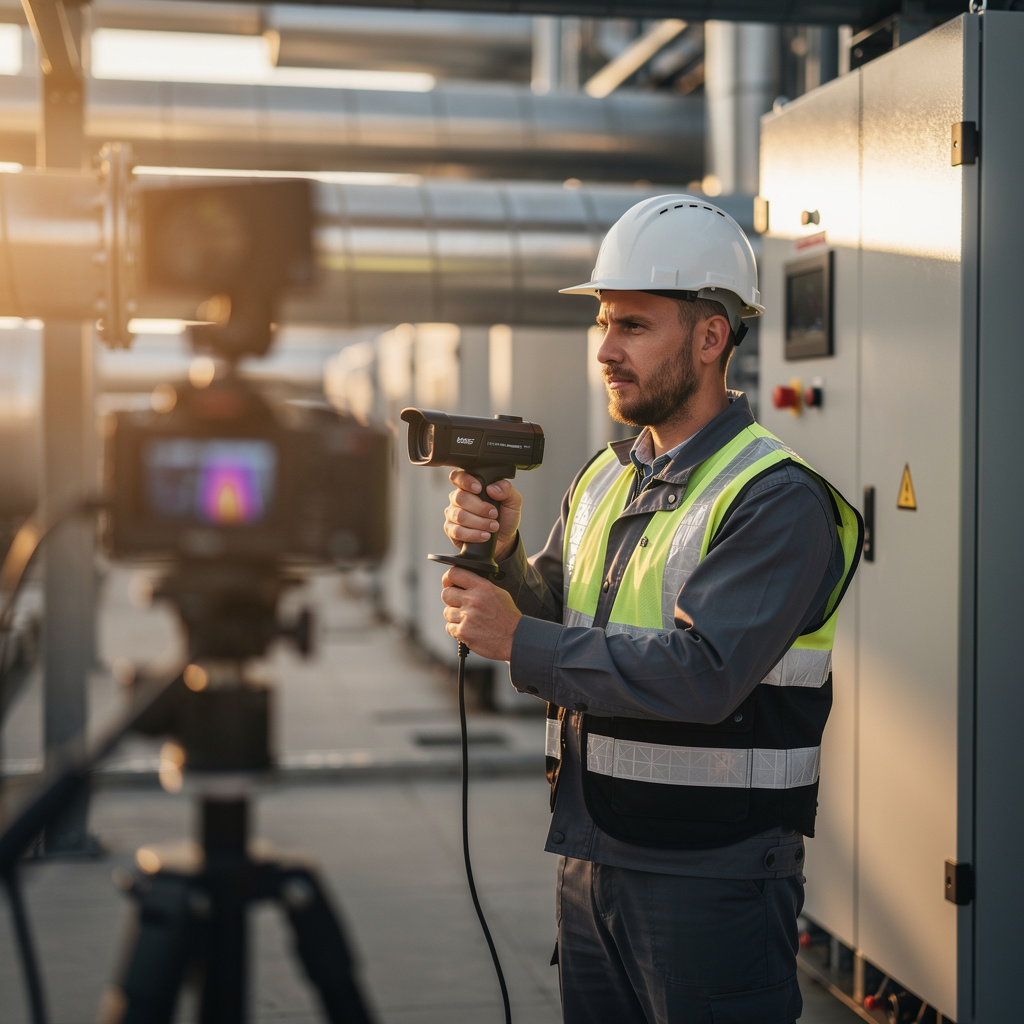
Infrared thermography is a non-contact diagnostic technique that detects infrared radiation emitted by objects and converts it into thermal images or temperature maps, revealing differences that are invisible to the naked eye. Its scope spans thermal physics and heat transfer, radiometric calibration, camera technology and specifications, and the material-dependent effects of emissivity and reflectivity on apparent temperature. Core concepts include thermal patterns and temperature differentials, radiometric measurement uncertainty, spatial and thermal resolution, environmental influences such as solar loading and wind, and the systematic interpretation of image features in context. The subject also encompasses application domains from electrical and mechanical systems to building envelopes and moisture detection, always grounded in recognized standards and safe inspection practices.
Infrared thermography matters today because it supports predictive maintenance, electrical safety, energy auditing, building diagnostics, and industrial process monitoring without interrupting operations or requiring contact with live equipment. Recent shifts include lower-cost and higher-resolution cameras, drone-mounted and automated thermal imaging systems, AI-assisted image analysis, and stricter standards for calibration, reporting, and inspector competence. In real life, it is used to find loose or overloaded electrical connections, mechanical friction and misalignment, missing or degraded insulation, air leakage, moisture intrusion, and abnormal process temperatures. As energy costs, reliability expectations, and safety regulations rise, thermal imaging has become a mainstream diagnostic tool across industry, facilities management, construction, and applied research.
Mastering infrared thermography builds a distinctive skill stack: thermal science literacy, camera and radiometric proficiency, material-aware interpretation, disciplined inspection methodology, standards-compliant reporting, and the ability to implement or improve a thermography program. These skills benefit professional contexts such as electrical and mechanical maintenance, building performance and energy management, manufacturing quality assurance, safety inspection, and facilities operations. They also support personal contexts, including home energy auditing, equipment troubleshooting, and making informed decisions about repairs, upgrades, or insurance claims. The subject ultimately bridges physics, instrumentation, and practical diagnostics, making it valuable wherever temperature patterns carry meaningful information about condition, performance, or safety.
What Will This Course Bring You?
- Apply foundational thermal physics and heat-transfer principles to explain how temperature differences produce interpretable infrared signatures in real inspection scenarios.
- Evaluate infrared camera specifications, detector characteristics, and lens options to select equipment appropriate for specific thermography inspection tasks and environmental conditions.
- Perform radiometric calibration and emissivity correction procedures to convert thermal image data into reliable temperature measurements across varied materials.
- Design image acquisition plans that control focus, span, palette, environmental load, and viewing angle for repeatable infrared inspections.
- Analyze thermal images and interpret patterns, anomalies, and reflections to distinguish genuine faults from artifacts in electrical and mechanical systems.
- Conduct building envelope and moisture inspections using infrared techniques to identify insulation defects, air leakage, and water intrusion indicators.
- Apply relevant thermography standards, safety practices, and reporting requirements to document findings and communicate actionable recommendations.
- Implement an infrared thermography program by defining inspection procedures, qualification pathways, and advanced application priorities for organizational use.
Curriculum
12 Units1. Foundations of Infrared Thermography
1 hour
2. Thermal Physics and Heat Transfer
1 hour
3. Infrared Camera Technology and Specifications
1 hour
4. Radiometric Calibration and Temperature Measurement
1 hour
5. Emissivity, Reflectivity, and Material Effects
1 hour
6. Image Acquisition, Settings, and Environmental Controls
1 hour
7. Image Analysis and Interpretation
1 hour
8. Electrical Systems Inspection
1 hour
9. Mechanical and Process Equipment Inspection
1 hour
10. Building Envelope and Moisture Inspection
1 hour
11. Standards, Safety, and Reporting
1 hour
12. Program Implementation and Advanced Applications
1 hour
Exam – Infrared Thermography
20 Questions • 70% Pass • 30 min
Unlock All Units for Free
Create an account, enroll in the course, and start with the first unit right away.
Exam – Infrared Thermography
20 Questions • Pass: 70% • 30 min
Course Duration
720
Total Minutes
12
Unit
1
Final Exam
~60
Min / Unit
Infrared Thermography Certificate Program
Document Your Skill
Those who pass the 20-question, 30-minute exam with 70% receive the Infrared Thermography Certificate.
Stand Out on Your CV
By adding your certificate to your CV, gain a professional reference in job applications and stand out from the crowd.
Career Advantage
With the verification code, employers can check your certificate instantly — a concrete way to show your growth.
CERTIFICATE FEE
At the end of the course, an online exam consisting of 20 questions with a 30-minute time limit is given. The exam appears automatically after you complete the topics. Anyone who scores at least 70 out of 100 on the certificate exam is awarded the Infrared Thermography Document (certificate of attendance). You can add the certificate you earn to your CV for job applications in the many sectors listed above, and use it as a reference proving that you took this interactive course.
The Certificate of Achievement you receive with the Infrared Thermography course program holds value that proves your personal and professional development in the business world. By adding it to your CV, it can serve as an important reference in your job applications. Moreover, compared with certificates from other private training institutions, Catch Wisdom certificates are offered to our participants at a much more affordable price.
The Infrared Thermography course certificate is a document that proves, with a unique verification code, that you completed the course. Employers can instantly check its authenticity with this code, which helps you show your development concretely in your job applications.
For more information, we recommend visiting the Support page.
Certificate in 7 Languages
Earning success certificates from our courses is now more meaningful and global. With certificates available in Turkish, English, German, French, Spanish, Arabic, and Russian, we fully unlock the potential of students worldwide.
Why Certificate in 7 Languages?
-
01
Global Skill Development
Receiving your certificates in 7 different languages strengthens your communication skills as you engage with more people worldwide. It lets you operate more confidently and capably on the international stage.
-
02
International Job Opportunities
Employers may see your certificates in multiple languages as a sign of your ability to seize global opportunities. You can open more doors to new jobs and projects.
-
03
Cultural Richness
The chance to earn certificates in different languages helps you build closer ties with various cultures and broadens your worldview. It enriches your global perspective and deepens cultural understanding.
-
04
Ability to Participate in International Projects
Multilingual certificates give you an edge to work more effectively on international projects. They boost your chances of leadership and participation in diverse projects in the business world.
-
05
Prove Yourself on the Global Stage
Certificates in multiple languages give you the opportunity to present your skills and knowledge worldwide.
Language diversity opens worldwide opportunities. If you want to prove yourself in the international arena, join our online Infrared Thermography course program and begin this journey with us.
Frequently Asked Questions (FAQ)
Is this course paid?
How do I join the course?
Can I take the course at my own pace?
How can I get my certificate?
What are the advantages of the certificate?
Boost Your Career
Take a new career step with the Infrared Thermography course. Add your certificate to your CV, stand out in job applications, and open the door to new opportunities in the industry.
StartStudent Reviews
No reviews yet
Enroll in this course and be the first to leave a review about your experience with Infrared Thermography.
Start