What is Interior Styling at Home?
Interior Styling at Home Certificate Program
Interior Styling at Home certificate program is a practical training that teaches you how to transform residential spaces using styling principles rather than costly renovations. This course covers everything from reading a room's scale and proportion to defining your personal style, working with color and pattern, layering textures, arranging furniture, and using lighting as a design tool. It is designed for homeowners, renters, aspiring interior stylists, and anyone who wants to make their living space more cohesive and expressive without a design degree. The main practical outcome is the ability to complete a room-by-room styling project, from initial concept to final surface styling with objects, books, and plants.
The program is structured as a beginner-friendly progression, starting with foundations of interior styling and moving through spatial analysis, style definition, color and pattern, texture and materials, furniture arrangement, lighting, wall and art composition, surface styling, and special challenges like small spaces and rentals. Each lesson balances theory with hands-on practice, so you learn why a room feels off and how to fix it using scale, proportion, focal points, and visual direction. The curriculum builds five core skill areas: spatial reading, visual direction, material layering, arrangement and flow, and display composition. You would choose this program now because more people are investing in their immediate home environment, seeking budget-conscious and sustainable ways to refresh their spaces without moving or renovating.
What is Interior Styling at Home?
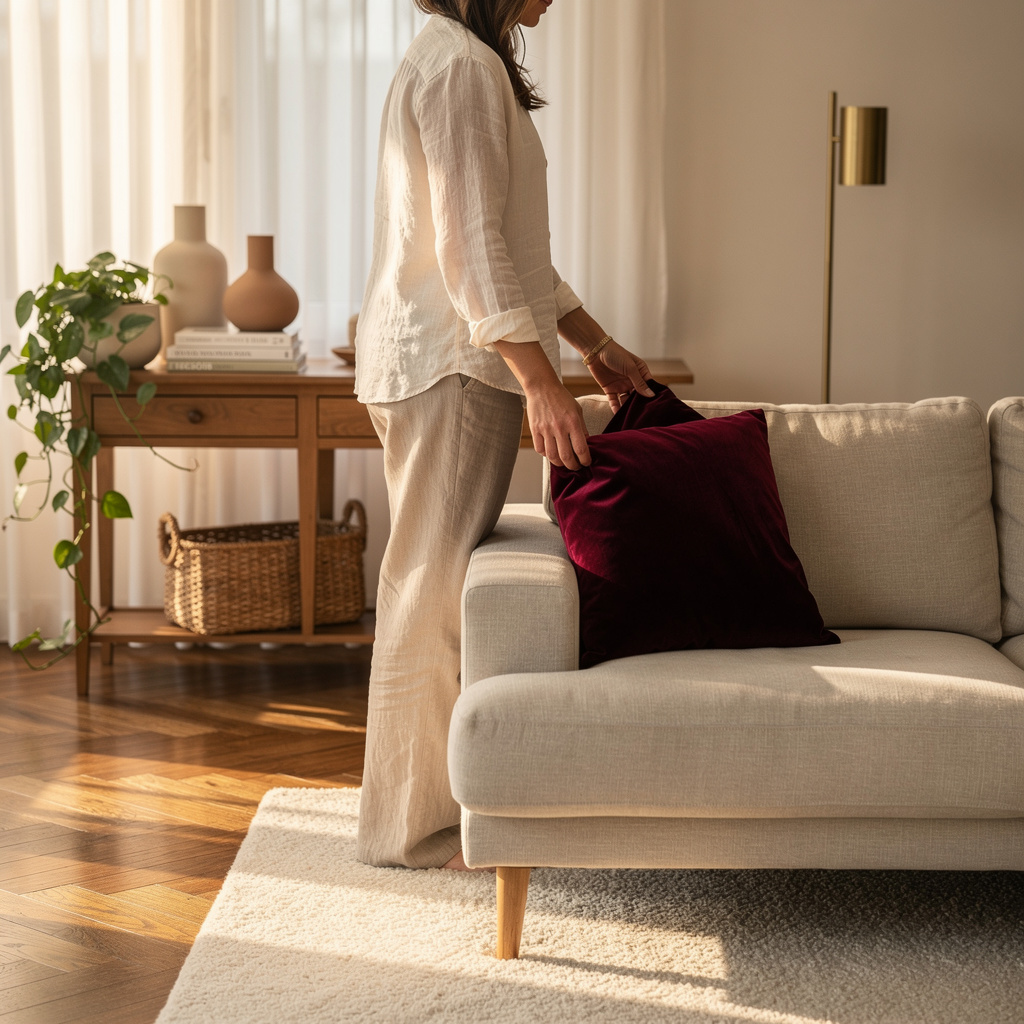
Interior styling at home is the intentional practice of arranging, layering, and composing elements within a residential space to create a functional, harmonious, and visually engaging environment. Its scope ranges from selecting a color palette and mixing patterns to positioning furniture, hanging art, and styling surfaces with objects, books, and plants. Core concepts include scale and proportion, focal points, visual weight, color theory, texture contrast, and lighting quality. Unlike interior design, which often involves structural changes, interior styling focuses on what you can move, swap, or add without major construction. It is both an art and a practical skill that responds to how people actually live in their rooms.
This subject matters today because homes have become multi-purpose spaces for work, rest, and socializing, making thoughtful styling more valuable than ever. Real-world applications include residential makeovers, rental-friendly updates, real estate staging, content creation for social media, and hospitality settings like boutique hotels and cafés. Recent shifts toward sustainable living, thrifting, and budget-conscious refreshes have made styling skills accessible and environmentally responsible. Digital platforms and online inspiration have also accelerated interest, but they often lack the foundational knowledge of scale, proportion, and composition that makes a room truly work. As a result, formal understanding of interior styling helps people move beyond trends and create spaces that feel personal and enduring.
Mastering interior styling at home builds a skill stack that includes visual literacy, spatial reasoning, color and pattern coordination, material and texture knowledge, sourcing and budgeting, and project sequencing. These skills transfer to personal contexts such as refreshing your own apartment, preparing a home for sale, or creating a cozy rental that reflects your identity. Professionally, they support roles like interior styling assistant, e-commerce product stylist, real estate staging consultant, and content creator for home and lifestyle brands. The subject also fosters confidence in making design decisions without relying on expensive consultants or constant purchases. Ultimately, interior styling at home bridges the gap between everyday living and intentional, expressive environments.
Common Questions About Interior Styling at Home
Does the Interior Styling at Home certificate add value to a CV?
Can a total beginner start the Interior Styling at Home course?
How do I fix scale and proportion when a room feels wrong?
Why does the 60-30-10 color rule fail in some rooms?
How do I layer texture so a room feels warm, not cold?
- Foundation: rugs, curtains, upholstery, and large surfaces set the tactile base.
- Mid-scale: cushions, throws, lampshades, and seat pads add contrast in weave and sheen.
- Detail: ceramics, books, baskets, and small textiles introduce hand-feel without clutter.
- Visual texture: mix matte, gloss, nubby, and smooth surfaces so the room reads rich from a distance.
- Tactile texture: include at least one element people want to touch near every seating spot.
What are the three layers of light in a living room?
Is interior styling just another word for interior design or staging?
What Will This Course Bring You?
- Apply foundational interior styling principles and room-reading techniques to assess a home space's scale, proportion, and focal points.
- Define a personal interior style direction by curating inspiration, keywords, and material preferences into a cohesive visual guide.
- Implement color and pattern schemes that harmonize with a chosen style while considering undertones, contrast, and room function.
- Layer texture, materials, and styled surfaces with objects, books, and plants to create depth without overcrowding a room.
- Arrange furniture and lighting to improve room flow, conversation zones, traffic paths, and mood based on daily use.
- Compose walls, art, and display vignettes using alignment, grouping, and negative space to create balanced visual interest.
- Build a budget-conscious, sustainable styling plan for small spaces or rentals using sourced and existing items.
- Design a room-by-room styling project that integrates style, color, texture, furniture, lighting, and display choices.
Curriculum
12 Units1. Foundations of Interior Styling at Home
1 hour
2. Reading a Room: Scale, Proportion, and Focal Points
1 hour
3. Defining Your Style and Visual Direction
1 hour
4. Color and Pattern Foundations for Styling
1 hour
5. Texture, Materials, and Layering
1 hour
6. Furniture Arrangement and Room Flow
1 hour
7. Lighting as a Styling Tool
1 hour
8. Walls, Art, and Display Composition
1 hour
9. Surface Styling with Objects, Books, and Plants
1 hour
10. Styling Small Spaces and Rentals
1 hour
11. Budget, Sourcing, and Sustainable Refresh
1 hour
12. Room-by-Room Styling Project
1 hour
Exam – Interior Styling at Home
20 Questions • 70% Pass • 30 min
Unlock All Units for Free
Create an account, enroll in the course, and start with the first unit right away.
Exam – Interior Styling at Home
20 Questions • Pass: 70% • 30 min
Course Duration
720
Total Minutes
12
Unit
1
Final Exam
~60
Min / Unit
Interior Styling at Home Certificate Program
Document Your Skill
Those who pass the 20-question, 30-minute exam with 70% receive the Interior Styling at Home Certificate.
Stand Out on Your CV
By adding your certificate to your CV, gain a professional reference in job applications and stand out from the crowd.
Career Advantage
With the verification code, employers can check your certificate instantly — a concrete way to show your growth.
CERTIFICATE FEE
At the end of the course, an online exam consisting of 20 questions with a 30-minute time limit is given. The exam appears automatically after you complete the topics. Anyone who scores at least 70 out of 100 on the certificate exam is awarded the Interior Styling at Home Document (certificate of attendance). You can add the certificate you earn to your CV for job applications in the many sectors listed above, and use it as a reference proving that you took this interactive course.
The Certificate of Achievement you receive with the Interior Styling at Home course program holds value that proves your personal and professional development in the business world. By adding it to your CV, it can serve as an important reference in your job applications. Moreover, compared with certificates from other private training institutions, Catch Wisdom certificates are offered to our participants at a much more affordable price.
The Interior Styling at Home course certificate is a document that proves, with a unique verification code, that you completed the course. Employers can instantly check its authenticity with this code, which helps you show your development concretely in your job applications.
For more information, we recommend visiting the Support page.
Certificate in 7 Languages
Earning success certificates from our courses is now more meaningful and global. With certificates available in Turkish, English, German, French, Spanish, Arabic, and Russian, we fully unlock the potential of students worldwide.
Why Certificate in 7 Languages?
-
01
Global Skill Development
Receiving your certificates in 7 different languages strengthens your communication skills as you engage with more people worldwide. It lets you operate more confidently and capably on the international stage.
-
02
International Job Opportunities
Employers may see your certificates in multiple languages as a sign of your ability to seize global opportunities. You can open more doors to new jobs and projects.
-
03
Cultural Richness
The chance to earn certificates in different languages helps you build closer ties with various cultures and broadens your worldview. It enriches your global perspective and deepens cultural understanding.
-
04
Ability to Participate in International Projects
Multilingual certificates give you an edge to work more effectively on international projects. They boost your chances of leadership and participation in diverse projects in the business world.
-
05
Prove Yourself on the Global Stage
Certificates in multiple languages give you the opportunity to present your skills and knowledge worldwide.
Language diversity opens worldwide opportunities. If you want to prove yourself in the international arena, join our online Interior Styling at Home course program and begin this journey with us.
Frequently Asked Questions (FAQ)
Is this course paid?
How do I join the course?
Can I take the course at my own pace?
How can I get my certificate?
What are the advantages of the certificate?
Boost Your Career
Take a new career step with the Interior Styling at Home course. Add your certificate to your CV, stand out in job applications, and open the door to new opportunities in the industry.
StartStudent Reviews
No reviews yet
Enroll in this course and be the first to leave a review about your experience with Interior Styling at Home.
Start