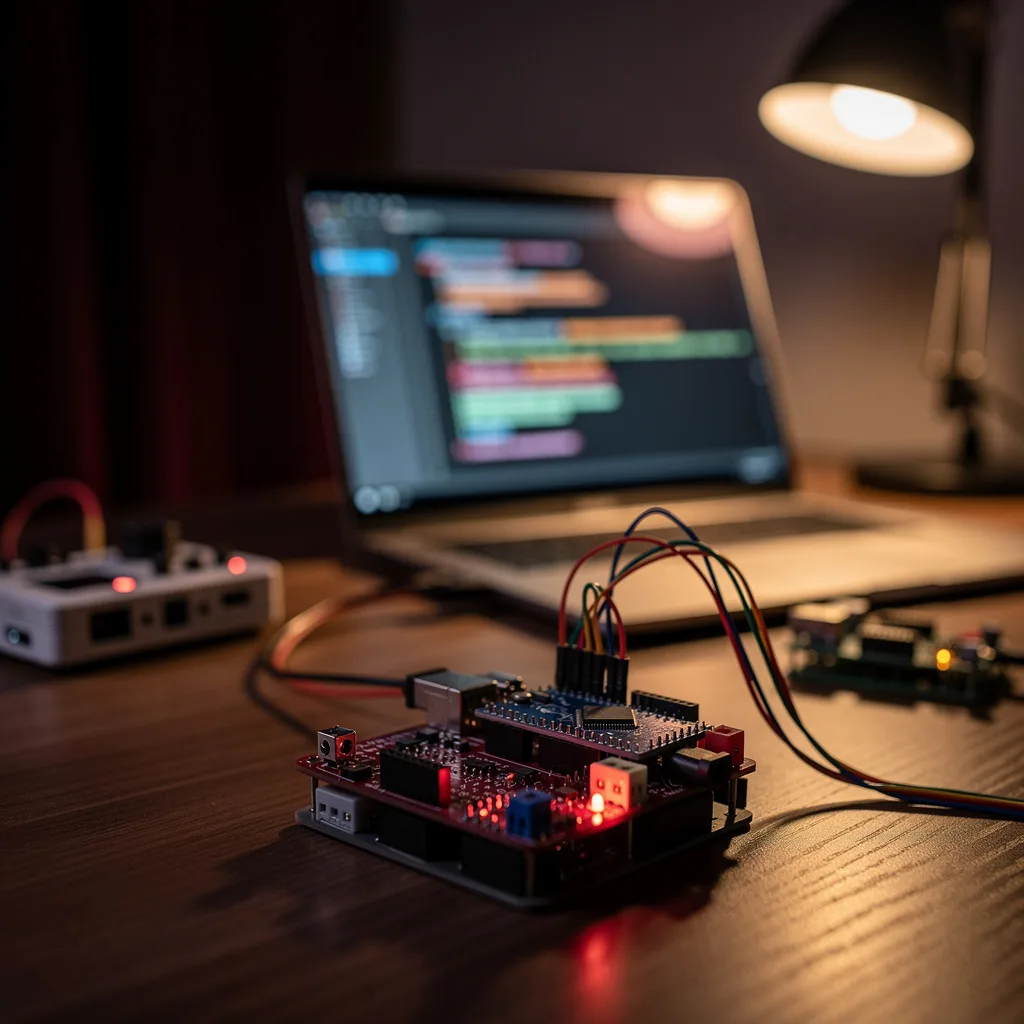
What is IoT with MicroPython?
IoT with MicroPython Training
The IoT with MicroPython certificate program teaches you how to build connected devices using MicroPython, a lean and efficient implementation of Python 3 designed for microcontrollers. This course is ideal for embedded developers, hobbyists, and software engineers who want to transition into the Internet of Things without the complexity of C or C++. By the end, you will have designed and deployed a complete end-to-end IoT system that reads sensors, communicates over Wi-Fi, publishes data via MQTT, and integrates with a cloud dashboard.
The program is structured to be beginner-friendly, starting with the basics of MicroPython on IoT devices and gradually advancing through digital I/O, analog inputs, and communication protocols like I2C and SPI. You will build core skills in networking (Wi-Fi, HTTP, MQTT), data logging and storage, cloud integration, power management, and even over-the-air (OTA) updates. This hands-on progression balances theory with practical exercises, culminating in a capstone project that ties everything together. Choosing this program now is timely because MicroPython is rapidly gaining traction in the IoT space for its rapid prototyping capabilities, and the demand for developers who can quickly iterate on connected solutions is higher than ever.
What is IoT with MicroPython?
IoT with MicroPython refers to the practice of using the MicroPython programming language to develop firmware for microcontroller-based Internet of Things devices. MicroPython is a compact, open-source implementation of Python 3 that runs directly on microcontrollers such as ESP32, ESP8266, and Raspberry Pi Pico, enabling developers to write high-level, readable code for hardware interaction. Its core concepts include digital and analog I/O, sensor interfacing, communication protocols (I2C, SPI, UART), networking stacks (Wi-Fi, TCP/IP), and asynchronous programming for event-driven IoT applications.
This subject matters today because the IoT ecosystem is expanding into smart homes, industrial automation, environmental monitoring, and wearable technology, all of which require fast, flexible firmware development. MicroPython lowers the barrier to entry, allowing engineers and makers to prototype and deploy IoT solutions in days rather than weeks. Recent shifts toward edge computing and low-power, battery-operated devices have further increased the relevance of MicroPython, as it supports deep sleep modes and efficient memory management, making it suitable for resource-constrained hardware.
Mastering IoT with MicroPython builds a versatile skill stack that combines embedded systems knowledge with modern software engineering practices. You gain proficiency in hardware-software integration, real-time data handling, wireless communication, and cloud connectivity—competencies that are directly applicable to roles in IoT development, embedded systems engineering, and product prototyping. Whether you are building a personal smart garden monitor or contributing to a commercial sensor network, this subject equips you with the tools to turn physical-world data into actionable insights.
Common Questions About IoT with MicroPython
Is this IoT with MicroPython course suitable for complete beginners?
What career benefits does the certificate from this IoT course provide?
How do I flash MicroPython firmware on ESP32 for IoT?
- Download the firmware .bin file for your ESP32 model.
- Install esptool via pip: pip install esptool.
- Erase the flash: esptool.py --port COM3 erase_flash (adjust port).
- Write the firmware: esptool.py --port COM3 write_flash 0x1000 firmware.bin.
How does ADC convert voltage to a number in MicroPython?
How to connect an ESP32 to Wi-Fi using MicroPython?
What are MQTT topic wildcards and how to use them?
- + (single-level wildcard): matches one topic level. Example: home/+/light matches home/kitchen/light but not home/kitchen/ceiling/light.
- # (multi-level wildcard): matches all remaining levels. Example: home/# matches home/kitchen/light and home/bedroom/temperature.
Is MicroPython too slow for real IoT applications?
What Will This Course Bring You?
- Set up a MicroPython development environment and flash firmware onto an ESP32 microcontroller.
- Apply digital input/output to read a button and control an LED on an ESP32.
- Read analog sensor values using the ADC and generate PWM signals for LED brightness.
- Implement I2C communication to read data from a BMP280 temperature and pressure sensor.
- Connect an ESP32 to Wi-Fi and make HTTP requests to a REST API for data exchange.
- Design an MQTT publish/subscribe system to transmit sensor data between IoT devices.
- Log sensor data to an SD card using MicroPython's file system for offline analysis.
- Implement deep sleep mode on an ESP32 to conserve battery power in remote deployments.
Curriculum
12 Units1. Getting Started with MicroPython on IoT Devices
1 hour
2. Digital I/O and Basic Sensors
1 hour
3. Analog Inputs and PWM
1 hour
4. Communication Protocols: I2C and SPI
1 hour
5. Networking with Wi-Fi and HTTP
1 hour
6. MQTT for IoT Messaging
1 hour
7. Data Logging and Storage
1 hour
8. Cloud Integration and Dashboards
1 hour
9. Power Management and Deep Sleep
1 hour
10. Advanced Sensors and Actuators
1 hour
11. Over-the-Air (OTA) Updates and Remote Management
1 hour
12. Capstone Project: End-to-End IoT System
1 hour
Exam – IoT with MicroPython
20 Questions • 70% Pass • 30 min
Unlock All Units for Free
Create an account, enroll in the course, and start with the first unit right away.
Exam – IoT with MicroPython
20 Questions • Pass: 70% • 30 min
Course Duration
720
Total Minutes
12
Unit
1
Final Exam
~60
Min / Unit
IoT with MicroPython Certificate Program
Document Your Skill
Those who pass the 20-question, 30-minute exam with 70% receive the IoT with MicroPython Certificate.
Stand Out on Your CV
By adding your certificate to your CV, gain a professional reference in job applications and stand out from the crowd.
Career Advantage
With the verification code, employers can check your certificate instantly — a concrete way to show your growth.
CERTIFICATE FEE
At the end of the course, an online exam consisting of 20 questions with a 30-minute time limit is given. The exam appears automatically after you complete the topics. Anyone who scores at least 70 out of 100 on the certificate exam is awarded the IoT with MicroPython Document (certificate of attendance). You can add the certificate you earn to your CV for job applications in the many sectors listed above, and use it as a reference proving that you took this interactive course.
The Certificate of Achievement you receive with the IoT with MicroPython course program holds value that proves your personal and professional development in the business world. By adding it to your CV, it can serve as an important reference in your job applications. Moreover, compared with certificates from other private training institutions, Catch Wisdom certificates are offered to our participants at a much more affordable price.
The IoT with MicroPython course certificate is a document that proves, with a unique verification code, that you completed the course. Employers can instantly check its authenticity with this code, which helps you show your development concretely in your job applications.
For more information, we recommend visiting the Support page.
Certificate in 7 Languages
Earning success certificates from our courses is now more meaningful and global. With certificates available in Turkish, English, German, French, Spanish, Arabic, and Russian, we fully unlock the potential of students worldwide.
Why Certificate in 7 Languages?
-
01
Global Skill Development
Receiving your certificates in 7 different languages strengthens your communication skills as you engage with more people worldwide. It lets you operate more confidently and capably on the international stage.
-
02
International Job Opportunities
Employers may see your certificates in multiple languages as a sign of your ability to seize global opportunities. You can open more doors to new jobs and projects.
-
03
Cultural Richness
The chance to earn certificates in different languages helps you build closer ties with various cultures and broadens your worldview. It enriches your global perspective and deepens cultural understanding.
-
04
Ability to Participate in International Projects
Multilingual certificates give you an edge to work more effectively on international projects. They boost your chances of leadership and participation in diverse projects in the business world.
-
05
Prove Yourself on the Global Stage
Certificates in multiple languages give you the opportunity to present your skills and knowledge worldwide.
Language diversity opens worldwide opportunities. If you want to prove yourself in the international arena, join our online IoT with MicroPython course program and begin this journey with us.
Frequently Asked Questions (FAQ)
Is this course paid?
How do I join the course?
Can I take the course at my own pace?
How can I get my certificate?
What are the advantages of the certificate?
Boost Your Career
Take a new career step with the IoT with MicroPython course. Add your certificate to your CV, stand out in job applications, and open the door to new opportunities in the industry.
StartStudent Reviews
No reviews yet
Enroll in this course and be the first to leave a review about your experience with IoT with MicroPython.
Start