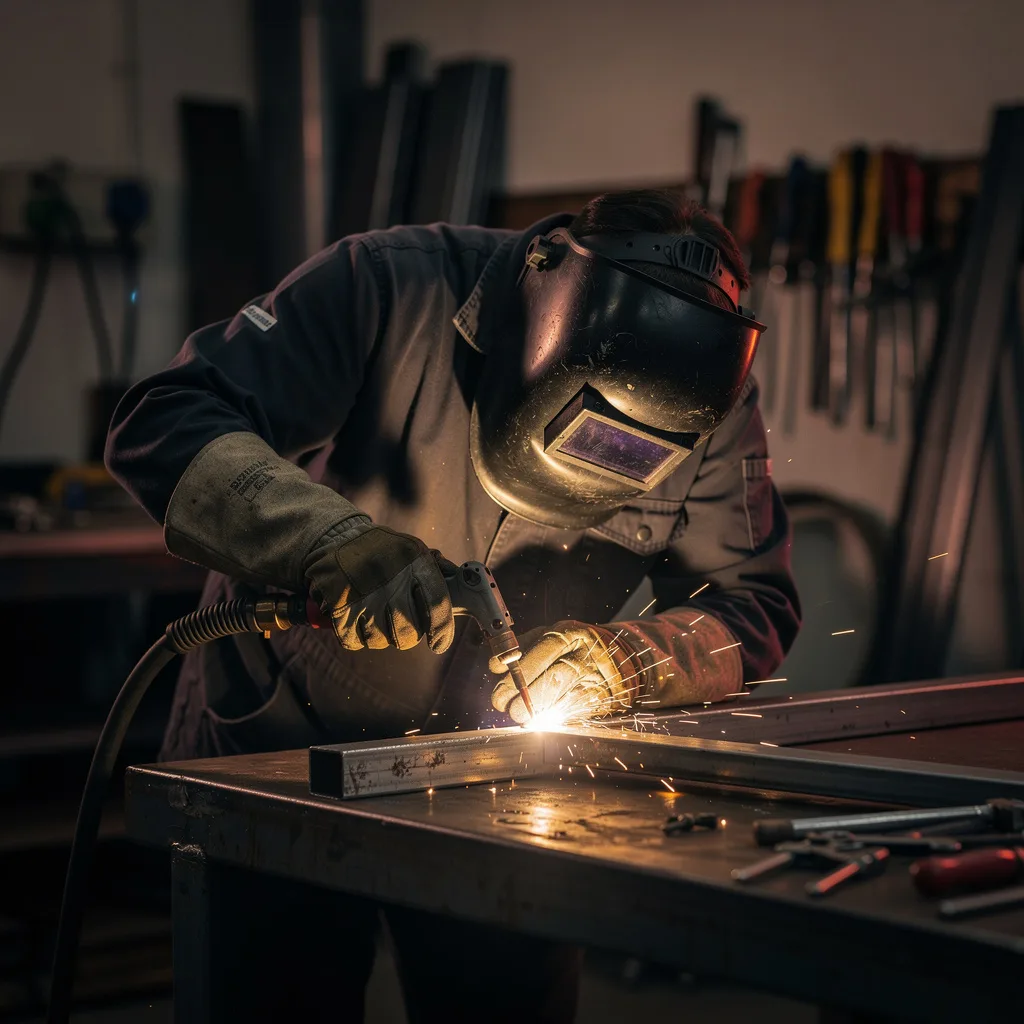
What is MIG Welding Techniques?
MIG Welding Techniques Training
The MIG Welding Techniques certificate program provides a comprehensive, hands-on curriculum that teaches you how to safely and effectively operate MIG welding equipment, from basic machine setup to advanced position welding. This course is designed for beginners with no prior welding experience as well as experienced welders looking to refine their skills, and the main practical outcome is the ability to produce strong, defect-free welds on a variety of materials and joint configurations in flat, horizontal, vertical, and overhead positions.
The program follows a beginner-friendly progression that balances theoretical fundamentals with extensive practical application, covering four core skill areas: safety and equipment mastery, position welding techniques, material-specific procedures, and weld quality inspection. You will work through lessons on troubleshooting common defects, advanced techniques, and a final practical project that consolidates everything you have learned. With the growing demand for skilled welders in construction, manufacturing, and automotive repair, this program offers a direct path to industry-recognized competence and job-ready skills.
What is MIG Welding Techniques?
MIG (Metal Inert Gas) welding, also known as Gas Metal Arc Welding (GMAW), is a semi-automatic or automatic arc welding process that uses a continuous solid wire electrode fed through a welding gun and an inert shielding gas to protect the weld pool from contamination. The core concepts include understanding voltage, wire feed speed, travel speed, and gun angle to control penetration, bead shape, and fusion. It is one of the most versatile and widely used welding processes because it can be applied to thin and thick sections of steel, stainless steel, and aluminum with high deposition rates and minimal slag.
Today, MIG welding is essential in industries such as automotive manufacturing, shipbuilding, structural steel fabrication, and pipeline construction, where speed, consistency, and weld quality are critical. Recent shifts toward automation and robotic welding have increased the need for operators who understand the underlying principles and can troubleshoot process variables. Additionally, the rise of lightweight materials in electric vehicles and aerospace has expanded the demand for skilled MIG welders who can adapt parameters for different alloys and thicknesses.
Mastering MIG welding techniques builds a practical skill stack that includes precise hand-eye coordination, metallurgical knowledge, and the ability to read and interpret weld symbols and inspection criteria. These competencies directly translate to roles such as production welder, fabrication technician, and maintenance welder, and they also provide a strong foundation for advancing into welding inspection, supervision, or specialized certifications. Whether you are pursuing a career in the trades or adding a valuable fabrication skill to your existing expertise, proficiency in MIG welding opens doors to high-demand, well-compensated positions.
Common Questions About MIG Welding Techniques
What are the basic MIG welding techniques for beginners?
Should you push or pull when MIG welding?
How do you MIG weld in the vertical position?
What is the proper MIG welding technique?
How does shielding gas affect MIG welding?
What are common MIG welding defects and how to fix them?
- Porosity: Caused by contaminated base metal, insufficient gas flow, or draft. Fix by cleaning the metal, checking gas flow, and shielding the weld area.
- Excessive spatter: Often due to incorrect voltage or wire feed speed. Adjust machine settings and check gun angle.
- Lack of fusion: Results from low heat input or improper travel speed. Increase amperage or slow down travel.
What Will This Course Bring You?
- Apply safety protocols and select appropriate PPE to prevent injury during MIG welding.
- Configure MIG welding machine parameters including wire feed speed and voltage for given material.
- Demonstrate proper technique for flat position fillet and groove welds (1F/1G).
- Execute horizontal and vertical position welds while maintaining proper travel angle and speed.
- Troubleshoot common MIG welding defects such as porosity and lack of fusion by adjusting parameters.
- Evaluate weld quality using visual inspection, bend tests, and macro-etch analysis.
- Implement advanced techniques like pulse MIG and robotic welding for complex applications.
- Perform welds on various materials including steel, aluminum, and stainless steel with appropriate settings.
Curriculum
12 Units1. MIG Welding Safety and Personal Protective Equipment
1 hour
2. MIG Welding Equipment and Machine Setup
1 hour
3. Fundamentals of the MIG Welding Process
1 hour
4. Flat Position Welding (1F and 1G)
1 hour
5. Horizontal and Vertical Position Welding
1 hour
6. Overhead Welding and Advanced Positions
1 hour
7. Welding Different Joint Configurations
1 hour
8. MIG Welding on Various Materials
1 hour
9. Troubleshooting Common MIG Welding Defects
1 hour
10. Advanced MIG Welding Techniques
1 hour
11. Weld Quality Inspection and Testing
1 hour
12. Practical Project and Course Review
1 hour
Exam – MIG Welding Techniques
20 Questions • 70% Pass • 30 min
Unlock All Units for Free
Create an account, enroll in the course, and start with the first unit right away.
Exam – MIG Welding Techniques
20 Questions • Pass: 70% • 30 min
Course Duration
720
Total Minutes
12
Unit
1
Final Exam
~60
Min / Unit
MIG Welding Techniques Certificate Program
Document Your Skill
Those who pass the 20-question, 30-minute exam with 70% receive the MIG Welding Techniques Certificate.
Stand Out on Your CV
By adding your certificate to your CV, gain a professional reference in job applications and stand out from the crowd.
Career Advantage
With the verification code, employers can check your certificate instantly — a concrete way to show your growth.
CERTIFICATE FEE
At the end of the course, an online exam consisting of 20 questions with a 30-minute time limit is given. The exam appears automatically after you complete the topics. Anyone who scores at least 70 out of 100 on the certificate exam is awarded the MIG Welding Techniques Document (certificate of attendance). You can add the certificate you earn to your CV for job applications in the many sectors listed above, and use it as a reference proving that you took this interactive course.
The Certificate of Achievement you receive with the MIG Welding Techniques course program holds value that proves your personal and professional development in the business world. By adding it to your CV, it can serve as an important reference in your job applications. Moreover, compared with certificates from other private training institutions, Catch Wisdom certificates are offered to our participants at a much more affordable price.
The MIG Welding Techniques course certificate is a document that proves, with a unique verification code, that you completed the course. Employers can instantly check its authenticity with this code, which helps you show your development concretely in your job applications.
For more information, we recommend visiting the Support page.
Certificate in 7 Languages
Earning success certificates from our courses is now more meaningful and global. With certificates available in Turkish, English, German, French, Spanish, Arabic, and Russian, we fully unlock the potential of students worldwide.
Why Certificate in 7 Languages?
-
01
Global Skill Development
Receiving your certificates in 7 different languages strengthens your communication skills as you engage with more people worldwide. It lets you operate more confidently and capably on the international stage.
-
02
International Job Opportunities
Employers may see your certificates in multiple languages as a sign of your ability to seize global opportunities. You can open more doors to new jobs and projects.
-
03
Cultural Richness
The chance to earn certificates in different languages helps you build closer ties with various cultures and broadens your worldview. It enriches your global perspective and deepens cultural understanding.
-
04
Ability to Participate in International Projects
Multilingual certificates give you an edge to work more effectively on international projects. They boost your chances of leadership and participation in diverse projects in the business world.
-
05
Prove Yourself on the Global Stage
Certificates in multiple languages give you the opportunity to present your skills and knowledge worldwide.
Language diversity opens worldwide opportunities. If you want to prove yourself in the international arena, join our online MIG Welding Techniques course program and begin this journey with us.
Frequently Asked Questions (FAQ)
Is this course paid?
How do I join the course?
Can I take the course at my own pace?
How can I get my certificate?
What are the advantages of the certificate?
Boost Your Career
Take a new career step with the MIG Welding Techniques course. Add your certificate to your CV, stand out in job applications, and open the door to new opportunities in the industry.
StartStudent Reviews
No reviews yet
Enroll in this course and be the first to leave a review about your experience with MIG Welding Techniques.
Start