What is Montessori Classroom Design: From Philosophy to Practice?
Montessori Classroom Design: From Philosophy to Practice Certificate Program
The Montessori Classroom Design: From Philosophy to Practice certificate program teaches educators, administrators, and design enthusiasts how to translate Maria Montessori’s core principles into functional, beautiful learning environments. You will explore the prepared environment concept, the teacher’s dual role as designer and observer, and the practical steps for arranging spatial flow, selecting furniture and materials, and creating dedicated areas for practical life, sensorial work, language, mathematics, cultural subjects, and outdoor spaces. The main practical outcome is the ability to design or redesign a classroom that actively supports child independence, concentration, and holistic development.
This program is structured to be beginner-friendly, starting with foundational philosophy before moving into hands‑on design decisions such as lighting, color, aesthetics, safety, accessibility, and inclusivity. It builds four core skill areas: philosophical grounding, spatial planning, material curation, and classroom management through design. You will also learn how to adapt environments for different age groups and how to evaluate and evolve your design over time. Now is the ideal moment to enroll because schools worldwide are rethinking learning spaces to better support child‑led discovery, and this course gives you the evidence‑based framework to lead that change.
What is Montessori Classroom Design? — in en
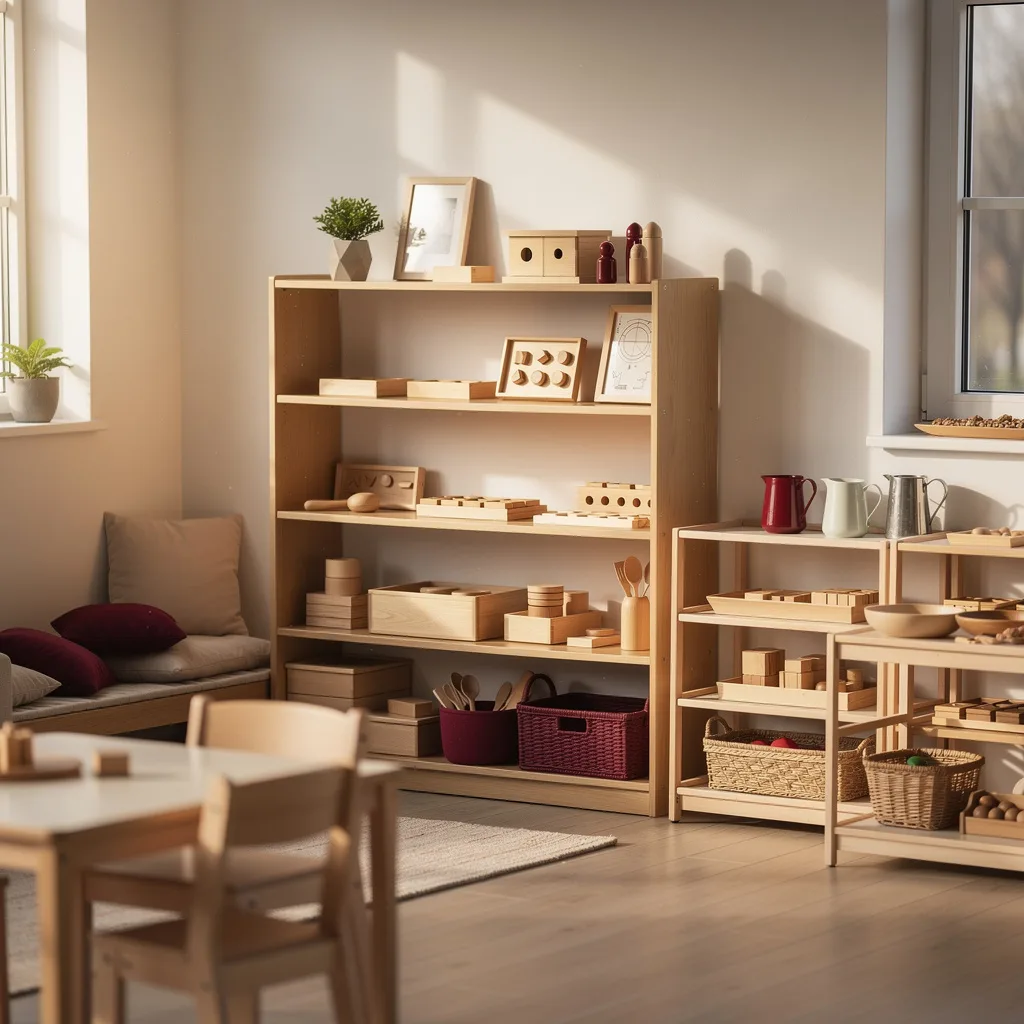
Montessori Classroom Design is the deliberate arrangement of physical space, furniture, and materials to create a “prepared environment” that fosters independence, order, and deep concentration in children. Its core concepts include the idea that the environment itself is a teacher, that every object has a purpose and a place, and that the layout must allow free movement and choice while maintaining calm and beauty. The design covers everything from low, open shelving and child‑sized furniture to the careful selection of natural materials, muted colors, and defined activity zones for practical life, sensorial exploration, language, mathematics, and cultural studies.
Today, Montessori Classroom Design matters more than ever as research in developmental psychology and neuroscience confirms that physical surroundings directly influence children’s cognitive, social, and emotional growth. It is used not only in Montessori schools but also in progressive public and private classrooms, early‑childhood centers, and even home‑learning environments. Recent shifts toward trauma‑informed education, neurodiversity‑affirming spaces, and sustainability have further elevated the demand for environments that are safe, inclusive, and responsive to each child’s unique needs.
Mastering this subject builds a skill stack that includes spatial reasoning, material curation, child‑development knowledge, and aesthetic sensitivity—competencies that are directly applicable to roles such as Montessori lead teacher, classroom designer, curriculum coordinator, or educational consultant. Whether you are setting up your first classroom, redesigning an existing one, or guiding other educators, the ability to create a prepared environment transforms both teaching practice and student outcomes, making this knowledge invaluable for any professional committed to child‑centered education.
Common Questions About Montessori Classroom Design: From Philosophy to Practice
What career benefits does the Montessori Classroom Design certificate offer?
How long does it take to complete the Montessori Classroom Design training?
How do the six principles of the prepared environment interrelate?
- Order provides the structure that allows freedom within limits, enabling children to navigate the space independently.
- Accessibility ensures that materials are within reach, supporting choice and fostering a sense of community as children share the environment.
- Beauty creates a calm atmosphere that enhances concentration, which in turn strengthens the order of the classroom.
What is the teacher's role as observer in Montessori design?
How to design traffic patterns for calm movement in a Montessori classroom?
Why is open shelving considered a presentation system?
Is Montessori classroom design only for preschool children?
What Will This Course Bring You?
- Analyze Montessori philosophy to design a prepared environment that fosters independence and self-directed learning.
- Apply principles of spatial layout and flow to create a classroom that supports movement and concentration.
- Select appropriate furniture and materials that align with Montessori principles and child development stages.
- Design practical life and sensorial areas that promote fine motor skills and sensory exploration.
- Evaluate lighting, color, and aesthetics to create a calm and inviting learning atmosphere.
- Implement strategies for classroom management through intentional design and organization.
- Adapt the classroom environment for different age groups, from toddlers to elementary students.
- Assess and evolve your classroom design using observation and feedback to meet changing needs.
Curriculum
12 Units1. Montessori Philosophy and the Prepared Environment
1 hour
2. The Role of the Teacher as Designer and Observer
1 hour
3. Spatial Layout and Flow
1 hour
4. Furniture and Materials Selection
1 hour
5. Creating Practical Life and Sensorial Areas
1 hour
6. Language and Mathematics Areas
1 hour
7. Cultural Subjects and Outdoor Spaces
1 hour
8. Lighting, Color, and Aesthetics
1 hour
9. Safety, Accessibility, and Inclusivity
1 hour
10. Classroom Management Through Design
1 hour
11. Adapting the Environment for Different Age Groups
1 hour
12. Evaluating and Evolving Your Classroom Design
1 hour
Exam – Montessori Classroom Design: From Philosophy to Practice
20 Questions • 70% Pass • 30 min
Unlock All Units for Free
Create an account, enroll in the course, and start with the first unit right away.
Exam – Montessori Classroom Design: From Philosophy to Practice
20 Questions • Pass: 70% • 30 min
Course Duration
720
Total Minutes
12
Unit
1
Final Exam
~60
Min / Unit
Montessori Classroom Design: From Philosophy to Practice Certificate Program
Document Your Skill
Those who pass the 20-question, 30-minute exam with 70% receive the Montessori Classroom Design: From Philosophy to Practice Certificate.
Stand Out on Your CV
By adding your certificate to your CV, gain a professional reference in job applications and stand out from the crowd.
Career Advantage
With the verification code, employers can check your certificate instantly — a concrete way to show your growth.
CERTIFICATE FEE
At the end of the course, an online exam consisting of 20 questions with a 30-minute time limit is given. The exam appears automatically after you complete the topics. Anyone who scores at least 70 out of 100 on the certificate exam is awarded the Montessori Classroom Design: From Philosophy to Practice Document (certificate of attendance). You can add the certificate you earn to your CV for job applications in the many sectors listed above, and use it as a reference proving that you took this interactive course.
The Certificate of Achievement you receive with the Montessori Classroom Design: From Philosophy to Practice course program holds value that proves your personal and professional development in the business world. By adding it to your CV, it can serve as an important reference in your job applications. Moreover, compared with certificates from other private training institutions, Catch Wisdom certificates are offered to our participants at a much more affordable price.
The Montessori Classroom Design: From Philosophy to Practice course certificate is a document that proves, with a unique verification code, that you completed the course. Employers can instantly check its authenticity with this code, which helps you show your development concretely in your job applications.
For more information, we recommend visiting the Support page.
Certificate in 7 Languages
Earning success certificates from our courses is now more meaningful and global. With certificates available in Turkish, English, German, French, Spanish, Arabic, and Russian, we fully unlock the potential of students worldwide.
Why Certificate in 7 Languages?
-
01
Global Skill Development
Receiving your certificates in 7 different languages strengthens your communication skills as you engage with more people worldwide. It lets you operate more confidently and capably on the international stage.
-
02
International Job Opportunities
Employers may see your certificates in multiple languages as a sign of your ability to seize global opportunities. You can open more doors to new jobs and projects.
-
03
Cultural Richness
The chance to earn certificates in different languages helps you build closer ties with various cultures and broadens your worldview. It enriches your global perspective and deepens cultural understanding.
-
04
Ability to Participate in International Projects
Multilingual certificates give you an edge to work more effectively on international projects. They boost your chances of leadership and participation in diverse projects in the business world.
-
05
Prove Yourself on the Global Stage
Certificates in multiple languages give you the opportunity to present your skills and knowledge worldwide.
Language diversity opens worldwide opportunities. If you want to prove yourself in the international arena, join our online Montessori Classroom Design: From Philosophy to Practice course program and begin this journey with us.
Frequently Asked Questions (FAQ)
Is this course paid?
How do I join the course?
Can I take the course at my own pace?
How can I get my certificate?
What are the advantages of the certificate?
Boost Your Career
Take a new career step with the Montessori Classroom Design: From Philosophy to Practice course. Add your certificate to your CV, stand out in job applications, and open the door to new opportunities in the industry.
StartStudent Reviews
No reviews yet
Enroll in this course and be the first to leave a review about your experience with Montessori Classroom Design: From Philosophy to Practice.
Start