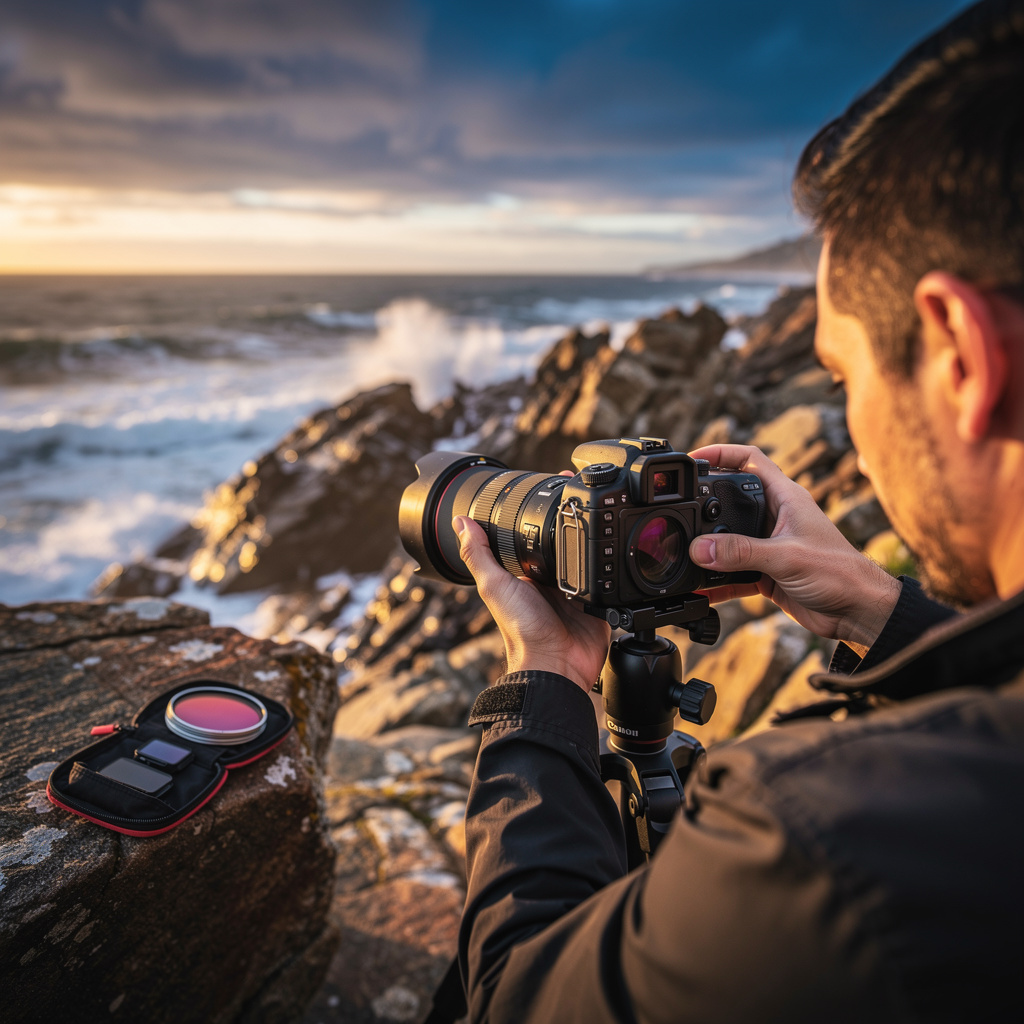
What is ND and Polarizer Filters?
ND and Polarizer Filters Training
The ND and Polarizer Filters certificate program is designed to transform your understanding of these essential photographic tools, taking you from basic filter usage to advanced creative control. This course is ideal for landscape, travel, and architectural photographers who want to master exposure management and color enhancement directly in-camera. By the end, you will confidently capture long-exposure silky water, dramatic skies, and glare-free reflections without relying on post-processing tricks.
The program progresses from foundational concepts like stops and exposure calculation to hands-on techniques for combining ND and polarizer filters in real-world scenarios. You will build four core skill areas: precise exposure metering, filter system selection, troubleshooting common artifacts, and creative composition with motion blur and polarized light. With lessons covering everything from filter accessories to advanced multi-filter stacking, this training is your timely advantage in an era where in-camera mastery sets professionals apart.
What is ND and Polarizer Filters?
Neutral density (ND) and polarizing filters are optical accessories that modify light before it reaches the camera sensor. ND filters reduce the intensity of all wavelengths equally, allowing longer shutter speeds or wider apertures in bright conditions, while polarizers selectively block polarized light, reducing reflections and enhancing color saturation. Together, they form a fundamental toolkit for controlling exposure and contrast in photography, with core concepts including optical density, stop reduction, and polarization angle.
Today, these filters are more relevant than ever as photographers seek to differentiate their work from digital manipulation. In landscape and outdoor photography, ND filters enable dreamy long exposures of waterfalls and clouds, while polarizers cut through haze and deepen blue skies—techniques widely used in travel, real estate, and commercial work. Recent shifts toward minimal post-processing and authentic capture have renewed interest in these physical tools, especially among creators who value efficiency and reproducibility in challenging lighting.
Mastering ND and polarizer filters builds a skill stack that includes light measurement, exposure reciprocity, and optical physics applied to visual art. This knowledge directly benefits photographers, videographers, and even drone operators who need to manage highlights and reflections. Whether you are a hobbyist seeking creative growth or a professional aiming to deliver consistent results on location, understanding these filters elevates your technical precision and artistic expression.
Common Questions About ND and Polarizer Filters
How does the ND and Polarizer Filters course boost my landscape portfolio?
Is this ND and Polarizer training enough for a beginner who never used filters?
Why use the exponential formula when calculating exposure with ND filters?
What is the correct stacking order when combining ND and polarizer filters?
How do I calculate stops for an ND filter like ND16 for long exposures?
- 1 second becomes 2, then 4, then 8, then 16 seconds
- 1/125s becomes 1/60s, 1/30s, 1/15s, then 1/8s
What is the difference between absorptive and reflective ND filter designs?
Can software truly replace an ND filter for smoothing water in post?
What Will This Course Bring You?
- Evaluate the benefits of using ND and polarizer filters in various lighting conditions.
- Differentiate between various ND filter strengths and their specific applications in photography.
- Apply ND filters to achieve long exposures for motion blur in landscapes.
- Compute the correct exposure time when using ND filters with different stop reductions.
- Explain how polarizing filters affect light transmission and reduce unwanted reflections in photography.
- Apply polarizing filters to enhance sky contrast and water clarity in landscape photography.
- Design a filter stack that combines ND and polarizer for controlled exposure and color.
- Diagnose and fix common issues like vignetting, color casts, and flare when using filters.
Curriculum
12 Units1. Why Use Filters?
1 hour
2. Understanding Exposure and Stops
1 hour
3. Neutral Density Filters Explained
1 hour
4. Long Exposure Photography with ND Filters
1 hour
5. Calculating Exposure with ND Filters
1 hour
6. Polarizing Filters Explained
1 hour
7. Using Polarizers for Skies and Water
1 hour
8. Combining ND and Polarizer Filters
1 hour
9. Filter Systems and Accessories
1 hour
10. Real-World Scenarios
1 hour
11. Troubleshooting and Common Mistakes
1 hour
12. Creative and Advanced Techniques
1 hour
Exam – ND and Polarizer Filters
20 Questions • 70% Pass • 30 min
Unlock All Units for Free
Create an account, enroll in the course, and start with the first unit right away.
Exam – ND and Polarizer Filters
20 Questions • Pass: 70% • 30 min
Course Duration
720
Total Minutes
12
Unit
1
Final Exam
~60
Min / Unit
ND and Polarizer Filters Certificate Program
Document Your Skill
Those who pass the 20-question, 30-minute exam with 70% receive the ND and Polarizer Filters Certificate.
Stand Out on Your CV
By adding your certificate to your CV, gain a professional reference in job applications and stand out from the crowd.
Career Advantage
Catch Wisdom certificates are recognized by HR departments and increase career opportunities.
CERTIFICATE FEE
At the end of the course, an online exam consisting of 20 questions with a 30-minute time limit is given. The exam appears automatically after you complete the topics. Anyone who scores at least 70 out of 100 on the certificate exam is awarded the ND and Polarizer Filters Document (certificate of attendance). You can add the certificate you earn to your CV for job applications in the many sectors listed above, and use it as a reference proving that you took this interactive course.
The Certificate of Achievement you receive with the ND and Polarizer Filters course program holds value that proves your personal and professional development in the business world. By adding it to your CV, it can serve as an important reference in your job applications. Moreover, compared with certificates from other private training institutions, Catch Wisdom certificates are offered to our participants at a much more affordable price.
Because HR departments recognize Catch Wisdom as a reputable institution in this field, they value these certificates and may evaluate your job applications favorably. For this reason, a ND and Polarizer Filters course certificate from Catch Wisdom can make your applications more attractive and place you in an advantageous position in the business world.
For more information, we recommend visiting the Support page.
Certificate in 7 Languages
Earning success certificates from our courses is now more meaningful and global. With certificates available in Turkish, English, German, French, Spanish, Arabic, and Russian, we fully unlock the potential of students worldwide.
Why Certificate in 7 Languages?
-
01
Global Skill Development
Receiving your certificates in 7 different languages strengthens your communication skills as you engage with more people worldwide. It lets you operate more confidently and capably on the international stage.
-
02
International Job Opportunities
Employers may see your certificates in multiple languages as a sign of your ability to seize global opportunities. You can open more doors to new jobs and projects.
-
03
Cultural Richness
The chance to earn certificates in different languages helps you build closer ties with various cultures and broadens your worldview. It enriches your global perspective and deepens cultural understanding.
-
04
Ability to Participate in International Projects
Multilingual certificates give you an edge to work more effectively on international projects. They boost your chances of leadership and participation in diverse projects in the business world.
-
05
Prove Yourself on the Global Stage
Certificates in multiple languages let you showcase your skills and knowledge worldwide. You can become an internationally recognized professional.
Language diversity opens worldwide opportunities. If you want to prove yourself in the international arena, join our online ND and Polarizer Filters course program and begin this journey with us.
Frequently Asked Questions (FAQ)
Is this course paid?
How do I join the course?
Can I take the course at my own pace?
How can I get my certificate?
What are the advantages of the Certified Certificate?
Boost Your Career
Take a new career step with the ND and Polarizer Filters course. Add your certificate to your CV, stand out in job applications, and open the door to new opportunities in the industry.
StartStudent Reviews
No reviews yet
Enroll in this course and be the first to leave a review about your experience with ND and Polarizer Filters.
Start