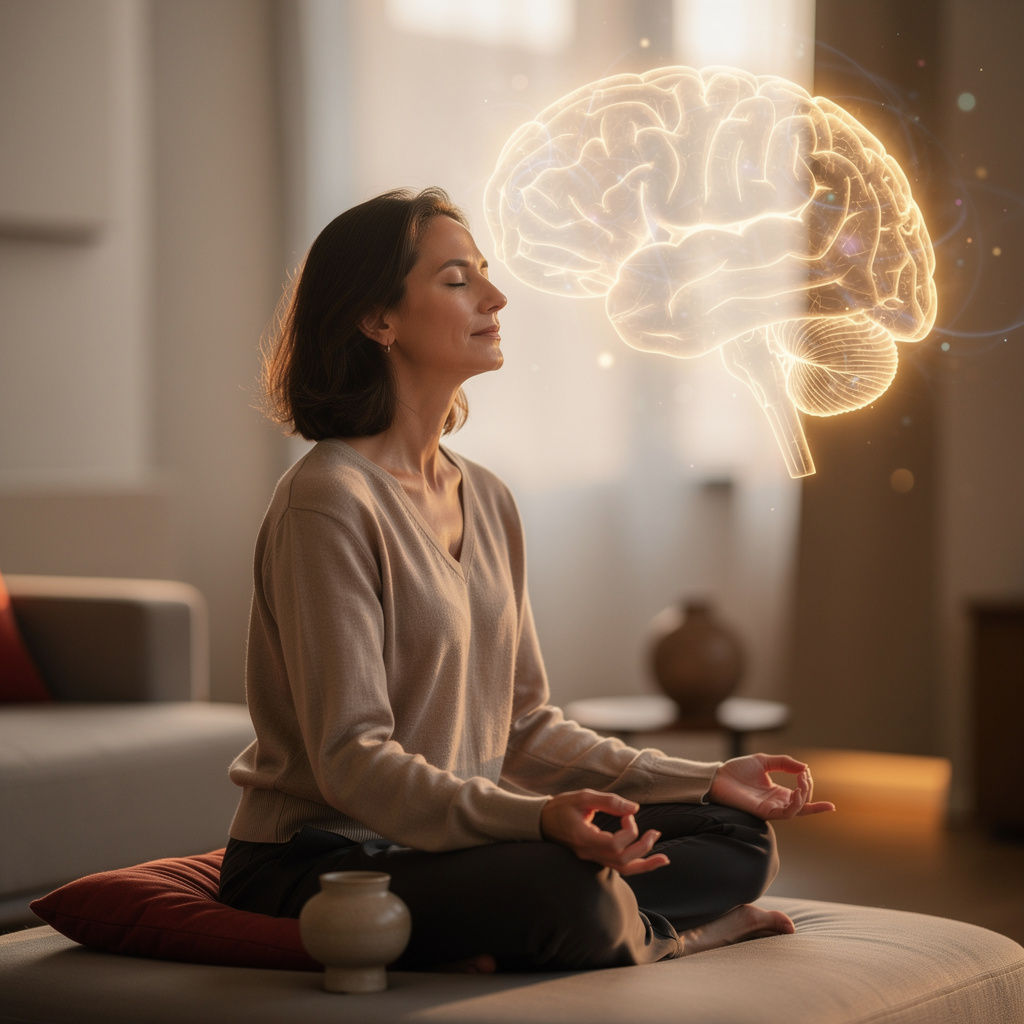
What is Neuroscience of Focus and Stillness?
Neuroscience of Focus and Stillness Training
This Neuroscience of Focus and Stillness certificate program offers a rigorous, science-driven journey into the brain mechanisms that govern attention, calm, and emotional balance. Designed for professionals in psychology, coaching, education, and healthcare—as well as dedicated mindfulness practitioners—the course translates cutting-edge research into immediately usable skills. You will learn to cultivate deep, stable focus and access a restorative stillness response even under pressure, building a neural foundation for greater clarity, resilience, and well-being in both personal and professional life.
The program unfolds as a carefully sequenced progression from the foundations of modern mindfulness through the attention system, the neurobiology of distraction, and the parasympathetic stillness response, into advanced topics like interoception, the social brain, and clinical applications. Each module balances clear theoretical models with experiential practices, ensuring you not only understand concepts like neuroplasticity and stress threat circuits but can directly train them. In an age of constant distraction and burnout, this program equips you with a rare, evidence-based toolkit to rewire scattered attention into sustained focus and transform reactive stress into intentional calm—skills that are becoming essential differentiators in every demanding field.
What is Neuroscience of Focus and Stillness?
Neuroscience of Focus and Stillness is the interdisciplinary study of how the brain initiates, sustains, and restores attention, and how it enters states of deep calm and receptive awareness. It draws on cognitive neuroscience, psychophysiology, and contemplative science to map the neural networks underlying concentration, the default mode network’s role in mind-wandering, and the parasympathetic nervous system’s regulation of rest and recovery. Core concepts include the attention system’s alerting, orienting, and executive control functions; the threat-driven amygdala-prefrontal dynamics that fuel distraction; and the interoceptive pathways through which we sense and regulate our internal bodily states, forming the bedrock of emotional balance.
In today’s hyperconnected world, where information overload and chronic stress fragment our attention, this subject has moved from academic curiosity to urgent practical necessity. Organizations integrate focus training to combat productivity loss, clinicians apply stillness-based protocols for anxiety and trauma, and educators use attentional neuroscience to support learning and self-regulation. The recent explosion of research on neuroplasticity has confirmed that these capacities are trainable across the lifespan, shifting the conversation from fixed traits to developable skills. This has sparked a quiet revolution in mental health, peak performance, and leadership development, making the neuroscience of focus and stillness a cornerstone of modern human optimization.
Mastering this subject builds a powerful skill stack: the ability to stabilize attention at will, to disengage from rumination and digital distraction, to downregulate stress in real time, and to access the creative insights that emerge from a quiet mind. These competencies translate directly into therapeutic settings, executive coaching, classroom management, athletic performance, and any context where clear thinking and emotional composure matter. By understanding the brain’s architecture of focus and stillness, you gain not just knowledge but a lived, embodied capacity to navigate complexity with steadiness and to foster the same in others.
Common Questions About Neuroscience of Focus and Stillness
Can someone with no meditation background start this course?
What is the weekly time commitment for this course?
How does the default mode network contribute to mind-wandering?
What is the role of the ventral vagal state in calmness?
Why is interoception called the sixth sense?
How does neuroplasticity help train focus?
- Functional plasticity: Changes in the efficiency of existing neural connections, making focus-related circuits fire more readily.
- Structural plasticity: Physical growth of new neurons and synapses, such as increased gray matter in attention-related regions like the anterior cingulate cortex.
Is multitasking a myth for productivity?
What Will This Course Bring You?
- Evaluate the scientific and historical foundations of modern mindfulness to differentiate evidence-based techniques from popular misconceptions.
- Map the brain's attention networks, including the default mode and salience networks, to explain how they interact during focused and mind-wandering states.
- Identify the neural mechanisms of distraction, such as dopamine-driven reward prediction errors, and apply strategies to counteract attentional capture.
- Design a progressive attention-training regimen leveraging Hebbian plasticity to enhance sustained focus and reduce mind-wandering over time.
- Practice vagus nerve stimulation techniques, like slow-paced breathing, to elicit the stillness response and measure resulting heart rate variability changes.
- Analyze the hypothalamic-pituitary-adrenal axis response to chronic stress and apply mindfulness-based stress reduction to downregulate cortisol levels.
- Develop interoceptive accuracy through body scanning to improve emotional granularity and regulate affective responses in challenging situations.
- Apply informal mindfulness strategies to daily activities, such as mindful listening and eating, to sustain present-moment attention and reduce cognitive reactivity.
Curriculum
12 Units1. Foundations of Modern Mindfulness
1 hour
2. The Attention System
1 hour
3. The Neuroscience of Distraction
1 hour
4. Training Focus Through Neuroplasticity
1 hour
5. The Stillness Response and the Parasympathetic Nervous System
1 hour
6. Stress, Threat, and the Brain
1 hour
7. Emotional Regulation and Interoception
1 hour
8. The Social Brain and Compassion
1 hour
9. Integrating Focus and Stillness
1 hour
10. Mindfulness in Daily Life
1 hour
11. Clinical Applications and Mental Health
1 hour
12. Beyond the Self: Advanced Frontiers
1 hour
Exam – Neuroscience of Focus and Stillness
20 Questions • 70% Pass • 30 min
Unlock All Units for Free
Create an account, enroll in the course, and start with the first unit right away.
Exam – Neuroscience of Focus and Stillness
20 Questions • Pass: 70% • 30 min
Course Duration
720
Total Minutes
12
Unit
1
Final Exam
~60
Min / Unit
Neuroscience of Focus and Stillness Certificate Program
Document Your Skill
Those who pass the 20-question, 30-minute exam with 70% receive the Neuroscience of Focus and Stillness Certificate.
Stand Out on Your CV
By adding your certificate to your CV, gain a professional reference in job applications and stand out from the crowd.
Career Advantage
With the verification code, employers can check your certificate instantly — a concrete way to show your growth.
CERTIFICATE FEE
At the end of the course, an online exam consisting of 20 questions with a 30-minute time limit is given. The exam appears automatically after you complete the topics. Anyone who scores at least 70 out of 100 on the certificate exam is awarded the Neuroscience of Focus and Stillness Document (certificate of attendance). You can add the certificate you earn to your CV for job applications in the many sectors listed above, and use it as a reference proving that you took this interactive course.
The Certificate of Achievement you receive with the Neuroscience of Focus and Stillness course program holds value that proves your personal and professional development in the business world. By adding it to your CV, it can serve as an important reference in your job applications. Moreover, compared with certificates from other private training institutions, Catch Wisdom certificates are offered to our participants at a much more affordable price.
The Neuroscience of Focus and Stillness course certificate is a document that proves, with a unique verification code, that you completed the course. Employers can instantly check its authenticity with this code, which helps you show your development concretely in your job applications.
For more information, we recommend visiting the Support page.
Certificate in 7 Languages
Earning success certificates from our courses is now more meaningful and global. With certificates available in Turkish, English, German, French, Spanish, Arabic, and Russian, we fully unlock the potential of students worldwide.
Why Certificate in 7 Languages?
-
01
Global Skill Development
Receiving your certificates in 7 different languages strengthens your communication skills as you engage with more people worldwide. It lets you operate more confidently and capably on the international stage.
-
02
International Job Opportunities
Employers may see your certificates in multiple languages as a sign of your ability to seize global opportunities. You can open more doors to new jobs and projects.
-
03
Cultural Richness
The chance to earn certificates in different languages helps you build closer ties with various cultures and broadens your worldview. It enriches your global perspective and deepens cultural understanding.
-
04
Ability to Participate in International Projects
Multilingual certificates give you an edge to work more effectively on international projects. They boost your chances of leadership and participation in diverse projects in the business world.
-
05
Prove Yourself on the Global Stage
Certificates in multiple languages give you the opportunity to present your skills and knowledge worldwide.
Language diversity opens worldwide opportunities. If you want to prove yourself in the international arena, join our online Neuroscience of Focus and Stillness course program and begin this journey with us.
Frequently Asked Questions (FAQ)
Is this course paid?
How do I join the course?
Can I take the course at my own pace?
How can I get my certificate?
What are the advantages of the certificate?
Boost Your Career
Take a new career step with the Neuroscience of Focus and Stillness course. Add your certificate to your CV, stand out in job applications, and open the door to new opportunities in the industry.
StartStudent Reviews
No reviews yet
Enroll in this course and be the first to leave a review about your experience with Neuroscience of Focus and Stillness.
Start