What is Origami and Paper Crafts?
Origami and Paper Crafts Certificate Program
The Origami and Paper Crafts certificate program is a structured training path that takes learners from their very first valley fold to the design of original paper artworks. It covers the full breadth of paper artistry: paper selection and workspace setup, diagram reading and fundamental folds, classic bases such as the bird and frog base, precision creasing and shaping, modular and geometric construction, kirigami cutting, quilling and filigree, paper flowers and gift boxes, card making and scrapbooking, papier-mâché sculpture, and advanced techniques like wet folding and complex model design. The program is built for absolute beginners, hobbyists returning to craft, teachers and activity leaders, designers, and anyone curious about turning a flat sheet into a three-dimensional object. Its main practical outcome is a portfolio of finished pieces plus the confidence to read any diagram, adapt a pattern, and invent a project of your own.
Learning progresses in a deliberate spiral: foundational material handling and diagram literacy come first, then core bases and beginner models, followed by precision work, modular systems, cutting and quilling, decorative and gift-oriented crafts, three-dimensional sculpture, and finally advanced and original design. Every stage pairs short conceptual explanations with hands-on folding, so theory about crease patterns, tension, grain direction, and structural geometry is immediately tested in the fingers. Across the twelve lessons, five core skill areas are developed: paper and tool fluency, diagram and pattern literacy, folding precision and shaping control, cutting and surface decoration, and structural design thinking. Learners choose this program now because paper craft has moved from a childhood pastime into a recognized design, therapy, and maker-economy discipline, and because a single sheet of paper remains the cheapest, most forgiving medium for practicing patience, spatial reasoning, and genuine craft.
What is Origami and Paper Crafts?
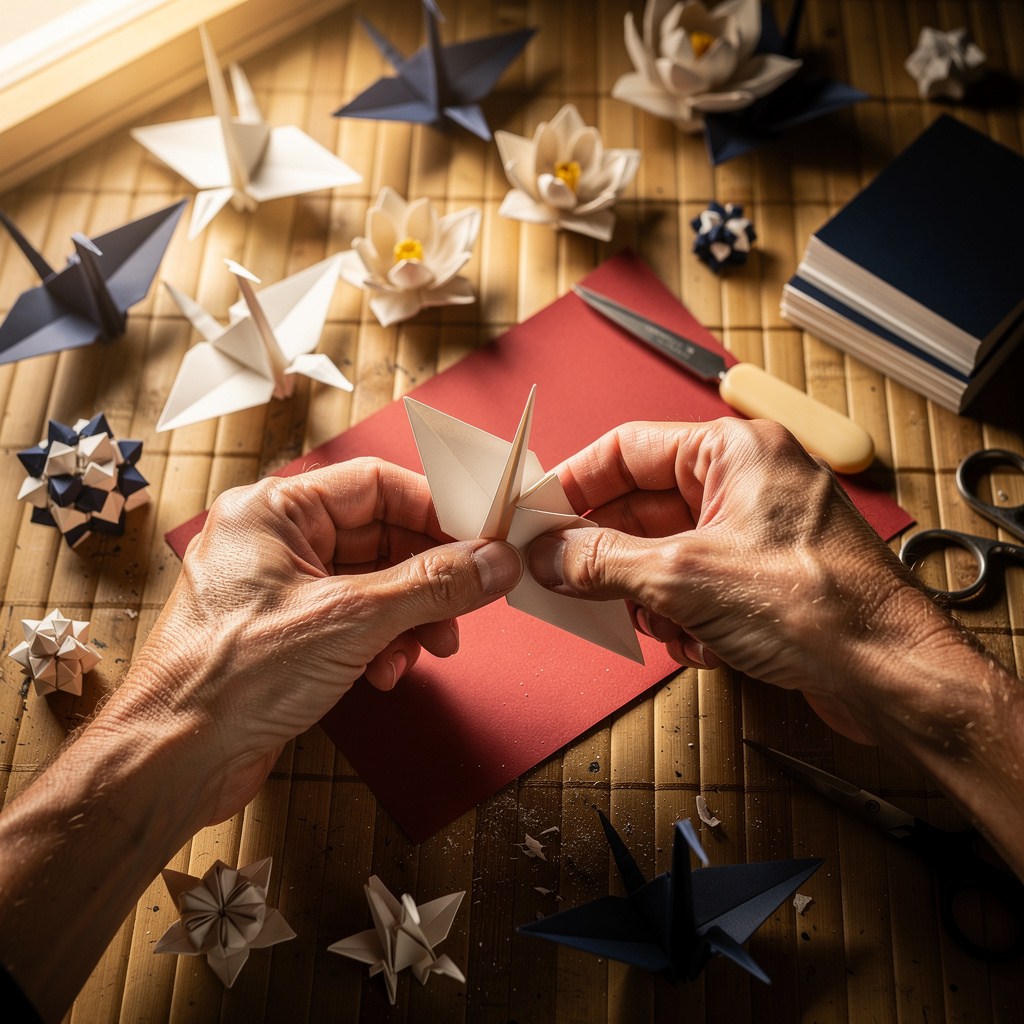
Origami and paper crafts describe the family of practices that transform flat sheets of paper into two- and three-dimensional forms through folding, cutting, curling, layering, and molding. Origami proper relies on folding alone, governed by crease patterns, base structures, and the geometry of angles that allow a square to become a crane, a dragon, or a tessellated surface. The wider field extends into kirigami, where cuts are integral to the structure; quilling, where narrow strips are rolled into filigree motifs; modular and geometric assembly, where identical units interlock without adhesive; and sculptural methods such as papier-mâché that build volume from pulp and form. Its core concepts are crease precision, tension and memory in paper fibers, symmetry and tessellation, structural load-bearing through folds, and the translation of a two-dimensional diagram into a physical object.
The subject matters today because it sits at an unexpected intersection of art, engineering, mathematics, and well-being. Engineers and researchers study fold patterns for deployable structures, stents, solar arrays, airbags, and lightweight architectural panels, while mathematicians analyze origami axioms and flat-foldability as a branch of computational geometry. In design and retail, paper craft underpins packaging prototypes, window displays, invitation suites, and handmade branding, and the rise of paper flower walls, quilled jewelry, and scrapbook-style memory keeping has created real demand for skilled makers. Recent shifts toward slow craft, screen-free hobbies, tactile learning in classrooms, and sustainable, recyclable materials have pushed paper arts back into mainstream attention, and digital pattern libraries and tutorial platforms now make advanced techniques accessible far beyond traditional apprenticeship.
Mastering this subject builds a distinctive skill stack: fine motor control and hand-eye precision, spatial and geometric reasoning, the patience to plan a sequence before executing it, material judgment about paper weight, grain, and finish, and the design literacy to move from copying a diagram to composing an original structure. Those abilities transfer directly into contexts such as teaching and classroom enrichment, occupational and art therapy, event and wedding design, packaging and product prototyping, illustration and set dressing, and community workshop leadership. Personally, the discipline rewards practitioners with a portable, low-cost creative practice that produces tangible objects, calms attention, and scales from a five-minute fold to a months-long sculptural commission.
Common Questions About Origami and Paper Crafts
Can a complete beginner join this origami course without prior skills?
How is the Origami and Paper Crafts course structured week by week?
Why does paper grammage matter when choosing origami paper?
- Lighter sheets: fold crisply and pack into thin layers, which suits complex and modular work where many layers meet.
- Heavier sheets: resist creasing but hold a sculptural shape, which makes them useful for wet folding and simple, sturdy forms.
- The everyday pair: kami and tant sit at different points on the scale, and comparing them side by side is the fastest way to feel what grammage actually does.
What is the most common mistake when reading origami crease patterns?
How do friction locks hold modular origami pieces together?
What defines a kirigami cut compared with a regular paper cut?
Do you really need expensive tools to start origami and paper crafts?
What Will This Course Bring You?
- Select appropriate paper weights, cutting tools, and workspace organization methods to prepare safe and efficient origami and paper craft sessions.
- Interpret standard origami diagram symbols and execute fundamental folds such as valley, mountain, squash, and reverse folds with accuracy.
- Construct core origami bases including bird, fish, frog, and waterbomb, then assemble beginner models by following sequential folding instructions.
- Apply precise creasing, crease pattern reading, and shaping techniques to refine model symmetry, angle alignment, and three-dimensional form.
- Design modular origami units and assemble them into geometric structures while evaluating connection stability and structural balance.
- Implement kirigami cutting techniques to create pop-up and lattice designs, demonstrating controlled blade work and clean edge finishing.
- Create quilled filigree shapes and compositions by rolling, shaping, and gluing paper strips into balanced decorative patterns.
- Evaluate advanced origami and wet-folding methods to design an original paper craft project that integrates complex shaping and personal creative expression.
Curriculum
12 Units1. Paper, Tools, and Workspace Foundations
1 hour
2. Reading Diagrams and Fundamental Folds
1 hour
3. Core Bases and Beginner Models
1 hour
4. Precision, Crease Patterns, and Shaping
1 hour
5. Modular Origami and Geometric Construction
1 hour
6. Kirigami and Paper Cutting Techniques
1 hour
7. Paper Quilling and Filigree Design
1 hour
8. Paper Flowers, Boxes, and Gift Crafts
1 hour
9. Card Making, Scrapbooking, and Decorative Paper Arts
1 hour
10. Papier-Mâché and 3D Paper Sculpture
1 hour
11. Advanced Origami: Complex Models and Wet Folding
1 hour
12. Designing Original Origami and Paper Craft Projects
1 hour
Exam – Origami and Paper Crafts
20 Questions • 70% Pass • 30 min
Unlock All Units for Free
Create an account, enroll in the course, and start with the first unit right away.
Exam – Origami and Paper Crafts
20 Questions • Pass: 70% • 30 min
Course Duration
720
Total Minutes
12
Unit
1
Final Exam
~60
Min / Unit
Origami and Paper Crafts Certificate Program
Document Your Skill
Those who pass the 20-question, 30-minute exam with 70% receive the Origami and Paper Crafts Certificate.
Stand Out on Your CV
By adding your certificate to your CV, gain a professional reference in job applications and stand out from the crowd.
Career Advantage
With the verification code, employers can check your certificate instantly — a concrete way to show your growth.
CERTIFICATE FEE
At the end of the course, an online exam consisting of 20 questions with a 30-minute time limit is given. The exam appears automatically after you complete the topics. Anyone who scores at least 70 out of 100 on the certificate exam is awarded the Origami and Paper Crafts Document (certificate of attendance). You can add the certificate you earn to your CV for job applications in the many sectors listed above, and use it as a reference proving that you took this interactive course.
The Certificate of Achievement you receive with the Origami and Paper Crafts course program holds value that proves your personal and professional development in the business world. By adding it to your CV, it can serve as an important reference in your job applications. Moreover, compared with certificates from other private training institutions, Catch Wisdom certificates are offered to our participants at a much more affordable price.
The Origami and Paper Crafts course certificate is a document that proves, with a unique verification code, that you completed the course. Employers can instantly check its authenticity with this code, which helps you show your development concretely in your job applications.
For more information, we recommend visiting the Support page.
Certificate in 7 Languages
Earning success certificates from our courses is now more meaningful and global. With certificates available in Turkish, English, German, French, Spanish, Arabic, and Russian, we fully unlock the potential of students worldwide.
Why Certificate in 7 Languages?
-
01
Global Skill Development
Receiving your certificates in 7 different languages strengthens your communication skills as you engage with more people worldwide. It lets you operate more confidently and capably on the international stage.
-
02
International Job Opportunities
Employers may see your certificates in multiple languages as a sign of your ability to seize global opportunities. You can open more doors to new jobs and projects.
-
03
Cultural Richness
The chance to earn certificates in different languages helps you build closer ties with various cultures and broadens your worldview. It enriches your global perspective and deepens cultural understanding.
-
04
Ability to Participate in International Projects
Multilingual certificates give you an edge to work more effectively on international projects. They boost your chances of leadership and participation in diverse projects in the business world.
-
05
Prove Yourself on the Global Stage
Certificates in multiple languages give you the opportunity to present your skills and knowledge worldwide.
Language diversity opens worldwide opportunities. If you want to prove yourself in the international arena, join our online Origami and Paper Crafts course program and begin this journey with us.
Frequently Asked Questions (FAQ)
Is this course paid?
How do I join the course?
Can I take the course at my own pace?
How can I get my certificate?
What are the advantages of the certificate?
Boost Your Career
Take a new career step with the Origami and Paper Crafts course. Add your certificate to your CV, stand out in job applications, and open the door to new opportunities in the industry.
StartStudent Reviews
No reviews yet
Enroll in this course and be the first to leave a review about your experience with Origami and Paper Crafts.
Start