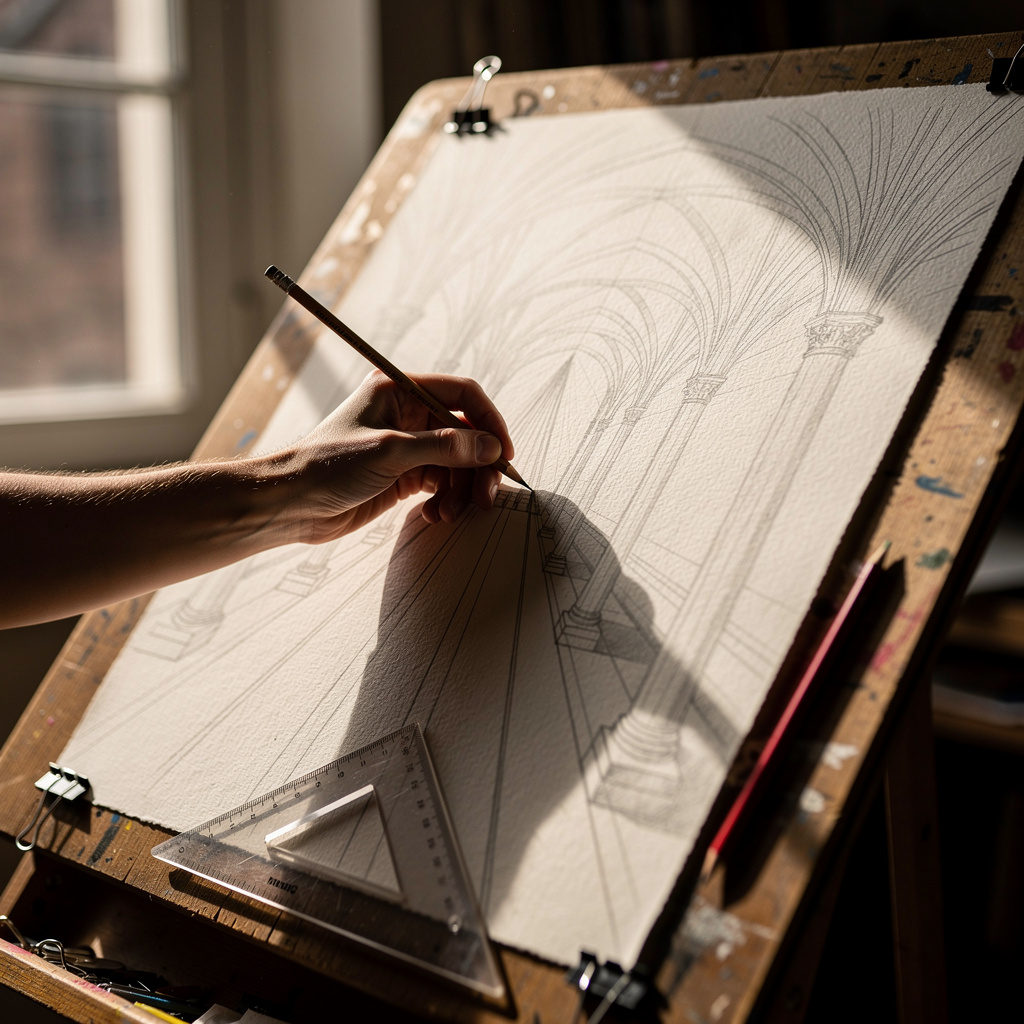
What is Perspective Drawing?
Perspective Drawing Training
The Perspective Drawing certificate program offers a comprehensive, hands-on pathway to mastering the visual language of depth and space. Designed for aspiring illustrators, architects, game artists, and anyone who sketches, this course transforms raw observation into structured drawing ability. From the first lesson on horizon lines and vanishing points to the final exploration of storytelling through composition, you will build a portfolio-ready skill set. By the end, you will confidently render interiors, cityscapes, organic forms, and even dramatic upward or downward views with accurate proportion and mood.
The program progresses deliberately from beginner-friendly foundations to advanced techniques, ensuring no prior drawing experience is required. Each lesson balances theoretical clarity with practical exercises, so you immediately apply concepts like measuring, scaling, and ellipses to real drawing scenarios. The curriculum builds five core skill areas: geometric construction, spatial measurement, atmospheric depth, shadow and reflection rendering, and figurative foreshortening. Choosing this training now is especially timely, as visual storytelling and spatial communication have become essential across digital media, architecture, and product design.
What is Perspective Drawing?
Perspective drawing is the systematic technique of representing three-dimensional objects and spaces on a two-dimensional surface, such as paper or a screen. Its core concepts include the horizon line, vanishing points, the picture plane, and the geometric rules that govern how parallel lines converge and how objects shrink with distance. The discipline spans one-point, two-point, and three-point perspective, as well as atmospheric perspective, which uses value and color shifts to suggest depth. It also encompasses the drawing of ellipses, curved forms, shadows, reflections, and foreshortened figures, making it a complete visual language for spatial realism.
Today, perspective drawing remains foundational in architecture, interior design, urban planning, concept art, game development, and film previsualization. While digital tools and 3D software have automated certain rendering tasks, the ability to sketch and communicate spatial ideas by hand is still highly valued in creative industries. Recent shifts toward virtual and augmented reality have renewed interest in accurate perspective, as designers must anticipate how viewers perceive depth in immersive environments. Understanding perspective also sharpens critical visual literacy, enabling professionals to analyze and critique imagery more effectively.
Mastering perspective drawing builds a robust skill stack that includes spatial reasoning, proportional judgment, observational acuity, and compositional instinct. These abilities translate directly into professional contexts such as architectural visualization, storyboarding, product rendering, and environmental design, as well as personal creative pursuits like urban sketching and fine art. The subject also cultivates patience and precision, qualities that enhance any visual practice. Whether you aim to communicate design ideas to clients or simply capture the world around you with greater fidelity, perspective drawing provides the underlying framework that makes your images believable and compelling.
Common Questions About Perspective Drawing
Does this perspective drawing course work for total beginners?
What career benefits does a perspective drawing certificate offer?
How do you find vanishing points in a two-point perspective drawing?
Why do circles become ellipses when drawn in perspective?
What is the measuring point method for scaling in perspective?
- Set your horizon line and vanishing point.
- Place a measuring point on the horizon, at a distance equal to the viewer's distance from the picture plane.
- Draw a line from the measuring point through your object's base to intersect the perspective line.
- Use that intersection to mark true scale along the receding line.
How does atmospheric perspective use value to show depth?
Is perspective drawing only useful for architectural sketches?
What Will This Course Bring You?
- Construct one-point perspective interiors by aligning orthogonal lines to a single vanishing point on the horizon.
- Apply two-point perspective to draw boxes and buildings with accurate vertical edges and converging horizontals.
- Implement three-point perspective to depict scenes looking up or down, adjusting vanishing points for dramatic angles.
- Draw ellipses and circles in perspective by using bounding boxes and axis alignment to maintain correct curvature.
- Use measuring and scaling techniques to proportionally transfer dimensions along perspective grids and depth planes.
- Render curved and organic forms in perspective by subdividing planes and using cross-sections to guide contours.
- Evaluate atmospheric perspective effects by manipulating value and color saturation to create depth in landscapes.
- Design complex scenes with multiple vanishing points, integrating shadows and reflections to enhance spatial realism.
Curriculum
12 Units1. Horizon, Vanishing Points, and Picture Plane
1 hour
2. One-Point Perspective: Interiors and Roads
1 hour
3. Two-Point Perspective: Boxes and Buildings
1 hour
4. Three-Point Perspective: Looking Up and Down
1 hour
5. Ellipses and Circles in Perspective
1 hour
6. Measuring and Scaling in Perspective
1 hour
7. Curved and Organic Forms in Perspective
1 hour
8. Atmospheric Perspective: Depth Through Value and Color
1 hour
9. Complex Scenes with Multiple Vanishing Points
1 hour
10. Shadows and Reflections in Perspective
1 hour
11. Figures and Foreshortening in Perspective
1 hour
12. Creative Perspective: Composition and Storytelling
1 hour
Exam – Perspective Drawing
20 Questions • 70% Pass • 30 min
Unlock All Units for Free
Create an account, enroll in the course, and start with the first unit right away.
Exam – Perspective Drawing
20 Questions • Pass: 70% • 30 min
Course Duration
720
Total Minutes
12
Unit
1
Final Exam
~60
Min / Unit
Perspective Drawing Certificate Program
Document Your Skill
Those who pass the 20-question, 30-minute exam with 70% receive the Perspective Drawing Certificate.
Stand Out on Your CV
By adding your certificate to your CV, gain a professional reference in job applications and stand out from the crowd.
Career Advantage
Catch Wisdom certificates are recognized by HR departments and increase career opportunities.
CERTIFICATE FEE
At the end of the course, an online exam consisting of 20 questions with a 30-minute time limit is given. The exam appears automatically after you complete the topics. Anyone who scores at least 70 out of 100 on the certificate exam is awarded the Perspective Drawing Document (certificate of attendance). You can add the certificate you earn to your CV for job applications in the many sectors listed above, and use it as a reference proving that you took this interactive course.
The Certificate of Achievement you receive with the Perspective Drawing course program holds value that proves your personal and professional development in the business world. By adding it to your CV, it can serve as an important reference in your job applications. Moreover, compared with certificates from other private training institutions, Catch Wisdom certificates are offered to our participants at a much more affordable price.
Because HR departments recognize Catch Wisdom as a reputable institution in this field, they value these certificates and may evaluate your job applications favorably. For this reason, a Perspective Drawing course certificate from Catch Wisdom can make your applications more attractive and place you in an advantageous position in the business world.
For more information, we recommend visiting the Support page.
Certificate in 7 Languages
Earning success certificates from our courses is now more meaningful and global. With certificates available in Turkish, English, German, French, Spanish, Arabic, and Russian, we fully unlock the potential of students worldwide.
Why Certificate in 7 Languages?
-
01
Global Skill Development
Receiving your certificates in 7 different languages strengthens your communication skills as you engage with more people worldwide. It lets you operate more confidently and capably on the international stage.
-
02
International Job Opportunities
Employers may see your certificates in multiple languages as a sign of your ability to seize global opportunities. You can open more doors to new jobs and projects.
-
03
Cultural Richness
The chance to earn certificates in different languages helps you build closer ties with various cultures and broadens your worldview. It enriches your global perspective and deepens cultural understanding.
-
04
Ability to Participate in International Projects
Multilingual certificates give you an edge to work more effectively on international projects. They boost your chances of leadership and participation in diverse projects in the business world.
-
05
Prove Yourself on the Global Stage
Certificates in multiple languages let you showcase your skills and knowledge worldwide. You can become an internationally recognized professional.
Language diversity opens worldwide opportunities. If you want to prove yourself in the international arena, join our online Perspective Drawing course program and begin this journey with us.
Frequently Asked Questions (FAQ)
Is this course paid?
How do I join the course?
Can I take the course at my own pace?
How can I get my certificate?
What are the advantages of the Certified Certificate?
Boost Your Career
Take a new career step with the Perspective Drawing course. Add your certificate to your CV, stand out in job applications, and open the door to new opportunities in the industry.
StartStudent Reviews
No reviews yet
Enroll in this course and be the first to leave a review about your experience with Perspective Drawing.
Start