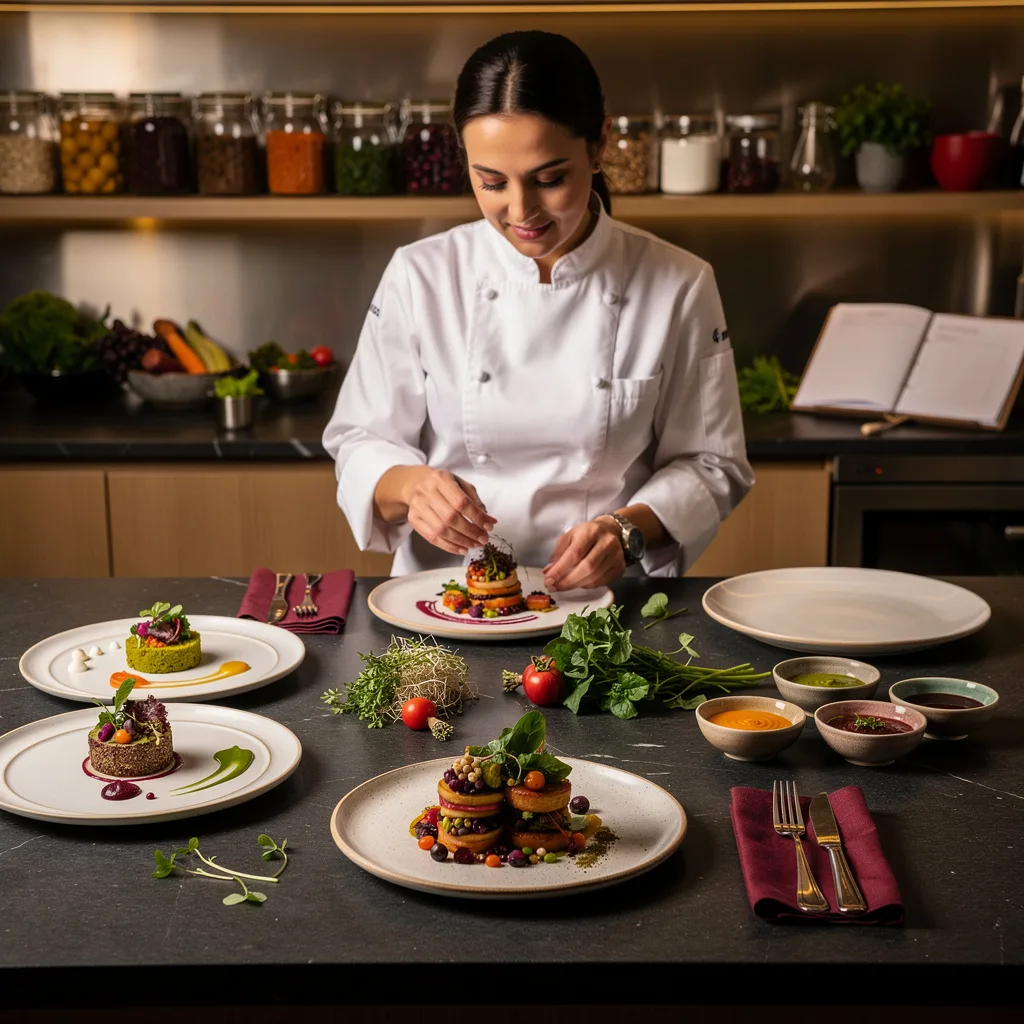
What is Plant-Based Menu Development?
Plant-Based Menu Development Certificate Program
The Plant-Based Menu Development certificate program is a comprehensive, hands-on course designed for culinary professionals, food entrepreneurs, and hospitality students who want to master the art and science of creating profitable, delicious, and nutritionally sound plant-based menus. You will learn to build flavor without animal products, structure balanced menus, and develop standardized recipes that can be scaled for any foodservice operation. The main practical outcome is a complete, ready-to-launch plant-based menu that demonstrates your ability to apply cost-effective ingredient cross-utilization, appealing plating techniques, and inclusive accommodations for dietary restrictions and allergies.
This program is structured as a beginner-friendly progression that balances theoretical foundations with real-world application. Starting with the core principles of plant-based cuisine and nutritional science, you will move through flavor-building techniques, menu architecture, and recipe standardization before tackling costing, profitability, and scaling for batch cooking. Each lesson builds a specific skill area: culinary technique, nutrition knowledge, business acumen, menu writing, and presentation artistry. The final project ties everything together, making this the ideal time to enroll as the plant-based market continues to expand rapidly and operators seek chefs who can deliver both taste and operational efficiency.
What is Plant-Based Menu Development?
Plant-Based Menu Development is the systematic process of designing, costing, and producing menus that exclude animal products while delivering exceptional flavor, texture, and visual appeal. It encompasses the selection of plant-based proteins, vegetables, grains, legumes, and alternative ingredients, along with techniques for building umami, creaminess, and satisfying mouthfeel without dairy, eggs, or meat. Core concepts include nutritional balance (protein complementation, vitamin B12 and iron sources), flavor layering through fermentation, roasting, and seasoning, and the strategic use of whole foods versus processed alternatives.
Today, plant-based menu development is a critical competency in the food industry, driven by rising consumer demand for sustainable, health-conscious, and ethical dining options. It is applied across fine dining restaurants, fast-casual chains, institutional cafeterias, and meal-kit services, as well as in product development for food manufacturers. Recent shifts include the mainstreaming of plant-based proteins like jackfruit and seitan, the integration of global cuisines (e.g., Middle Eastern, Asian, Latin American) into plant-forward menus, and a growing emphasis on reducing food waste through cross-utilization of ingredients.
Mastering this subject builds a versatile skill stack that combines culinary creativity with business analytics—recipe costing, yield management, and menu engineering—alongside a deep understanding of nutrition and allergen management. Professional contexts that benefit include restaurant ownership, menu consulting, foodservice management, and recipe development for brands. For home cooks and enthusiasts, it empowers confident meal planning and the ability to host inclusive gatherings. The knowledge gained directly translates to creating menus that are not only plant-based but also profitable, scalable, and memorable.
Common Questions About Plant-Based Menu Development
Is this plant-based menu course suitable for beginners?
Can I start this course with no cooking experience?
How do you create umami without animal products?
What is the plant plate visual template for balanced meals?
Why is cross-utilization key for ingredient efficiency?
How to standardize a plant-based recipe for consistency?
Is plant-based food always bland and unappetizing?
What Will This Course Bring You?
- Analyze foundational plant-based ingredients and techniques to build a versatile culinary repertoire.
- Apply nutritional principles to design balanced plant-based menus that meet dietary requirements.
- Evaluate flavor-building methods using umami, fats, and acids to enhance plant-based dishes.
- Design a structured menu that incorporates cross-utilization and ingredient efficiency.
- Develop standardized recipes with accurate costing to ensure profitability in plant-based menus.
- Implement plating and presentation techniques that elevate the visual appeal of plant-based dishes.
- Accommodate common dietary restrictions and allergies when creating plant-based menu options.
- Scale batch cooking processes to maintain quality and consistency in plant-based production.
Curriculum
12 Units1. Foundations of Plant-Based Cuisine
1 hour
2. Nutritional Principles for Plant-Based Menus
1 hour
3. Flavor Building Without Animal Products
1 hour
4. Menu Structure and Meal Planning
1 hour
5. Recipe Development and Standardization
1 hour
6. Costing and Profitability for Plant-Based Menus
1 hour
7. Cross-Utilization and Ingredient Efficiency
1 hour
8. Writing Plant-Based Menu Descriptions
1 hour
9. Accommodating Dietary Restrictions and Allergies
1 hour
10. Plating and Presentation for Plant-Based Dishes
1 hour
11. Scaling Production and Batch Cooking
1 hour
12. Final Project: Design a Complete Plant-Based Menu
1 hour
Exam – Plant-Based Menu Development
20 Questions • 70% Pass • 30 min
Unlock All Units for Free
Create an account, enroll in the course, and start with the first unit right away.
Exam – Plant-Based Menu Development
20 Questions • Pass: 70% • 30 min
Course Duration
720
Total Minutes
12
Unit
1
Final Exam
~60
Min / Unit
Plant-Based Menu Development Certificate Program
Document Your Skill
Those who pass the 20-question, 30-minute exam with 70% receive the Plant-Based Menu Development Certificate.
Stand Out on Your CV
By adding your certificate to your CV, gain a professional reference in job applications and stand out from the crowd.
Career Advantage
With the verification code, employers can check your certificate instantly — a concrete way to show your growth.
CERTIFICATE FEE
At the end of the course, an online exam consisting of 20 questions with a 30-minute time limit is given. The exam appears automatically after you complete the topics. Anyone who scores at least 70 out of 100 on the certificate exam is awarded the Plant-Based Menu Development Document (certificate of attendance). You can add the certificate you earn to your CV for job applications in the many sectors listed above, and use it as a reference proving that you took this interactive course.
The Certificate of Achievement you receive with the Plant-Based Menu Development course program holds value that proves your personal and professional development in the business world. By adding it to your CV, it can serve as an important reference in your job applications. Moreover, compared with certificates from other private training institutions, Catch Wisdom certificates are offered to our participants at a much more affordable price.
The Plant-Based Menu Development course certificate is a document that proves, with a unique verification code, that you completed the course. Employers can instantly check its authenticity with this code, which helps you show your development concretely in your job applications.
For more information, we recommend visiting the Support page.
Certificate in 7 Languages
Earning success certificates from our courses is now more meaningful and global. With certificates available in Turkish, English, German, French, Spanish, Arabic, and Russian, we fully unlock the potential of students worldwide.
Why Certificate in 7 Languages?
-
01
Global Skill Development
Receiving your certificates in 7 different languages strengthens your communication skills as you engage with more people worldwide. It lets you operate more confidently and capably on the international stage.
-
02
International Job Opportunities
Employers may see your certificates in multiple languages as a sign of your ability to seize global opportunities. You can open more doors to new jobs and projects.
-
03
Cultural Richness
The chance to earn certificates in different languages helps you build closer ties with various cultures and broadens your worldview. It enriches your global perspective and deepens cultural understanding.
-
04
Ability to Participate in International Projects
Multilingual certificates give you an edge to work more effectively on international projects. They boost your chances of leadership and participation in diverse projects in the business world.
-
05
Prove Yourself on the Global Stage
Certificates in multiple languages give you the opportunity to present your skills and knowledge worldwide.
Language diversity opens worldwide opportunities. If you want to prove yourself in the international arena, join our online Plant-Based Menu Development course program and begin this journey with us.
Frequently Asked Questions (FAQ)
Is this course paid?
How do I join the course?
Can I take the course at my own pace?
How can I get my certificate?
What are the advantages of the certificate?
Boost Your Career
Take a new career step with the Plant-Based Menu Development course. Add your certificate to your CV, stand out in job applications, and open the door to new opportunities in the industry.
StartStudent Reviews
No reviews yet
Enroll in this course and be the first to leave a review about your experience with Plant-Based Menu Development.
Start