What is Plant-Based Milk Making?
Plant-Based Milk Making Certificate Program
Plant-Based Milk Making certificate program is a focused training in designing and producing stable, safe, and appealing plant-based milks from nuts, grains, legumes, and seeds. It teaches the full production chain—from raw material selection and soaking through blending, extraction, straining, formulation ratios, texture and stability, flavor control, heat treatment, hygiene, shelf life, and troubleshooting—so learners understand why recipes succeed or fail. The program suits home producers, small food-business owners, product developers, baristas, and culinary entrepreneurs who want to move beyond trial-and-error. Its main practical outcome is the ability to build repeatable recipes and production routines with consistent texture, flavor, and food-safety standards.
The curriculum progresses in a beginner-friendly sequence: it begins with the foundations of plant-based milk making and ingredient functions, then moves into raw material sourcing, prep techniques such as soaking and rinsing, blending and extraction mechanics, and straining and pulp management. From there, learners advance to formulation ratios, recipe design, texture and stability, fortification, flavor development, off-flavor control, heat treatment, hygiene, food safety, shelf life, packaging, storage, troubleshooting, quality control, and scaling. Theory is paired with practical decision-making, so each concept connects to real production choices rather than abstract knowledge. The program builds five core skill areas: ingredient and raw material evaluation, extraction and processing control, formulation and stability design, safety and shelf-life management, and quality troubleshooting and scale-up. It is a timely choice as demand grows for dairy alternatives, cleaner labels, and reliable small-batch production that can meet commercial expectations.
What is Plant-Based Milk Making?
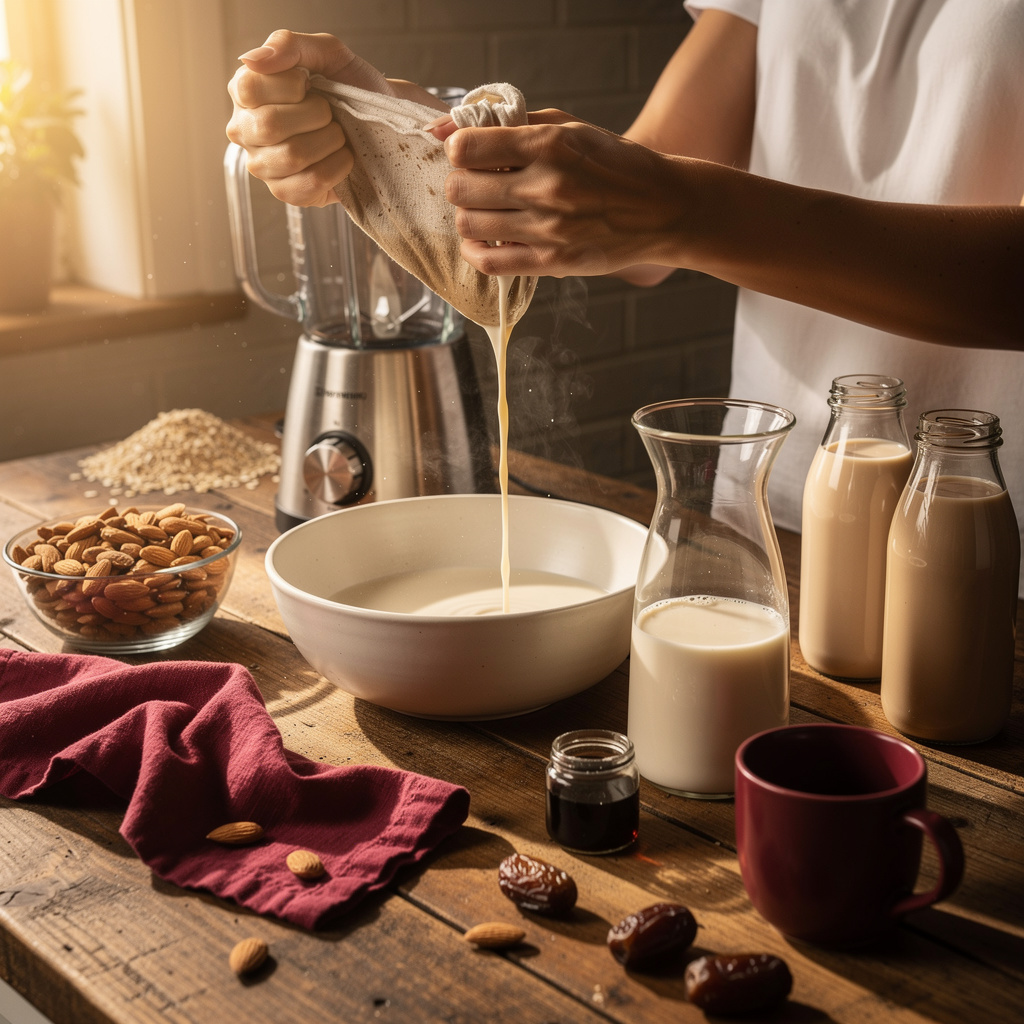
Plant-based milk making is the science and craft of turning plant materials—nuts, grains, legumes, seeds, and blends—into liquid products that resemble, replace, or complement dairy milk. Its scope covers raw material chemistry, hydration and soaking behavior, mechanical extraction, solid-liquid separation, formulation ratios, emulsification and stability, texture, flavor, fortification, thermal processing, hygiene, and shelf-life management. Core concepts include the ingredient functions of water, oil, protein, starch, fiber, emulsifiers, stabilizers, salts, and sweeteners, as well as the balance between particle size, viscosity, mouthfeel, and separation. It also involves understanding how processing steps such as blending speed, temperature, filtration, and heat treatment alter the final product’s sensory and safety profile.
Plant-based milk making matters today because plant-based beverages have moved from niche health-food shelves into mainstream retail, coffee service, food manufacturing, and institutional catering. Consumers increasingly expect clean labels, consistent texture, neutral flavor, and reliable performance in coffee and cooking, while manufacturers face pressure to reduce waste, extend shelf life, and control costs. Recent shifts include more precise formulation for barista-style foaming, broader use of legumes and upcycled ingredients, tighter food-safety scrutiny, and growing academic and industry research on plant protein functionality and emulsion stability. These developments make practical knowledge of extraction, stabilization, and hygienic processing relevant across product development, small-scale entrepreneurship, and food-science education.
Mastering plant-based milk making builds a skill stack that combines ingredient evaluation, process control, formulation design, sensory correction, safety management, and scale-up problem solving. These skills apply in food product development, café and barista operations, small-batch dairy-alternative production, quality assurance, and recipe development for restaurants or retail brands. Home producers benefit from more dependable results and less waste, while industry learners gain a clearer framework for diagnosing separation, grittiness, off-flavors, and shelf-life failures. Because the category continues to diversify, the ability to connect raw material choices to processing outcomes and consumer expectations remains valuable in both professional and personal contexts.
What Will This Course Bring You?
- Analyze the functional roles of water, fat, protein, and hydrocolloids in plant-based milk formulas to predict how ingredient substitutions affect body, stability, and mouthfeel.
- Evaluate raw material selection criteria for nuts, grains, legumes, and seeds by comparing flavor, yield, cost, and sourcing constraints relevant to small-scale plant-based milk production.
- Apply soaking, rinsing, and prep techniques for specific raw materials to reduce bitterness, control microbial load, and improve extraction consistency before blending.
- Design a blending and extraction workflow that balances equipment capability, time, temperature, and batch size to achieve targeted solids dispersion and yield in plant-based milk.
- Implement straining and pulp management procedures that separate fiber effectively while minimizing waste and maintaining desired texture in finished plant-based milks.
- Calculate formulation ratios and build a recipe template that adjusts water, solids, oil, and stabilizer levels to meet target consistency, cost, and nutritional specifications.
- Evaluate heat-treatment, hygiene, and packaging options to design a shelf-life strategy that controls spoilage organisms and preserves safety in plant-based milk production.
- Diagnose common plant-based milk defects such as separation, grittiness, and off-flavors, and implement corrective quality-control and scaling adjustments for consistent batch production.
Curriculum
12 Units1. Foundations of Plant-Based Milk Making
1 hour
2. Ingredient Functions and Formula Roles
1 hour
3. Raw Material Selection and Sourcing
1 hour
4. Soaking, Rinsing, and Prep Techniques
1 hour
5. Blending and Extraction Mechanics
1 hour
6. Straining, Filtration, and Pulp Management
1 hour
7. Formulation Ratios and Recipe Design
1 hour
8. Texture, Stability, and Fortification
1 hour
9. Flavor Development and Off-Flavor Control
1 hour
10. Heat Treatment, Hygiene, and Food Safety
1 hour
11. Shelf Life, Packaging, and Storage
1 hour
12. Troubleshooting, Quality Control, and Scaling
1 hour
Exam – Plant-Based Milk Making
20 Questions • 70% Pass • 30 min
Unlock All Units for Free
Create an account, enroll in the course, and start with the first unit right away.
Exam – Plant-Based Milk Making
20 Questions • Pass: 70% • 30 min
Course Duration
720
Total Minutes
12
Unit
1
Final Exam
~60
Min / Unit
Plant-Based Milk Making Certificate Program
Document Your Skill
Those who pass the 20-question, 30-minute exam with 70% receive the Plant-Based Milk Making Certificate.
Stand Out on Your CV
By adding your certificate to your CV, gain a professional reference in job applications and stand out from the crowd.
Career Advantage
With the verification code, employers can check your certificate instantly — a concrete way to show your growth.
CERTIFICATE FEE
At the end of the course, an online exam consisting of 20 questions with a 30-minute time limit is given. The exam appears automatically after you complete the topics. Anyone who scores at least 70 out of 100 on the certificate exam is awarded the Plant-Based Milk Making Document (certificate of attendance). You can add the certificate you earn to your CV for job applications in the many sectors listed above, and use it as a reference proving that you took this interactive course.
The Certificate of Achievement you receive with the Plant-Based Milk Making course program holds value that proves your personal and professional development in the business world. By adding it to your CV, it can serve as an important reference in your job applications. Moreover, compared with certificates from other private training institutions, Catch Wisdom certificates are offered to our participants at a much more affordable price.
The Plant-Based Milk Making course certificate is a document that proves, with a unique verification code, that you completed the course. Employers can instantly check its authenticity with this code, which helps you show your development concretely in your job applications.
For more information, we recommend visiting the Support page.
Certificate in 7 Languages
Earning success certificates from our courses is now more meaningful and global. With certificates available in Turkish, English, German, French, Spanish, Arabic, and Russian, we fully unlock the potential of students worldwide.
Why Certificate in 7 Languages?
-
01
Global Skill Development
Receiving your certificates in 7 different languages strengthens your communication skills as you engage with more people worldwide. It lets you operate more confidently and capably on the international stage.
-
02
International Job Opportunities
Employers may see your certificates in multiple languages as a sign of your ability to seize global opportunities. You can open more doors to new jobs and projects.
-
03
Cultural Richness
The chance to earn certificates in different languages helps you build closer ties with various cultures and broadens your worldview. It enriches your global perspective and deepens cultural understanding.
-
04
Ability to Participate in International Projects
Multilingual certificates give you an edge to work more effectively on international projects. They boost your chances of leadership and participation in diverse projects in the business world.
-
05
Prove Yourself on the Global Stage
Certificates in multiple languages give you the opportunity to present your skills and knowledge worldwide.
Language diversity opens worldwide opportunities. If you want to prove yourself in the international arena, join our online Plant-Based Milk Making course program and begin this journey with us.
Frequently Asked Questions (FAQ)
Is this course paid?
How do I join the course?
Can I take the course at my own pace?
How can I get my certificate?
What are the advantages of the certificate?
Boost Your Career
Take a new career step with the Plant-Based Milk Making course. Add your certificate to your CV, stand out in job applications, and open the door to new opportunities in the industry.
StartStudent Reviews
No reviews yet
Enroll in this course and be the first to leave a review about your experience with Plant-Based Milk Making.
Start