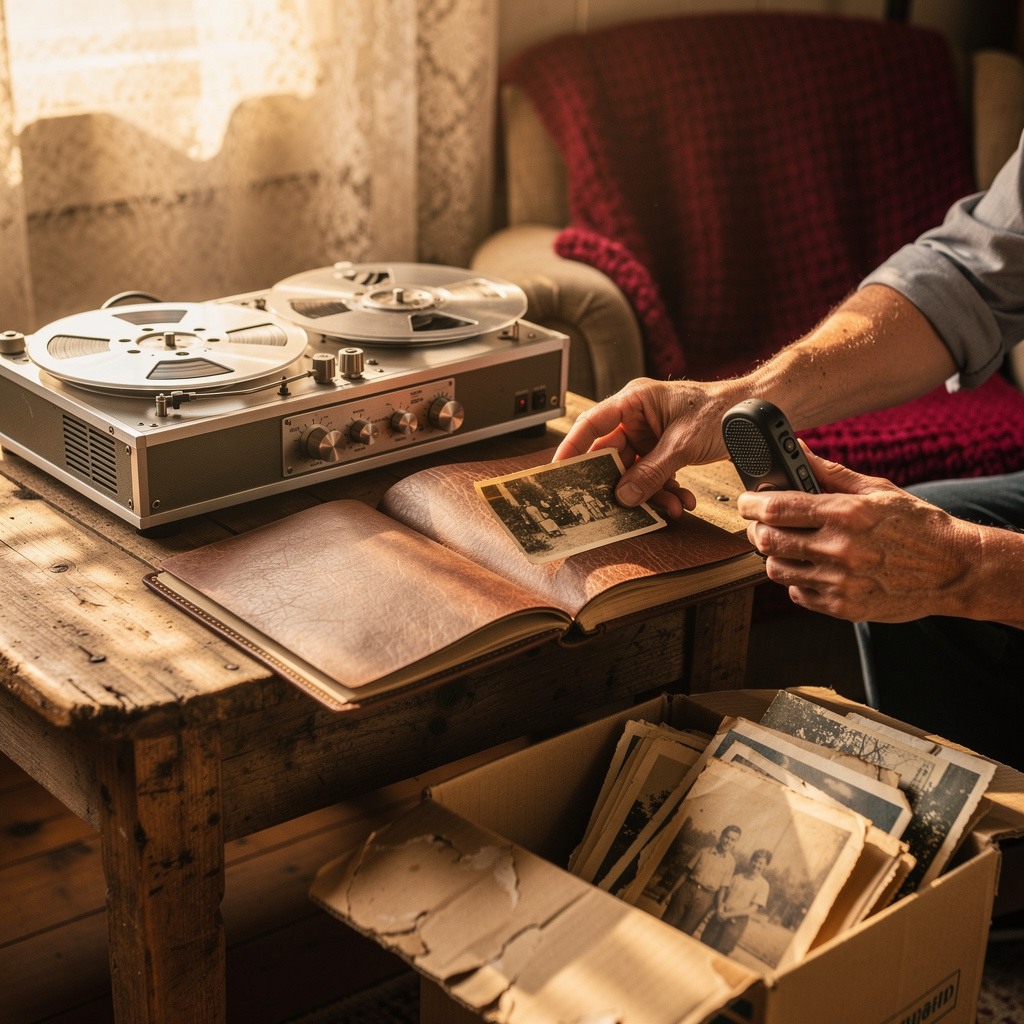
What is Recording Family Stories?
Recording Family Stories Training
The Recording Family Stories certificate program teaches participants how to capture, preserve, and present family narratives through structured audio and video interviews. It is designed for genealogists, oral historians, journalists, and family members who want to document their heritage before it is lost. The main practical outcome is a polished, shareable family story project that weaves recorded interviews, photographs, and documents into a lasting narrative.
The program progresses from foundational concepts like the value of family stories and preparation techniques, through hands-on skills in interviewing, audio and video recording, transcription, and editing, to final stages of organizing, archiving, and sharing. It balances theory with practical exercises, building core competencies in interview technique, technical production, narrative writing, ethical handling of sensitive material, and archival organization. With the growing interest in personal heritage and genealogy, this program equips learners to create meaningful records that families will treasure for generations.
What is Recording Family Stories?
Recording family stories is the practice of systematically capturing the memories, experiences, and wisdom of family members through structured interviews and media production. It encompasses the full arc of oral history work—from preparing interview questions and setting up recording equipment, to conducting conversations that draw out rich narratives, to editing and preserving the final material. Core concepts include active listening, narrative structure, audio and video fidelity, transcription accuracy, and ethical considerations around consent and emotional sensitivity.
In an era of rapid social change and dispersed families, the urgency of preserving personal histories has never been greater. Oral history projects are used by academic researchers, community archives, museums, and genealogy platforms, while families increasingly seek to capture the voices of older generations before they are lost. Recent shifts toward digital storytelling and accessible recording technology have democratized the field, making it possible for anyone with a smartphone to create professional-quality family archives.
Mastering this subject builds a versatile skill stack that includes interviewing, technical media production, narrative writing, and archival management. These competencies are valuable not only for personal genealogy projects but also for careers in journalism, documentary filmmaking, library science, and cultural heritage preservation. The ability to listen deeply, structure a compelling story, and handle sensitive material with care translates directly to professional contexts where human narratives are the core product.
Common Questions About Recording Family Stories
Is the Recording Family Stories course suitable for complete beginners?
Can I complete the Recording Family Stories course at my own pace?
What is the best way to build rapport before starting a family interview?
Why is WAV with 24-bit depth considered the archival standard for audio?
How do I choose between a condenser and a dynamic microphone for recording?
What are the most common mistakes in the digitization workflow for old photos?
- Inventory your photos and note any damage.
- Clean them gently with a soft brush.
- Scan at 300-600 DPI in TIFF format.
- Adjust color and contrast in editing software.
- Save both the raw scan and the edited version.
- Back up everything to at least two locations.
Do I need expensive professional equipment to preserve my family's stories?
What Will This Course Bring You?
- Analyze the personal and historical significance of family stories to identify which narratives merit recording.
- Design a pre-interview preparation plan including question lists, logistics, and consent forms.
- Apply active listening and open-ended questioning techniques to conduct an engaging family story interview.
- Implement proper microphone placement and recording settings to capture clear audio during interviews.
- Evaluate video framing, lighting, and camera stability to produce visually stable interview footage.
- Apply transcription and note-taking methods to accurately document interview content for later use.
- Compose a cohesive narrative that weaves interview excerpts, photos, and documents into a compelling family story.
- Evaluate ethical considerations such as consent, privacy, and emotional impact when sharing family stories.
Curriculum
12 Units1. The Value of Family Stories
1 hour
2. Preparing to Record
1 hour
3. Conducting the Interview
1 hour
4. Audio Recording Essentials
1 hour
5. Video Recording Essentials
1 hour
6. Transcribing and Note-Taking
1 hour
7. Writing the Narrative
1 hour
8. Incorporating Photos and Documents
1 hour
9. Editing Audio and Video
1 hour
10. Ethical and Emotional Considerations
1 hour
11. Organizing and Archiving
1 hour
12. Sharing and Passing On
1 hour
Exam – Recording Family Stories
20 Questions • 70% Pass • 30 min
Unlock All Units for Free
Create an account, enroll in the course, and start with the first unit right away.
Exam – Recording Family Stories
20 Questions • Pass: 70% • 30 min
Course Duration
720
Total Minutes
12
Unit
1
Final Exam
~60
Min / Unit
Recording Family Stories Certificate Program
Document Your Skill
Those who pass the 20-question, 30-minute exam with 70% receive the Recording Family Stories Certificate.
Stand Out on Your CV
By adding your certificate to your CV, gain a professional reference in job applications and stand out from the crowd.
Career Advantage
Catch Wisdom certificates are recognized by HR departments and increase career opportunities.
CERTIFICATE FEE
At the end of the course, an online exam consisting of 20 questions with a 30-minute time limit is given. The exam appears automatically after you complete the topics. Anyone who scores at least 70 out of 100 on the certificate exam is awarded the Recording Family Stories Document (certificate of attendance). You can add the certificate you earn to your CV for job applications in the many sectors listed above, and use it as a reference proving that you took this interactive course.
The Certificate of Achievement you receive with the Recording Family Stories course program holds value that proves your personal and professional development in the business world. By adding it to your CV, it can serve as an important reference in your job applications. Moreover, compared with certificates from other private training institutions, Catch Wisdom certificates are offered to our participants at a much more affordable price.
Because HR departments recognize Catch Wisdom as a reputable institution in this field, they value these certificates and may evaluate your job applications favorably. For this reason, a Recording Family Stories course certificate from Catch Wisdom can make your applications more attractive and place you in an advantageous position in the business world.
For more information, we recommend visiting the Support page.
Certificate in 7 Languages
Earning success certificates from our courses is now more meaningful and global. With certificates available in Turkish, English, German, French, Spanish, Arabic, and Russian, we fully unlock the potential of students worldwide.
Why Certificate in 7 Languages?
-
01
Global Skill Development
Receiving your certificates in 7 different languages strengthens your communication skills as you engage with more people worldwide. It lets you operate more confidently and capably on the international stage.
-
02
International Job Opportunities
Employers may see your certificates in multiple languages as a sign of your ability to seize global opportunities. You can open more doors to new jobs and projects.
-
03
Cultural Richness
The chance to earn certificates in different languages helps you build closer ties with various cultures and broadens your worldview. It enriches your global perspective and deepens cultural understanding.
-
04
Ability to Participate in International Projects
Multilingual certificates give you an edge to work more effectively on international projects. They boost your chances of leadership and participation in diverse projects in the business world.
-
05
Prove Yourself on the Global Stage
Certificates in multiple languages let you showcase your skills and knowledge worldwide. You can become an internationally recognized professional.
Language diversity opens worldwide opportunities. If you want to prove yourself in the international arena, join our online Recording Family Stories course program and begin this journey with us.
Frequently Asked Questions (FAQ)
Is this course paid?
How do I join the course?
Can I take the course at my own pace?
How can I get my certificate?
What are the advantages of the Certified Certificate?
Boost Your Career
Take a new career step with the Recording Family Stories course. Add your certificate to your CV, stand out in job applications, and open the door to new opportunities in the industry.
StartStudent Reviews
No reviews yet
Enroll in this course and be the first to leave a review about your experience with Recording Family Stories.
Start