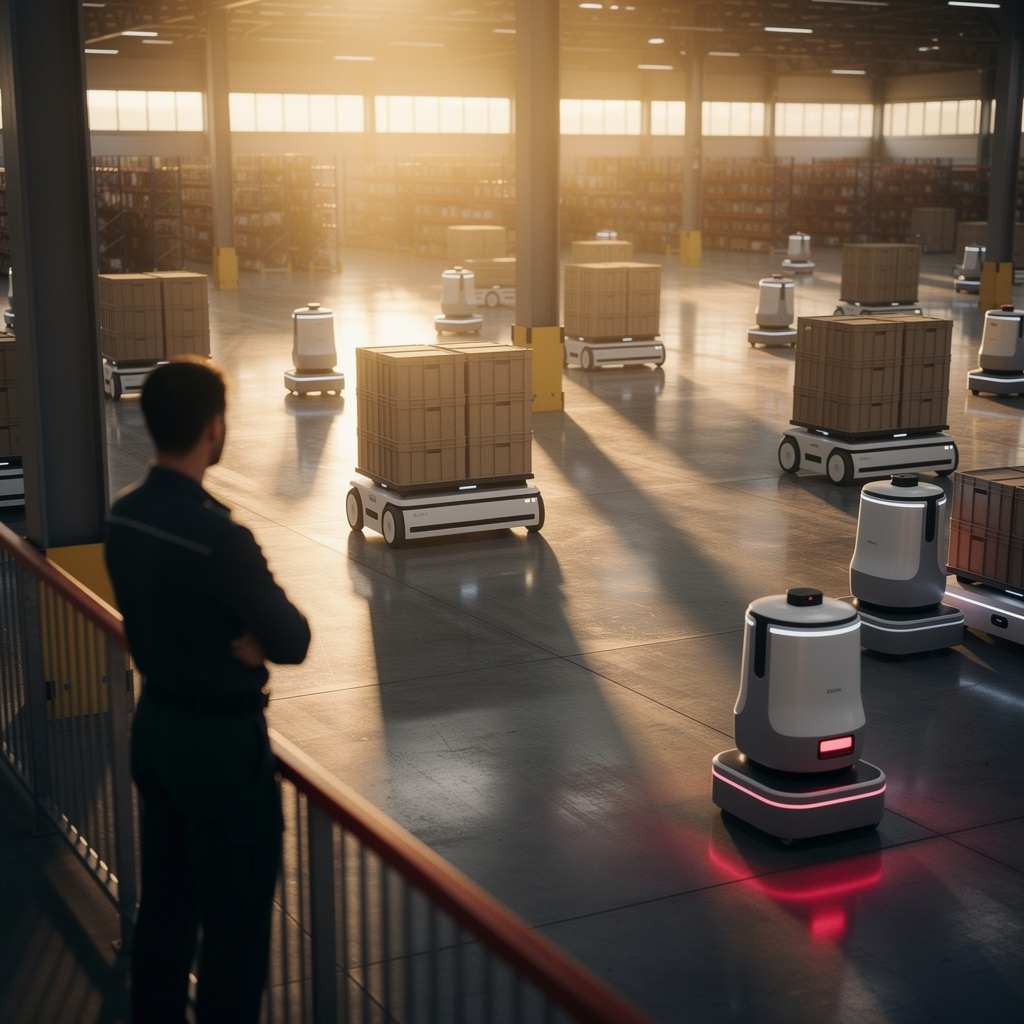
What is Robot Fleet Management?
Robot Fleet Management Training
The Robot Fleet Management certificate program provides a comprehensive foundation for engineers, robotics specialists, and operations managers who need to coordinate multiple autonomous robots working toward shared objectives. This course covers the full lifecycle of fleet operations, from multi-robot localization and mapping to task allocation, path planning, and real-time telemetry. By the end of the program, participants will be able to design, deploy, and supervise a coordinated robot fleet in industrial, logistics, or service environments, with a practical focus on reducing downtime and maximizing throughput.
The program is structured to guide learners from foundational concepts through advanced operational strategies, making it accessible even to those new to multi-robot systems while still offering depth for experienced practitioners. Each lesson builds on the previous one, balancing theoretical frameworks with hands-on simulation exercises and digital twin scenarios that mirror real-world fleet challenges. The curriculum develops five core skill areas: fleet architecture, coordination algorithms, monitoring and recovery, human supervision, and security and safety. With the rapid expansion of warehouse automation, autonomous delivery, and smart factory initiatives, this training equips professionals to lead fleet operations at a moment when the industry is actively seeking these competencies.
What is Robot Fleet Management?
Robot Fleet Management is the discipline of coordinating, monitoring, and optimizing a group of autonomous robots that operate within a shared environment. It encompasses the architectural design of communication infrastructures, multi-robot localization and mapping, task allocation, path planning, traffic management, and fault detection and recovery. At its core, the field is about ensuring that multiple robots work together efficiently and safely, whether they are warehouse AGVs, delivery drones, or mobile robots in a manufacturing plant.
The relevance of robot fleet management has grown dramatically as industries adopt automation at scale. Warehouses, distribution centers, ports, and hospitals now rely on fleets of robots that must navigate dynamic environments, avoid collisions, and coordinate tasks in real time. Recent shifts toward autonomous mobile robots (AMRs) and the integration of digital twin technologies have made fleet management a critical operational discipline, one that directly impacts productivity, safety, and return on investment. As fleets grow larger and more heterogeneous, the need for sophisticated management strategies becomes increasingly urgent.
Mastering robot fleet management builds a versatile skill stack that spans robotics, software engineering, systems thinking, and human-robot interaction. Professionals who develop these competencies are well positioned for roles in robotics engineering, automation management, logistics optimization, and operations consulting. The subject also benefits researchers and entrepreneurs who need to understand how multi-robot systems behave in real-world settings, enabling them to design more resilient and scalable automation solutions.
Common Questions About Robot Fleet Management
Does the robot fleet management certificate help with robotics job applications?
Is this fleet management course suitable for complete beginners in robotics?
How does map merging work when robots don't start together?
Why is the MRTA assignment problem exponentially complex?
How do hot path and cold path differ in the telemetry pipeline?
How do centralized and decentralized fleet architectures compare?
- Centralized: one brain, many hands; easier to optimize but vulnerable to failure.
- Decentralized: many minds, no master; more robust but harder to coordinate.
- Hybrid: combines both to balance control and resilience.
Is managing 50 robots just scaling up single-robot software?
What Will This Course Bring You?
- Analyze foundational concepts of robot fleet management to design scalable operational frameworks.
- Design a communication infrastructure enabling reliable data exchange across heterogeneous robot fleets.
- Apply multi-robot localization and mapping techniques to maintain accurate spatial awareness in dynamic environments.
- Evaluate task allocation and scheduling algorithms to optimize fleet productivity under resource constraints.
- Implement path planning and traffic management strategies to prevent collisions and ensure efficient navigation.
- Use simulation and digital twins to predict fleet behavior and validate operational scenarios before deployment.
- Develop fault detection and recovery mechanisms to enhance fleet resilience and minimize operational downtime.
- Assess security and safety protocols to protect robot fleets from cyber threats and physical hazards.
Curriculum
12 Units1. Foundations of Robot Fleet Management
1 hour
2. Fleet Architecture and Communication Infrastructure
1 hour
3. Multi-Robot Localization and Mapping
1 hour
4. Task Allocation and Scheduling
1 hour
5. Path Planning and Traffic Management
1 hour
6. Fleet Monitoring and Telemetry
1 hour
7. Simulation and Digital Twins for Fleets
1 hour
8. Fault Detection and Recovery
1 hour
9. Human-Robot Interaction and Supervision
1 hour
10. Fleet Management Software and Platforms
1 hour
11. Security and Safety in Robot Fleets
1 hour
12. Scaling and Optimizing Fleet Operations
1 hour
Exam – Robot Fleet Management
20 Questions • 70% Pass • 30 min
Unlock All Units for Free
Create an account, enroll in the course, and start with the first unit right away.
Exam – Robot Fleet Management
20 Questions • Pass: 70% • 30 min
Course Duration
720
Total Minutes
12
Unit
1
Final Exam
~60
Min / Unit
Robot Fleet Management Certificate Program
Document Your Skill
Those who pass the 20-question, 30-minute exam with 70% receive the Robot Fleet Management Certificate.
Stand Out on Your CV
By adding your certificate to your CV, gain a professional reference in job applications and stand out from the crowd.
Career Advantage
Catch Wisdom certificates are recognized by HR departments and increase career opportunities.
CERTIFICATE FEE
At the end of the course, an online exam consisting of 20 questions with a 30-minute time limit is given. The exam appears automatically after you complete the topics. Anyone who scores at least 70 out of 100 on the certificate exam is awarded the Robot Fleet Management Document (certificate of attendance). You can add the certificate you earn to your CV for job applications in the many sectors listed above, and use it as a reference proving that you took this interactive course.
The Certificate of Achievement you receive with the Robot Fleet Management course program holds value that proves your personal and professional development in the business world. By adding it to your CV, it can serve as an important reference in your job applications. Moreover, compared with certificates from other private training institutions, Catch Wisdom certificates are offered to our participants at a much more affordable price.
Because HR departments recognize Catch Wisdom as a reputable institution in this field, they value these certificates and may evaluate your job applications favorably. For this reason, a Robot Fleet Management course certificate from Catch Wisdom can make your applications more attractive and place you in an advantageous position in the business world.
For more information, we recommend visiting the Support page.
Certificate in 7 Languages
Earning success certificates from our courses is now more meaningful and global. With certificates available in Turkish, English, German, French, Spanish, Arabic, and Russian, we fully unlock the potential of students worldwide.
Why Certificate in 7 Languages?
-
01
Global Skill Development
Receiving your certificates in 7 different languages strengthens your communication skills as you engage with more people worldwide. It lets you operate more confidently and capably on the international stage.
-
02
International Job Opportunities
Employers may see your certificates in multiple languages as a sign of your ability to seize global opportunities. You can open more doors to new jobs and projects.
-
03
Cultural Richness
The chance to earn certificates in different languages helps you build closer ties with various cultures and broadens your worldview. It enriches your global perspective and deepens cultural understanding.
-
04
Ability to Participate in International Projects
Multilingual certificates give you an edge to work more effectively on international projects. They boost your chances of leadership and participation in diverse projects in the business world.
-
05
Prove Yourself on the Global Stage
Certificates in multiple languages let you showcase your skills and knowledge worldwide. You can become an internationally recognized professional.
Language diversity opens worldwide opportunities. If you want to prove yourself in the international arena, join our online Robot Fleet Management course program and begin this journey with us.
Frequently Asked Questions (FAQ)
Is this course paid?
How do I join the course?
Can I take the course at my own pace?
How can I get my certificate?
What are the advantages of the Certified Certificate?
Boost Your Career
Take a new career step with the Robot Fleet Management course. Add your certificate to your CV, stand out in job applications, and open the door to new opportunities in the industry.
StartStudent Reviews
No reviews yet
Enroll in this course and be the first to leave a review about your experience with Robot Fleet Management.
Start