What is Sculpture Fundamentals?
Sculpture Fundamentals Certificate Program
Sculpture Fundamentals certificate program provides a comprehensive foundation in the art and craft of three-dimensional creation, guiding learners from initial perception of form through to finished, documented works. It covers the essential language of sculptural composition, studio safety, and the major material families, then moves into hands-on techniques such as additive clay modeling, armature building, wood and stone carving, mold making, plaster casting, construction, assemblage, and mixed media. The program also addresses relief sculpture from low to high, figure and portrait work, abstraction and maquette development, and the professional finishing and presentation of sculptures. It is designed for aspiring and practicing artists, designers, art students, hobbyists, and anyone who wants to think and make in three dimensions, with no prior experience required. The main practical outcome is the ability to confidently plan, build, and complete original sculptural pieces across multiple materials while understanding the structural and aesthetic decisions behind them.
The program is structured as a beginner-friendly progression that balances conceptual theory with intensive studio practice, beginning with seeing form in three dimensions and the language of composition before introducing tools, safety, and material families. Learners then cycle through four core skill areas: additive modeling and armature construction, subtractive carving in wood and stone, reproduction through mold making and plaster casting, and constructional approaches including assemblage, mixed media, and relief. A fifth area—concept development, abstraction, maquettes, and finishing—runs throughout, culminating in figure and portrait sculpture and professional documentation. Each lesson builds on the last, so students develop hand skills, material intuition, and structural problem-solving in a logical sequence. This program is worth choosing now because tactile, three-dimensional literacy is increasingly valuable in a screen-dominated world, and it opens doors to traditional studio practice, public art, design prototyping, and interdisciplinary creative work.
What is Sculpture Fundamentals?
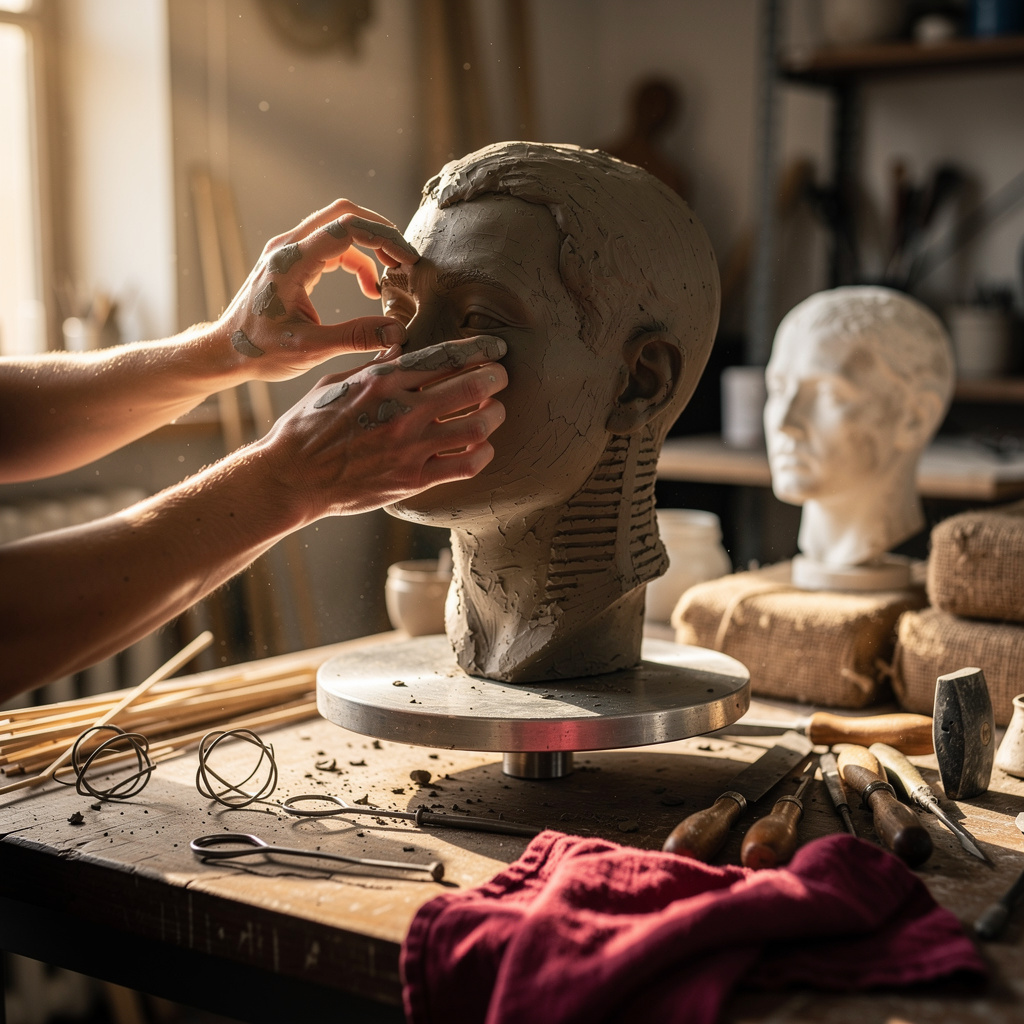
Sculpture fundamentals is the study of three-dimensional form—its mass, volume, plane, line, texture, and spatial presence—and the core methods by which artists conceive, construct, and finish physical objects. It encompasses the language of composition in space, the behavior of materials such as clay, wood, stone, plaster, and mixed media, and the structural logic of armatures and supports. Key concepts include additive and subtractive processes, mold making and casting, relief carving from low to high, figure and portrait modeling, abstraction, and the role of maquettes in concept development. The subject also covers studio safety, tool selection, and the presentation and documentation of finished work.
Sculpture fundamentals remains highly relevant today because three-dimensional thinking underpins fields as diverse as fine art, architecture, industrial design, film and game production, prosthetics, and public installation art. Recent shifts toward digital sculpting, 3D printing, and virtual reality have not replaced traditional skills; instead, they have increased demand for artists who understand real-world mass, balance, and material behavior. In academia, sculpture fundamentals is a cornerstone of studio art programs, while in industry it supports model making, set design, product prototyping, and conservation. There is also a growing cultural appetite for handmade, tactile, and sustainable objects, which makes foundational sculpture knowledge more valuable than ever.
Mastering sculpture fundamentals builds a distinctive skill stack: spatial reasoning, manual dexterity, material literacy, structural engineering intuition, and the ability to translate an idea into a physical object. It also cultivates patience, iterative problem-solving, and visual communication—skills that transfer to collaborative projects, teaching, and creative direction. Professionally, this subject supports careers as a sculptor, model maker, fabricator, set designer, art director, conservator, or art educator, while personally it offers a deeply satisfying way to engage with the physical world. Whether in a studio, a classroom, a workshop, or a community art center, the knowledge of form, material, and process empowers learners to make meaningful three-dimensional work.
Common Questions About Sculpture Fundamentals
Can complete beginners join this sculpture course with zero experience?
Will this sculpture course help me build a portfolio for applications?
How do you tell shape from form when a sculpture occupies space?
- Silhouette test: squint until detail disappears; if what remains is a flat outline, you have drawn, not built.
- Two families of form: closed masses that push outward and open forms that enclose air behave differently under light, and they demand different structural answers.
- Movement test: walk a quarter turn around the piece; if nothing new is revealed, the form is still a shape with thickness.
What is the most common mistake when building an armature for clay?
How does wedging prepare a clay body before additive modeling?
- Air removal: pockets trapped during storage expand when heated and split the piece from inside.
- Moisture equalizing: soft and stiff patches dry at different rates, and uneven shrinkage is what opens seams.
- Wedge-ability: the feel of the mass tells you whether the body is ready for armature work or needs to rest.
Why must a waste mold be destroyed to free the plaster cast?
The cycle is fairly short — build the shell, let it harden, then chip it away, working slowly near the surface. Dividing a model is a separate skill, handled with flashing, plates, and collars, where the aim is a mold that survives. Keeping the two approaches distinct prevents the frustration of building elaborate sections on a model that was always going to surrender its mold.
Do you really need natural talent to learn sculpture from scratch?
What Will This Course Bring You?
- Analyze three-dimensional form by observing mass, volume, plane, and negative space in sculptural objects and maquettes.
- Apply sculptural composition principles such as balance, rhythm, scale, and focal point when designing original three-dimensional artworks.
- Implement studio safety protocols while selecting and using hand tools, power tools, and material families for clay, wood, stone, plaster, and mixed media.
- Build additive clay sculptures using pinching, coiling, slab construction, and joining techniques to create stable three-dimensional forms.
- Construct armatures and structural supports that safely bear the weight and gesture of modeled clay figures or abstract forms.
- Carve wood or stone by evaluating grain, hardness, and tool direction to remove material and reveal intended forms.
- Create plaster casts from flexible and rigid molds, then evaluate surface detail, undercuts, and release agents for successful reproductions.
- Design and present a finished sculpture with a maquette, artist statement, and documentation photographs that communicate concept and process.
Curriculum
12 Units1. Seeing Form in Three Dimensions
1 hour
2. The Language of Sculptural Composition
1 hour
3. Studio Safety, Tools, and Material Families
1 hour
4. Additive Modeling with Clay
1 hour
5. Armatures and Structural Support
1 hour
6. Carving Wood and Stone
1 hour
7. Mold Making and Plaster Casting
1 hour
8. Construction, Assemblage, and Mixed Media
1 hour
9. Relief Sculpture from Low to High
1 hour
10. Figure and Portrait Sculpture
1 hour
11. Abstraction, Maquettes, and Concept Development
1 hour
12. Finishing, Presentation, and Documentation
1 hour
Exam – Sculpture Fundamentals
20 Questions • 70% Pass • 30 min
Unlock All Units for Free
Create an account, enroll in the course, and start with the first unit right away.
Exam – Sculpture Fundamentals
20 Questions • Pass: 70% • 30 min
Course Duration
720
Total Minutes
12
Unit
1
Final Exam
~60
Min / Unit
Sculpture Fundamentals Certificate Program
Document Your Skill
Those who pass the 20-question, 30-minute exam with 70% receive the Sculpture Fundamentals Certificate.
Stand Out on Your CV
By adding your certificate to your CV, gain a professional reference in job applications and stand out from the crowd.
Career Advantage
With the verification code, employers can check your certificate instantly — a concrete way to show your growth.
CERTIFICATE FEE
At the end of the course, an online exam consisting of 20 questions with a 30-minute time limit is given. The exam appears automatically after you complete the topics. Anyone who scores at least 70 out of 100 on the certificate exam is awarded the Sculpture Fundamentals Document (certificate of attendance). You can add the certificate you earn to your CV for job applications in the many sectors listed above, and use it as a reference proving that you took this interactive course.
The Certificate of Achievement you receive with the Sculpture Fundamentals course program holds value that proves your personal and professional development in the business world. By adding it to your CV, it can serve as an important reference in your job applications. Moreover, compared with certificates from other private training institutions, Catch Wisdom certificates are offered to our participants at a much more affordable price.
The Sculpture Fundamentals course certificate is a document that proves, with a unique verification code, that you completed the course. Employers can instantly check its authenticity with this code, which helps you show your development concretely in your job applications.
For more information, we recommend visiting the Support page.
Certificate in 7 Languages
Earning success certificates from our courses is now more meaningful and global. With certificates available in Turkish, English, German, French, Spanish, Arabic, and Russian, we fully unlock the potential of students worldwide.
Why Certificate in 7 Languages?
-
01
Global Skill Development
Receiving your certificates in 7 different languages strengthens your communication skills as you engage with more people worldwide. It lets you operate more confidently and capably on the international stage.
-
02
International Job Opportunities
Employers may see your certificates in multiple languages as a sign of your ability to seize global opportunities. You can open more doors to new jobs and projects.
-
03
Cultural Richness
The chance to earn certificates in different languages helps you build closer ties with various cultures and broadens your worldview. It enriches your global perspective and deepens cultural understanding.
-
04
Ability to Participate in International Projects
Multilingual certificates give you an edge to work more effectively on international projects. They boost your chances of leadership and participation in diverse projects in the business world.
-
05
Prove Yourself on the Global Stage
Certificates in multiple languages give you the opportunity to present your skills and knowledge worldwide.
Language diversity opens worldwide opportunities. If you want to prove yourself in the international arena, join our online Sculpture Fundamentals course program and begin this journey with us.
Frequently Asked Questions (FAQ)
Is this course paid?
How do I join the course?
Can I take the course at my own pace?
How can I get my certificate?
What are the advantages of the certificate?
Boost Your Career
Take a new career step with the Sculpture Fundamentals course. Add your certificate to your CV, stand out in job applications, and open the door to new opportunities in the industry.
StartStudent Reviews
No reviews yet
Enroll in this course and be the first to leave a review about your experience with Sculpture Fundamentals.
Start