What is Sleep Science Fundamentals?
Sleep Science Fundamentals Training
The Sleep Science Fundamentals certificate program provides a comprehensive exploration of the biological, psychological, and behavioral dimensions of sleep. Designed for healthcare professionals, wellness coaches, students, and anyone seeking to understand the science behind rest, this course delivers a practical framework for applying sleep principles to improve personal and client well-being. By the end, participants will be equipped to assess sleep patterns, identify common disorders, and implement evidence-based interventions for better sleep health.
The program is structured as a beginner-friendly progression that balances foundational theory with real-world application, starting with the purpose and architecture of sleep before moving into circadian rhythms, neurobiology, and the two-process model. It builds core competencies across four key areas: sleep physiology and regulation, lifespan and health impacts, behavioral and cognitive effects, and measurement and research methods. With sleep science gaining urgency in fields from sports performance to mental health, this training offers timely, actionable knowledge for anyone looking to integrate sleep expertise into their professional or personal toolkit.
What is Sleep Science Fundamentals? — in en
Sleep science fundamentals encompass the interdisciplinary study of sleep as a vital biological process, covering its purpose, stages, regulation, and impact on human health and performance. Core concepts include sleep architecture—the cycling through NREM and REM stages—circadian rhythms governed by the suprachiasmatic nucleus, and sleep homeostasis, which together form the two-process model of sleep regulation. The field also examines how sleep changes across the lifespan, the neurobiological mechanisms underlying sleep-wake states, and the physiological systems—immune, cardiovascular, metabolic—that are intimately linked to sleep quality.
Today, sleep science matters more than ever as modern lifestyles increasingly disrupt natural sleep patterns, contributing to epidemics of insomnia, sleep apnea, and circadian misalignment. It is applied in clinical settings for diagnosing and managing sleep disorders, in workplace wellness programs to enhance productivity and safety, and in athletic training to optimize recovery and performance. Recent shifts, such as the rise of wearable sleep trackers and the integration of sleep hygiene into public health campaigns, have brought sleep science into mainstream awareness, making it a critical area of knowledge for both professionals and the general public.
Mastering sleep science fundamentals builds a skill stack that includes the ability to interpret sleep data, evaluate sleep hygiene practices, understand the bidirectional links between sleep and mental health, and apply behavioral interventions like cognitive behavioral therapy for insomnia. This knowledge benefits healthcare practitioners, educators, coaches, and individuals seeking to improve their own rest and resilience. Whether used to guide clinical decisions, design evidence-based wellness programs, or simply make informed lifestyle choices, a solid grasp of sleep science empowers learners to address one of the most foundational pillars of health.
Common Questions About Sleep Science Fundamentals
Is Sleep Science Fundamentals suitable for complete beginners?
Does the course offer practical sleep hygiene techniques?
How does the glymphatic system clean the brain during sleep?
What is the difference between NREM and REM sleep stages?
- NREM (Non‑Rapid Eye Movement) sleep includes stages N1, N2, and N3, characterized by slow brain waves, reduced muscle activity, and minimal dreaming. It is often called restorative sleep, supporting physical repair and growth hormone release.
- REM (Rapid Eye Movement) sleep features rapid eye movements, vivid dreaming, and muscle atonia (temporary paralysis of most muscles). It is crucial for memory consolidation, emotional regulation, and brain development.
How does the suprachiasmatic nucleus regulate circadian rhythms?
What is the two-process model of sleep regulation?
Can you fully catch up on lost sleep over the weekend?
What Will This Course Bring You?
- Analyze the two-process model of sleep regulation by evaluating the interaction between circadian rhythm and sleep homeostatic drive.
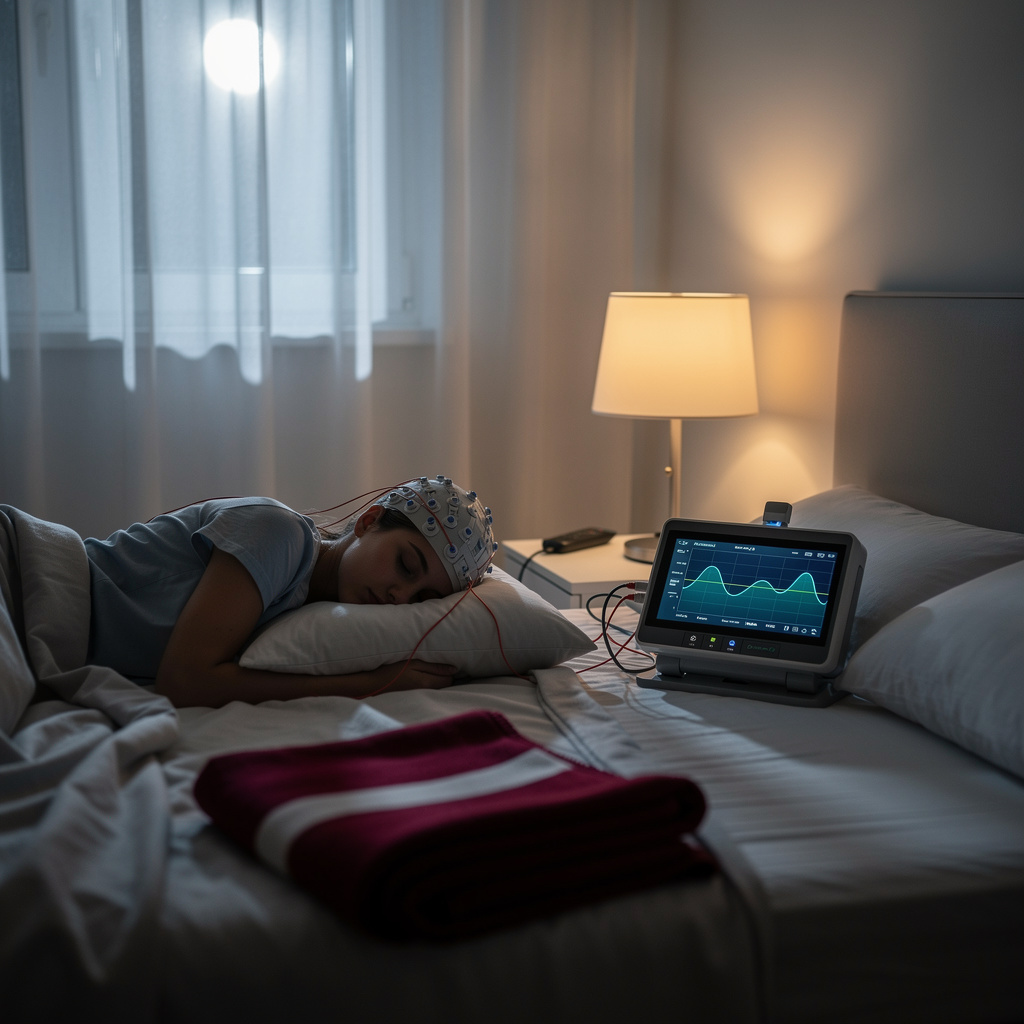
- Differentiate the stages of sleep architecture, including NREM and REM, based on polysomnographic features.
- Evaluate the impact of common sleep disorders such as insomnia and sleep apnea on physical health outcomes.
- Design a personalized sleep hygiene intervention plan incorporating behavioral strategies to improve sleep quality.
- Explain the neurobiological mechanisms underlying sleep-wake regulation, including the roles of the hypothalamus and brainstem.
- Assess the relationship between sleep duration and cognitive performance, particularly in memory consolidation and executive function.
- Compare sleep patterns across the lifespan, from infancy to older adulthood, identifying key developmental changes.
- Apply principles of sleep measurement, including actigraphy and polysomnography, to interpret sleep research data.
Curriculum
12 Units1. The Purpose and Importance of Sleep
1 hour
2. Sleep Architecture and Stages
1 hour
3. Circadian Rhythms and the Biological Clock
1 hour
4. Sleep Homeostasis and the Two-Process Model
1 hour
5. Sleep Across the Lifespan
1 hour
6. The Neurobiology of Sleep
1 hour
7. Common Sleep Disorders
1 hour
8. Sleep and Physical Health
1 hour
9. Sleep Hygiene and Behavioral Interventions
1 hour
10. Sleep and Mental Health
1 hour
11. Sleep, Cognition, and Performance
1 hour
12. Measuring and Researching Sleep
1 hour
Exam – Sleep Science Fundamentals
20 Questions • 70% Pass • 30 min
Unlock All Units for Free
Create an account, enroll in the course, and start with the first unit right away.
Exam – Sleep Science Fundamentals
20 Questions • Pass: 70% • 30 min
Course Duration
720
Total Minutes
12
Unit
1
Final Exam
~60
Min / Unit
Sleep Science Fundamentals Certificate Program
Document Your Skill
Those who pass the 20-question, 30-minute exam with 70% receive the Sleep Science Fundamentals Certificate.
Stand Out on Your CV
By adding your certificate to your CV, gain a professional reference in job applications and stand out from the crowd.
Career Advantage
With the verification code, employers can check your certificate instantly — a concrete way to show your growth.
CERTIFICATE FEE
At the end of the course, an online exam consisting of 20 questions with a 30-minute time limit is given. The exam appears automatically after you complete the topics. Anyone who scores at least 70 out of 100 on the certificate exam is awarded the Sleep Science Fundamentals Document (certificate of attendance). You can add the certificate you earn to your CV for job applications in the many sectors listed above, and use it as a reference proving that you took this interactive course.
The Certificate of Achievement you receive with the Sleep Science Fundamentals course program holds value that proves your personal and professional development in the business world. By adding it to your CV, it can serve as an important reference in your job applications. Moreover, compared with certificates from other private training institutions, Catch Wisdom certificates are offered to our participants at a much more affordable price.
The Sleep Science Fundamentals course certificate is a document that proves, with a unique verification code, that you completed the course. Employers can instantly check its authenticity with this code, which helps you show your development concretely in your job applications.
For more information, we recommend visiting the Support page.
Certificate in 7 Languages
Earning success certificates from our courses is now more meaningful and global. With certificates available in Turkish, English, German, French, Spanish, Arabic, and Russian, we fully unlock the potential of students worldwide.
Why Certificate in 7 Languages?
-
01
Global Skill Development
Receiving your certificates in 7 different languages strengthens your communication skills as you engage with more people worldwide. It lets you operate more confidently and capably on the international stage.
-
02
International Job Opportunities
Employers may see your certificates in multiple languages as a sign of your ability to seize global opportunities. You can open more doors to new jobs and projects.
-
03
Cultural Richness
The chance to earn certificates in different languages helps you build closer ties with various cultures and broadens your worldview. It enriches your global perspective and deepens cultural understanding.
-
04
Ability to Participate in International Projects
Multilingual certificates give you an edge to work more effectively on international projects. They boost your chances of leadership and participation in diverse projects in the business world.
-
05
Prove Yourself on the Global Stage
Certificates in multiple languages give you the opportunity to present your skills and knowledge worldwide.
Language diversity opens worldwide opportunities. If you want to prove yourself in the international arena, join our online Sleep Science Fundamentals course program and begin this journey with us.
Frequently Asked Questions (FAQ)
Is this course paid?
How do I join the course?
Can I take the course at my own pace?
How can I get my certificate?
What are the advantages of the certificate?
Boost Your Career
Take a new career step with the Sleep Science Fundamentals course. Add your certificate to your CV, stand out in job applications, and open the door to new opportunities in the industry.
StartStudent Reviews
No reviews yet
Enroll in this course and be the first to leave a review about your experience with Sleep Science Fundamentals.
Start