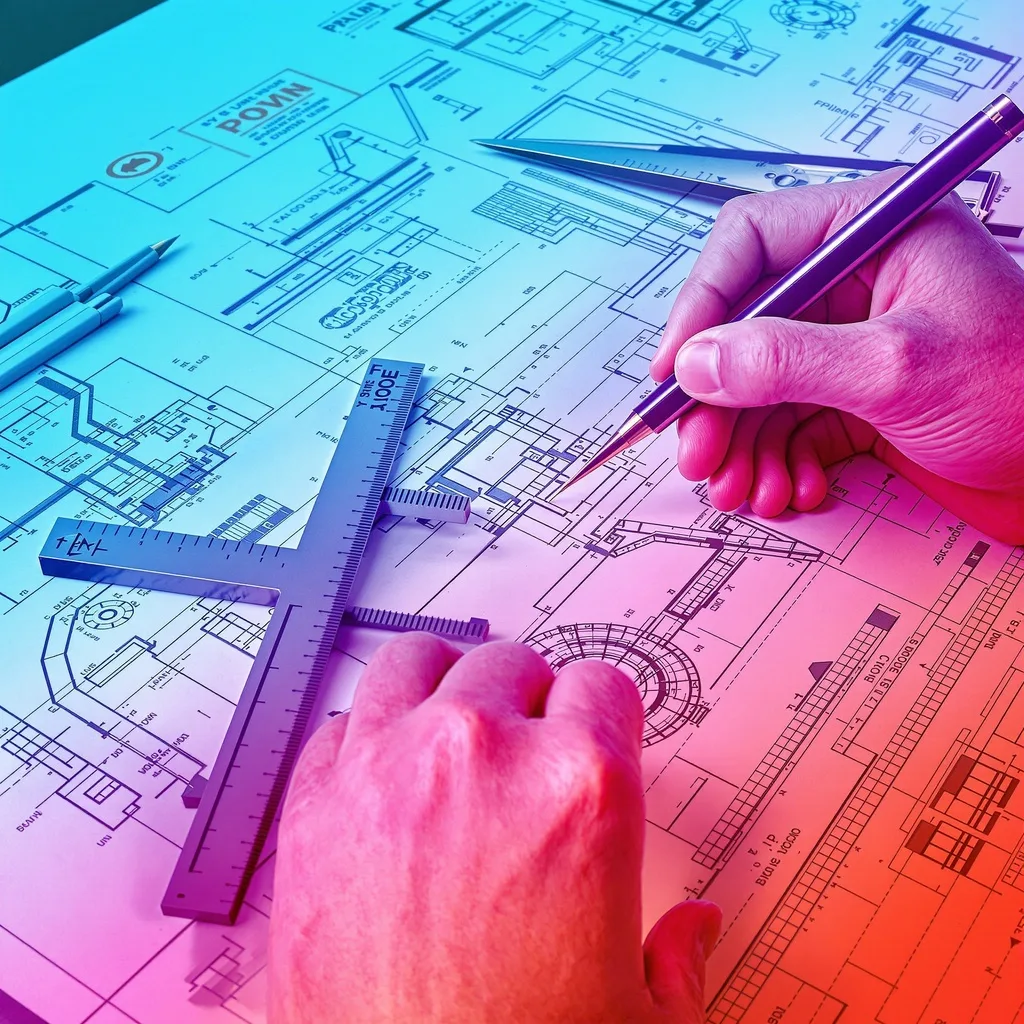
What is Technical Drawing?
Technical Drawing Training
The Technical Drawing certificate program teaches you how to create precise, standardized drawings used in engineering, architecture, and manufacturing. It is designed for beginners and professionals seeking to master the visual language of design, from hand-drafted sketches to modern CAD outputs. By the end, you will be able to produce clear orthographic projections, isometric views, and dimensioned assembly drawings that meet industry standards.
The program follows a beginner-friendly progression, starting with fundamental tools and line types before advancing to complex topics like tolerances, section views, and auxiliary projections. Each lesson balances theoretical principles with hands-on practice, building four core skill areas: manual drafting techniques, geometric construction, measurement and scaling, and introductory CAD proficiency. This structured approach ensures you gain both the conceptual understanding and the practical competence needed to communicate technical ideas effectively in today’s engineering and design environments.
What is Technical Drawing?
Technical drawing is the universal method of representing objects, structures, and systems through standardized graphical conventions. Its core concepts include orthographic projection, isometric views, sectioning, dimensioning, and tolerancing — all of which allow designers to convey exact shape, size, and material specifications. Unlike artistic drawing, technical drawing prioritizes clarity, accuracy, and reproducibility, forming the backbone of product development and construction documentation.
Today, technical drawing remains indispensable across industries such as mechanical engineering, civil engineering, architecture, and product design. While CAD software has automated many drafting tasks, the underlying principles of projection, scale, and annotation are still essential for interpreting and creating blueprints, assembly instructions, and quality control documents. Recent shifts toward digital collaboration and 3D modeling have only increased the need for professionals who can bridge traditional drafting knowledge with modern tools.
Mastering technical drawing builds a skill stack that includes spatial reasoning, attention to detail, and the ability to read and produce standardized technical documents. These competencies are directly applicable in roles like drafter, design engineer, architect, machinist, and project manager. Whether you are creating a simple bracket drawing or a complex assembly layout, this subject equips you with the visual language and precision required to turn ideas into manufacturable reality.
Common Questions About Technical Drawing
Will a Technical Drawing certificate help me get an engineering job?
Is this Technical Drawing course suitable for complete beginners?
Why are hidden lines important in orthographic projection?
How do you choose the right scale for a technical drawing?
- Full scale (1:1) is used when the object fits the drawing sheet.
- Reduction scales (e.g., 1:50, 1:100) are for large objects like buildings.
- Enlargement scales (e.g., 2:1, 5:1) are for small parts that need detail.
What is the difference between isometric and orthographic drawing?
What are the common mistakes in dimensioning technical drawings?
- Over-dimensioning – repeating the same dimension in multiple views, causing clutter.
- Missing critical dimensions – omitting key measurements needed for manufacturing.
- Inconsistent units – mixing millimeters and inches without clear notation.
- Placing dimensions on hidden lines – making them hard to read.
- Ignoring standard placement – not following rules like keeping dimensions outside the view when possible.
Is technical drawing only for architects and engineers?
What Will This Course Bring You?
- Select and use appropriate drawing tools and equipment to produce precise technical drawings.
- Apply standard line types and lettering conventions to ensure clear communication in drawings.
- Calculate and implement proper scales and measurements to accurately represent object dimensions.
- Construct geometric shapes using compass and straightedge techniques for complex technical designs.
- Generate accurate orthographic projections from three-dimensional objects to create multi-view drawings.
- Create isometric drawings to depict three-dimensional objects in a single pictorial view.
- Develop section views to reveal internal features of objects using appropriate cutting planes.
- Apply dimensioning rules and tolerances to specify allowable variations in manufactured parts.
Curriculum
12 Units1. Drawing Tools and Equipment
1 hour
2. Line Types and Lettering
1 hour
3. Scales and Measurement
1 hour
4. Geometric Constructions
1 hour
5. Orthographic Projection
1 hour
6. Isometric Drawing
1 hour
7. Section Views
1 hour
8. Dimensioning
1 hour
9. Tolerances and Fits
1 hour
10. Auxiliary Views
1 hour
11. Assembly Drawings
1 hour
12. Introduction to CAD for Technical Drawing
1 hour
Exam – Technical Drawing
20 Questions • 70% Pass • 30 min
Unlock All Units for Free
Create an account, enroll in the course, and start with the first unit right away.
Exam – Technical Drawing
20 Questions • Pass: 70% • 30 min
Course Duration
720
Total Minutes
12
Unit
1
Final Exam
~60
Min / Unit
Technical Drawing Certificate Program
Document Your Skill
Those who pass the 20-question, 30-minute exam with 70% receive the Technical Drawing Certificate.
Stand Out on Your CV
By adding your certificate to your CV, gain a professional reference in job applications and stand out from the crowd.
Career Advantage
With the verification code, employers can check your certificate instantly — a concrete way to show your growth.
CERTIFICATE FEE
At the end of the course, an online exam consisting of 20 questions with a 30-minute time limit is given. The exam appears automatically after you complete the topics. Anyone who scores at least 70 out of 100 on the certificate exam is awarded the Technical Drawing Document (certificate of attendance). You can add the certificate you earn to your CV for job applications in the many sectors listed above, and use it as a reference proving that you took this interactive course.
The Certificate of Achievement you receive with the Technical Drawing course program holds value that proves your personal and professional development in the business world. By adding it to your CV, it can serve as an important reference in your job applications. Moreover, compared with certificates from other private training institutions, Catch Wisdom certificates are offered to our participants at a much more affordable price.
The Technical Drawing course certificate is a document that proves, with a unique verification code, that you completed the course. Employers can instantly check its authenticity with this code, which helps you show your development concretely in your job applications.
For more information, we recommend visiting the Support page.
Certificate in 7 Languages
Earning success certificates from our courses is now more meaningful and global. With certificates available in Turkish, English, German, French, Spanish, Arabic, and Russian, we fully unlock the potential of students worldwide.
Why Certificate in 7 Languages?
-
01
Global Skill Development
Receiving your certificates in 7 different languages strengthens your communication skills as you engage with more people worldwide. It lets you operate more confidently and capably on the international stage.
-
02
International Job Opportunities
Employers may see your certificates in multiple languages as a sign of your ability to seize global opportunities. You can open more doors to new jobs and projects.
-
03
Cultural Richness
The chance to earn certificates in different languages helps you build closer ties with various cultures and broadens your worldview. It enriches your global perspective and deepens cultural understanding.
-
04
Ability to Participate in International Projects
Multilingual certificates give you an edge to work more effectively on international projects. They boost your chances of leadership and participation in diverse projects in the business world.
-
05
Prove Yourself on the Global Stage
Certificates in multiple languages give you the opportunity to present your skills and knowledge worldwide.
Language diversity opens worldwide opportunities. If you want to prove yourself in the international arena, join our online Technical Drawing course program and begin this journey with us.
Frequently Asked Questions (FAQ)
Is this course paid?
How do I join the course?
Can I take the course at my own pace?
How can I get my certificate?
What are the advantages of the certificate?
Boost Your Career
Take a new career step with the Technical Drawing course. Add your certificate to your CV, stand out in job applications, and open the door to new opportunities in the industry.
StartStudent Reviews
No reviews yet
Enroll in this course and be the first to leave a review about your experience with Technical Drawing.
Start