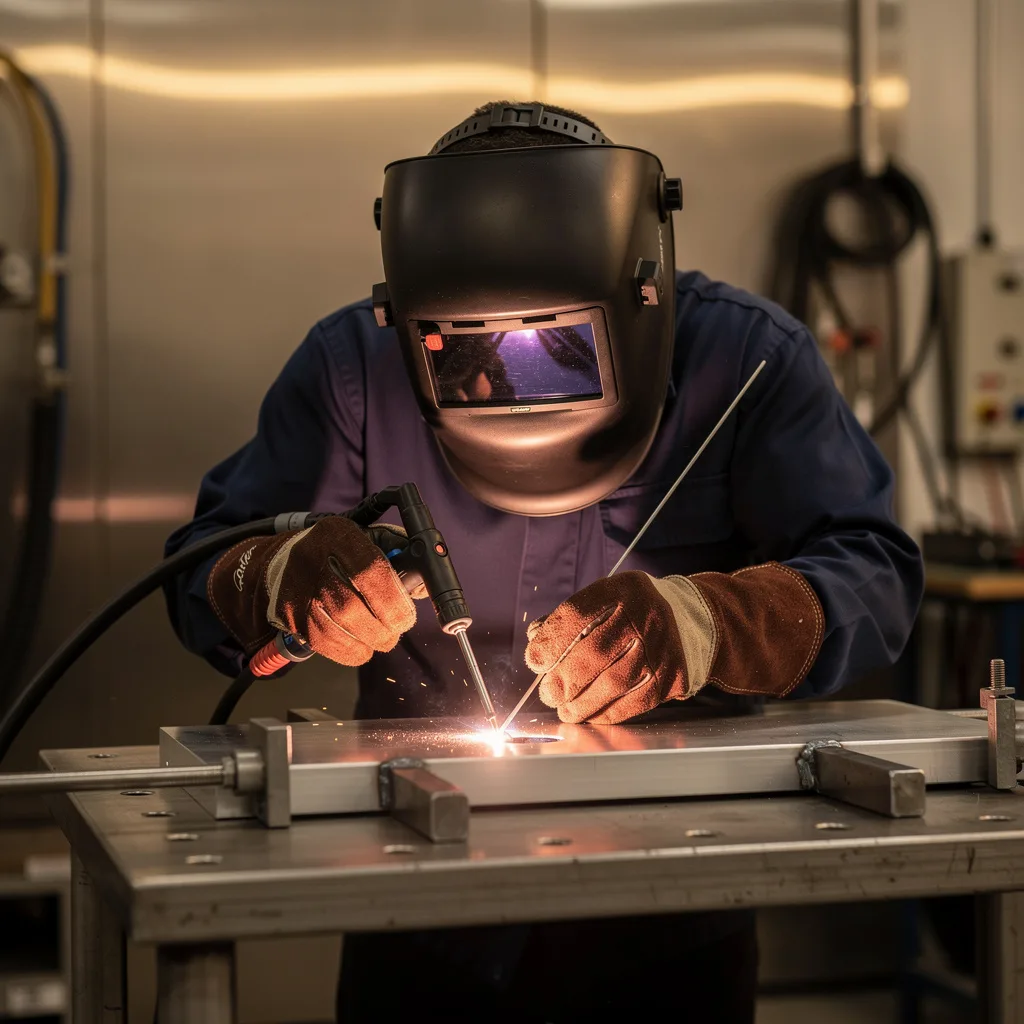
What is TIG Welding Aluminum?
TIG Welding Aluminum Training
The TIG Welding Aluminum certificate program delivers a comprehensive, hands-on curriculum designed for welders, fabricators, and engineers who need to master the unique challenges of joining aluminum. From understanding aluminum’s high thermal conductivity and oxide layer to producing clean, structurally sound welds, this course equips you with the practical skills to work confidently on everything from thin-gauge sheet to thick plate. The main practical outcome is the ability to set up AC TIG equipment, select the correct tungsten and filler, and execute butt, fillet, and corner joints in flat, horizontal, vertical, and overhead positions.
The program follows a beginner-friendly progression that balances theoretical knowledge with extensive shop practice. You will start with aluminum properties and equipment setup, then move through electrode selection, joint preparation, and heat-input control before tackling increasingly complex joint configurations and out-of-position welding. Four core skill areas are built: material behavior, machine tuning, technique refinement, and defect troubleshooting. With aluminum usage surging in automotive, aerospace, and marine industries, this training addresses the growing demand for skilled TIG welders who can produce high-quality, distortion-free welds on a notoriously difficult material.
What is TIG Welding Aluminum?
TIG (Tungsten Inert Gas) welding of aluminum is a precision arc-welding process that uses a non-consumable tungsten electrode and an inert shielding gas, typically pure argon, to protect the weld pool from atmospheric contamination. Unlike steel, aluminum presents distinct challenges: it forms a tenacious oxide layer with a much higher melting point than the base metal, it conducts heat rapidly, and it is prone to distortion and porosity. TIG welding overcomes these by using alternating current (AC) to break up the oxide, precise heat input control via foot pedal or torch amperage, and careful filler metal selection to match the alloy being welded.
Today, TIG welding aluminum is indispensable across industries where strength, corrosion resistance, and a clean appearance are critical. Aerospace fabricators rely on it for fuel tanks and structural components; automotive shops use it for custom intake manifolds, intercoolers, and chassis parts; marine builders depend on it for hulls and railings that withstand saltwater. Recent shifts toward lightweighting in electric vehicles and renewable energy structures have further increased demand for skilled aluminum TIG welders, making this skill set more valuable than ever.
Mastering TIG welding of aluminum builds a robust skill stack that includes metallurgical understanding, precise hand-eye coordination, and systematic troubleshooting. These competencies translate directly into roles such as certified welding inspector, custom fabrication specialist, or production welder in high-tech manufacturing. For hobbyists and small-shop owners, the ability to produce professional-grade aluminum welds opens up new project possibilities and revenue streams. The subject itself is a blend of science and art—learning to read the puddle, adjust parameters on the fly, and control heat input to avoid burn-through or warpage is what separates a competent welder from an expert.
Common Questions About TIG Welding Aluminum
Is this TIG welding aluminum course good for beginners?
Will the certificate help me get a welding job?
Why is AC TIG necessary for welding aluminum?
- Oxide removal: The EP half cleans the aluminum oxide layer.
- Penetration: The EN half provides heat for melting.
- Balance control: Adjusting AC balance lets you fine-tune cleaning vs. penetration.
How do you set AC balance for aluminum TIG welding?
What tungsten electrode is best for AC aluminum TIG?
How to prepare aluminum joints before TIG welding?
- Degreasing: Remove oils and contaminants with acetone or a dedicated degreaser.
- Oxide removal: Use a stainless steel brush dedicated to aluminum to break the oxide layer.
- Edge preparation: Bevel thicker plates to create a V-groove for proper fusion.
Can you TIG weld aluminum with a DC power source?
What Will This Course Bring You?
- Analyze aluminum properties and welding challenges to determine appropriate pre-weld and in-process strategies.
- Set up TIG welding equipment with AC polarity, balance, and frequency controls for aluminum.
- Select and prepare tungsten electrodes (e.g., pure, 2% lanthanated) for optimal arc stability on aluminum.
- Choose filler metals and shielding gases (e.g., ER4043, 100% argon) based on base metal and joint requirements.
- Apply rigorous joint preparation and cleaning procedures to remove aluminum oxide and contaminants.
- Control heat input and manage distortion using techniques such as tack welding, heat sinks, and travel speed adjustments.
- Troubleshoot common aluminum TIG welding defects (e.g., porosity, cracking, lack of fusion) and implement corrective actions.
- Perform out-of-position TIG welding on aluminum joints (vertical, overhead) using appropriate torch angles and filler manipulation.
Curriculum
12 Units1. Aluminum Properties and Welding Challenges
1 hour
2. TIG Welding Equipment and Setup for Aluminum
1 hour
3. Tungsten Electrode Selection and Preparation
1 hour
4. Filler Metals and Shielding Gases for Aluminum
1 hour
5. Joint Preparation and Cleaning for Aluminum Welds
1 hour
6. AC TIG Welding Fundamentals on Aluminum
1 hour
7. Controlling Heat Input and Distortion in Aluminum
1 hour
8. TIG Welding Aluminum Butt Joints
1 hour
9. TIG Welding Aluminum Fillet and Corner Joints
1 hour
10. Out-of-Position TIG Welding of Aluminum
1 hour
11. Troubleshooting Common Aluminum TIG Welding Defects
1 hour
12. Advanced Techniques and Project Application
1 hour
Exam – TIG Welding Aluminum
20 Questions • 70% Pass • 30 min
Unlock All Units for Free
Create an account, enroll in the course, and start with the first unit right away.
Exam – TIG Welding Aluminum
20 Questions • Pass: 70% • 30 min
Course Duration
720
Total Minutes
12
Unit
1
Final Exam
~60
Min / Unit
TIG Welding Aluminum Certificate Program
Document Your Skill
Those who pass the 20-question, 30-minute exam with 70% receive the TIG Welding Aluminum Certificate.
Stand Out on Your CV
By adding your certificate to your CV, gain a professional reference in job applications and stand out from the crowd.
Career Advantage
With the verification code, employers can check your certificate instantly — a concrete way to show your growth.
CERTIFICATE FEE
At the end of the course, an online exam consisting of 20 questions with a 30-minute time limit is given. The exam appears automatically after you complete the topics. Anyone who scores at least 70 out of 100 on the certificate exam is awarded the TIG Welding Aluminum Document (certificate of attendance). You can add the certificate you earn to your CV for job applications in the many sectors listed above, and use it as a reference proving that you took this interactive course.
The Certificate of Achievement you receive with the TIG Welding Aluminum course program holds value that proves your personal and professional development in the business world. By adding it to your CV, it can serve as an important reference in your job applications. Moreover, compared with certificates from other private training institutions, Catch Wisdom certificates are offered to our participants at a much more affordable price.
The TIG Welding Aluminum course certificate is a document that proves, with a unique verification code, that you completed the course. Employers can instantly check its authenticity with this code, which helps you show your development concretely in your job applications.
For more information, we recommend visiting the Support page.
Certificate in 7 Languages
Earning success certificates from our courses is now more meaningful and global. With certificates available in Turkish, English, German, French, Spanish, Arabic, and Russian, we fully unlock the potential of students worldwide.
Why Certificate in 7 Languages?
-
01
Global Skill Development
Receiving your certificates in 7 different languages strengthens your communication skills as you engage with more people worldwide. It lets you operate more confidently and capably on the international stage.
-
02
International Job Opportunities
Employers may see your certificates in multiple languages as a sign of your ability to seize global opportunities. You can open more doors to new jobs and projects.
-
03
Cultural Richness
The chance to earn certificates in different languages helps you build closer ties with various cultures and broadens your worldview. It enriches your global perspective and deepens cultural understanding.
-
04
Ability to Participate in International Projects
Multilingual certificates give you an edge to work more effectively on international projects. They boost your chances of leadership and participation in diverse projects in the business world.
-
05
Prove Yourself on the Global Stage
Certificates in multiple languages give you the opportunity to present your skills and knowledge worldwide.
Language diversity opens worldwide opportunities. If you want to prove yourself in the international arena, join our online TIG Welding Aluminum course program and begin this journey with us.
Frequently Asked Questions (FAQ)
Is this course paid?
How do I join the course?
Can I take the course at my own pace?
How can I get my certificate?
What are the advantages of the certificate?
Boost Your Career
Take a new career step with the TIG Welding Aluminum course. Add your certificate to your CV, stand out in job applications, and open the door to new opportunities in the industry.
StartStudent Reviews
No reviews yet
Enroll in this course and be the first to leave a review about your experience with TIG Welding Aluminum.
Start