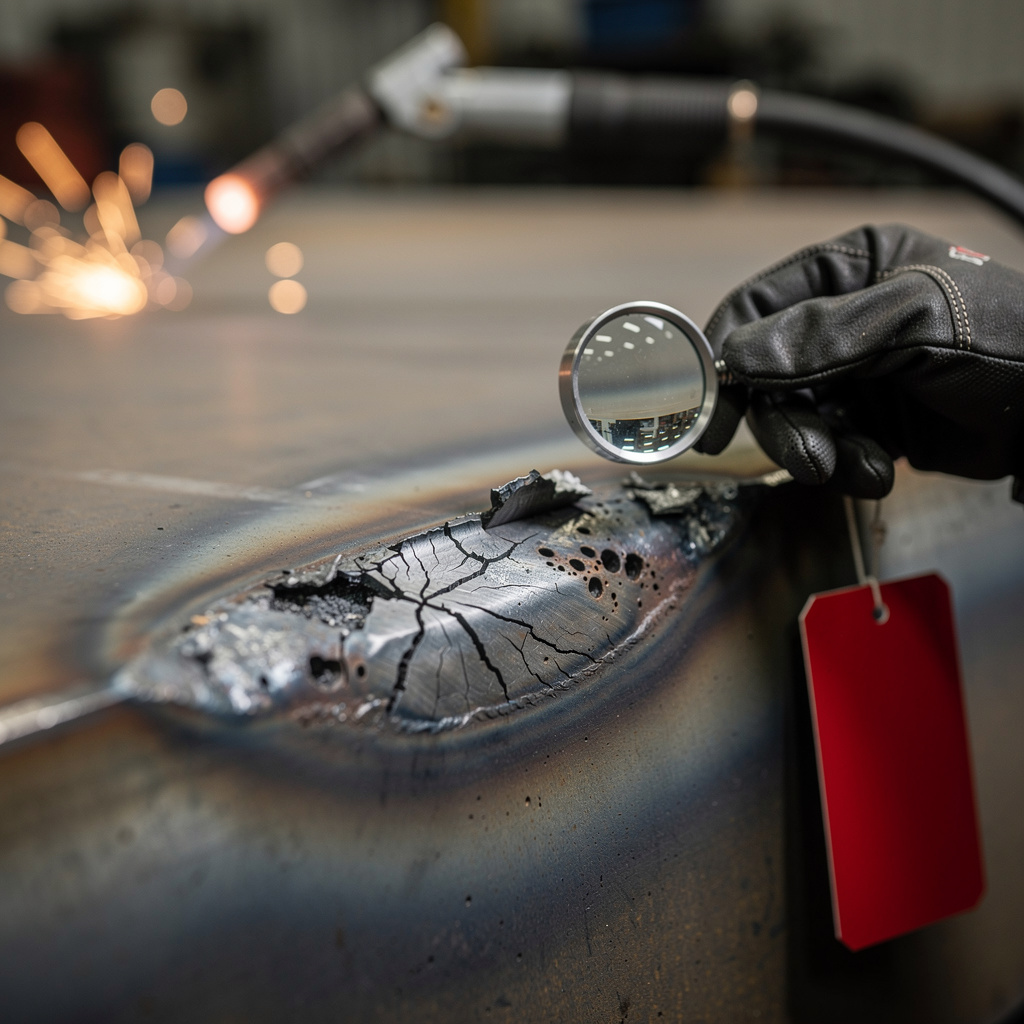
What is Weld Defects and Their Causes?
Weld Defects and Their Causes Training
The Weld Defects and Their Causes certificate program delivers a thorough, hands-on exploration of why welds fail and how to prevent it, covering everything from porosity and slag inclusions to hot and cold cracking, distortion, and geometric irregularities. This training is designed for welders, welding supervisors, quality control inspectors, and manufacturing engineers who need to move beyond basic weld execution and into defect diagnosis and prevention. By the end of the program, participants gain the practical ability to identify defect types on sight, trace them to their root causes in specific welding processes, and implement targeted corrective actions that reduce rework and improve weld integrity.
The program is structured as a beginner-friendly progression that starts with the fundamentals of weld defects and process susceptibility, then moves through each major defect category—porosity, slag, fusion issues, cracks, surface flaws, and profile problems—before culminating in inspection methods, root cause analysis, and quality control strategies. It builds five core skill areas: defect recognition, process–defect correlation, metallurgical reasoning, inspection technique selection, and systematic troubleshooting. With welding quality standards tightening across aerospace, energy, and structural fabrication, this training is a timely investment for anyone responsible for producing or verifying sound welds in high-stakes environments.
What is Weld Defects and Their Causes?
Weld defects and their causes is the discipline of classifying, analyzing, and explaining the imperfections that arise during fusion welding processes, ranging from internal discontinuities like porosity and incomplete fusion to surface anomalies such as undercut, overlap, and spatter. The subject encompasses the metallurgical, thermal, and procedural factors that give rise to these flaws, including improper shielding gas coverage, contaminated base materials, incorrect heat input, and poor joint preparation. Core concepts include defect taxonomy, the distinction between acceptable discontinuities and rejectable defects per standards like AWS D1.1 and ISO 5817, and the physical mechanisms—such as hydrogen embrittlement, solidification shrinkage, and residual stress—that drive crack formation and distortion.
Today, the subject matters more than ever as industries push welding into higher-strength materials, thicker sections, and automated or robotic processes where defects are less visible and more costly to correct. In real-world applications, weld defects are the leading cause of catastrophic failures in pressure vessels, pipelines, bridges, and critical structural components, making defect knowledge essential for compliance with international quality codes and for maintaining safety certifications. Recent shifts toward digital weld monitoring and advanced non-destructive testing have also increased the demand for professionals who can interpret defect data and link it to process variables with precision.
Mastering this subject builds a robust skill stack that combines metallurgical understanding, process knowledge, and diagnostic reasoning, enabling professionals to predict where defects are likely to occur and design preventive measures before welding begins. This expertise is invaluable for welding engineers, quality assurance teams, and inspection personnel who must certify welds, reduce scrap rates, and ensure long-term structural reliability. Beyond industrial roles, the knowledge also empowers educators, researchers, and consultants who advise on weld quality improvement, making it a versatile foundation for career advancement in any welding-dependent sector.
What Will This Course Bring You?
- Analyze the fundamental categories of weld defects and their impact on weld integrity.
- Evaluate the susceptibility of various welding processes to specific defect types such as porosity and cracking.
- Apply preventive measures to eliminate porosity in welds by controlling gas shielding and surface contamination.
- Diagnose the root causes of slag inclusions and implement techniques to prevent their formation.
- Distinguish between incomplete fusion and incomplete penetration and propose corrective actions for each condition.
- Analyze the mechanisms of hot and cold cracking and design strategies to mitigate them.
- Assess the effects of distortion and residual stress on weld quality and apply control methods.
- Implement appropriate inspection and testing methods to detect weld defects accurately and reliably.
Curriculum
12 Units1. Fundamentals of Weld Defects
30 min
2. Welding Processes and Defect Susceptibility
30 min
3. Porosity: Causes and Prevention
30 min
4. Slag Inclusions: Causes and Prevention
30 min
5. Incomplete Fusion and Incomplete Penetration
30 min
6. Cracks: Hot and Cold Cracking
30 min
7. Distortion and Residual Stress
30 min
8. Surface Defects: Undercut, Overlap, and Spatter
30 min
9. Weld Profile and Geometric Defects
30 min
10. Inspection and Testing Methods for Weld Defects
30 min
11. Root Cause Analysis and Troubleshooting
30 min
12. Prevention Strategies and Quality Control
30 min
Exam – Weld Defects and Their Causes
20 Questions • 70% Pass • 30 min
Unlock All Units for Free
Create an account, enroll in the course, and start with the first unit right away.
Exam – Weld Defects and Their Causes
20 Questions • Pass: 70% • 30 min
Course Duration
360
Total Minutes
12
Unit
1
Final Exam
~30
Min / Unit
Weld Defects and Their Causes Certificate Program
Document Your Skill
Those who pass the 20-question, 30-minute exam with 70% receive the Weld Defects and Their Causes Certificate.
Stand Out on Your CV
By adding your certificate to your CV, gain a professional reference in job applications and stand out from the crowd.
Career Advantage
Catch Wisdom certificates are recognized by HR departments and increase career opportunities.
CERTIFICATE FEE
At the end of the course, an online exam consisting of 20 questions with a 30-minute time limit is given. The exam appears automatically after you complete the topics. Anyone who scores at least 70 out of 100 on the certificate exam is awarded the Weld Defects and Their Causes Document (certificate of attendance). You can add the certificate you earn to your CV for job applications in the many sectors listed above, and use it as a reference proving that you took this interactive course.
The Certificate of Achievement you receive with the Weld Defects and Their Causes course program holds value that proves your personal and professional development in the business world. By adding it to your CV, it can serve as an important reference in your job applications. Moreover, compared with certificates from other private training institutions, Catch Wisdom certificates are offered to our participants at a much more affordable price.
Because HR departments recognize Catch Wisdom as a reputable institution in this field, they value these certificates and may evaluate your job applications favorably. For this reason, a Weld Defects and Their Causes course certificate from Catch Wisdom can make your applications more attractive and place you in an advantageous position in the business world.
For more information, we recommend visiting the Support page.
Certificate in 7 Languages
Earning success certificates from our courses is now more meaningful and global. With certificates available in Turkish, English, German, French, Spanish, Arabic, and Russian, we fully unlock the potential of students worldwide.
Why Certificate in 7 Languages?
-
01
Global Skill Development
Receiving your certificates in 7 different languages strengthens your communication skills as you engage with more people worldwide. It lets you operate more confidently and capably on the international stage.
-
02
International Job Opportunities
Employers may see your certificates in multiple languages as a sign of your ability to seize global opportunities. You can open more doors to new jobs and projects.
-
03
Cultural Richness
The chance to earn certificates in different languages helps you build closer ties with various cultures and broadens your worldview. It enriches your global perspective and deepens cultural understanding.
-
04
Ability to Participate in International Projects
Multilingual certificates give you an edge to work more effectively on international projects. They boost your chances of leadership and participation in diverse projects in the business world.
-
05
Prove Yourself on the Global Stage
Certificates in multiple languages let you showcase your skills and knowledge worldwide. You can become an internationally recognized professional.
Language diversity opens worldwide opportunities. If you want to prove yourself in the international arena, join our online Weld Defects and Their Causes course program and begin this journey with us.
Frequently Asked Questions (FAQ)
Is this course paid?
How do I join the course?
Can I take the course at my own pace?
How can I get my certificate?
What are the advantages of the Certified Certificate?
Boost Your Career
Take a new career step with the Weld Defects and Their Causes course. Add your certificate to your CV, stand out in job applications, and open the door to new opportunities in the industry.
StartStudent Reviews
No reviews yet
Enroll in this course and be the first to leave a review about your experience with Weld Defects and Their Causes.
Start