What is Artisan Bread Baking?
Artisan Bread Baking Training
The Artisan Bread Baking certificate program teaches you to master the craft of handcrafted bread from ingredient selection to finished loaf. Designed for home bakers, culinary students, and aspiring professionals, this program delivers the practical outcome of confidently producing a wide range of artisan breads—from crusty sourdough to buttery croissants—using traditional techniques. You will learn the science behind flour, water, salt, and yeast, and how to manipulate fermentation, hydration, and shaping to achieve consistent, bakery-quality results.
The program is structured to be beginner-friendly yet progressively challenging, balancing foundational theory with hands-on practice across four core skill areas: ingredient roles, mixing and fermentation, shaping and scoring, and advanced dough management. Starting with basic lean doughs, you move through preferments, sourdough starters, enriched doughs, whole grains, and laminated pastries, culminating in recipe development and personal style. This comprehensive approach ensures you build a deep, intuitive understanding of bread making, making it the ideal choice for anyone seeking to elevate their baking skills in today’s artisanal food movement.
What is Artisan Bread Baking?
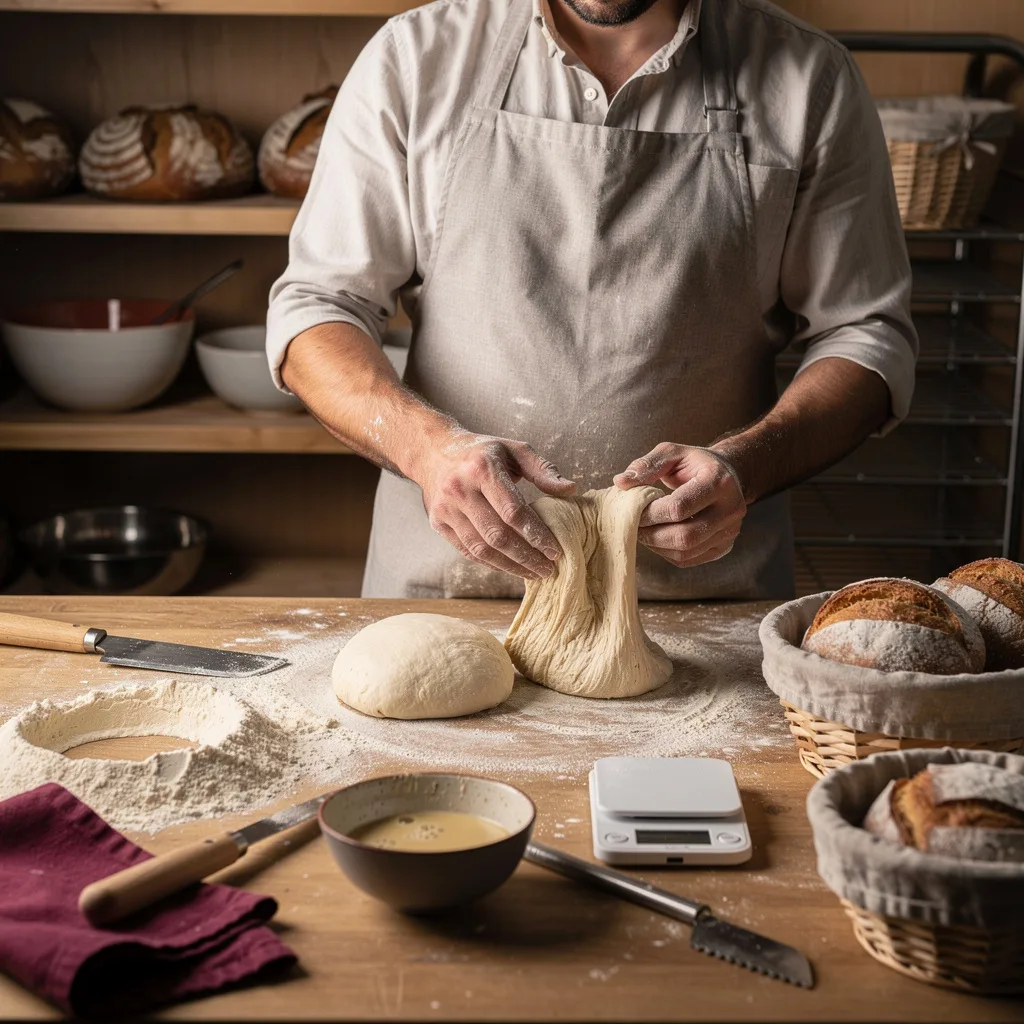
Artisan bread baking is the craft of producing bread using traditional methods that emphasize natural fermentation, high-quality ingredients, and manual shaping rather than commercial shortcuts. Its core concepts include understanding the roles of flour, water, salt, and yeast; managing fermentation time and temperature; developing gluten through mixing and folding; and using preferments like sourdough starter or poolish to enhance flavor and texture. The scope extends from simple rustic loaves to complex laminated pastries, all rooted in the principle that time and technique create superior crumb, crust, and taste.
Today, artisan bread baking matters because it responds to a growing consumer demand for authentic, minimally processed food with deep flavor and nutritional integrity. In the industry, artisan bakeries and restaurants increasingly rely on these skills to differentiate their offerings, while home bakers seek the satisfaction of creating real bread from scratch. Recent shifts toward sourdough during the pandemic and a renewed interest in traditional food crafts have made artisan bread knowledge more relevant than ever, both in professional kitchens and in personal wellness routines.
Mastering artisan bread baking builds a versatile skill stack that includes sensory evaluation, dough physics, time management, and creative problem-solving. These competencies are directly applicable in bakery production, food entrepreneurship, culinary education, and even food science contexts. On a personal level, the ability to bake exceptional bread fosters self-reliance, deepens appreciation for food origins, and provides a meditative, rewarding practice that connects you to centuries of culinary tradition.
Common Questions About Artisan Bread Baking
Does this artisan bread baking course include a certificate for my resume?
Can a complete beginner start this artisan bread baking course?
What is autolyse and why is it important in bread baking?
- Better gluten development with less mechanical work
- Improved flavor through enzymatic activity
- Easier shaping due to a more relaxed dough
How does hydration affect sourdough fermentation?
What is the difference between brioche and challah dough?
What are the five essential preferments in artisan baking?
- Poolish – a high-hydration preferment (equal flour and water) that produces a mild, slightly tangy flavor
- Biga – a stiff preferment with low hydration, yielding a more complex, nutty taste
- Pâte Fermentée – a piece of leftover dough from a previous batch, adding depth and fermentation strength
- Levain – a natural sourdough starter made from wild yeast and bacteria, giving distinctive sour notes
- Sponge – a wet, foamy preferment often used in commercial baking for quick fermentation
Is it true that you need a stand mixer to make good bread?
What Will This Course Bring You?
- Analyze the functional roles of flour, water, salt, and yeast to adjust recipes for desired texture and flavor.
- Apply proper mixing and fermentation techniques to develop gluten structure and optimize dough strength.
- Build and maintain a sourdough starter using preferments to achieve consistent leavening and complex flavor.
- Shape various loaf styles including boules, batards, and baguettes with correct tension and surface integrity.
- Evaluate scoring patterns and baking conditions to control oven spring and achieve ideal crust development.
- Design a complete sourdough bread formula from starter maintenance to final bake, adjusting hydration and timing.
- Implement enriched dough techniques for brioche and challah, incorporating butter and eggs without compromising structure.
- Troubleshoot common bread faults such as dense crumb or poor oven spring by analyzing fermentation and hydration variables.
Curriculum
12 Units1. Understanding Ingredients and Their Roles
1 hour
2. Mixing and Fermentation Fundamentals
1 hour
3. Preferments and Sourdough Starters
1 hour
4. Shaping Techniques for Different Loaves
1 hour
5. Scoring and Baking
1 hour
6. Sourdough Bread – From Starter to Loaf
1 hour
7. Enriched Doughs – Brioche and Challah
1 hour
8. Whole Grain and Specialty Flours
1 hour
9. Laminated Doughs – Croissants and Danish
1 hour
10. Advanced Fermentation and Hydration Management
1 hour
11. Troubleshooting Common Bread Problems
1 hour
12. Recipe Development and Personal Style
1 hour
Exam – Artisan Bread Baking
20 Questions • 70% Pass • 30 min
Unlock All Units for Free
Create an account, enroll in the course, and start with the first unit right away.
Exam – Artisan Bread Baking
20 Questions • Pass: 70% • 30 min
Course Duration
720
Total Minutes
12
Unit
1
Final Exam
~60
Min / Unit
Artisan Bread Baking Certificate Program
Document Your Skill
Those who pass the 20-question, 30-minute exam with 70% receive the Artisan Bread Baking Certificate.
Stand Out on Your CV
By adding your certificate to your CV, gain a professional reference in job applications and stand out from the crowd.
Career Advantage
With the verification code, employers can check your certificate instantly — a concrete way to show your growth.
CERTIFICATE FEE
At the end of the course, an online exam consisting of 20 questions with a 30-minute time limit is given. The exam appears automatically after you complete the topics. Anyone who scores at least 70 out of 100 on the certificate exam is awarded the Artisan Bread Baking Document (certificate of attendance). You can add the certificate you earn to your CV for job applications in the many sectors listed above, and use it as a reference proving that you took this interactive course.
The Certificate of Achievement you receive with the Artisan Bread Baking course program holds value that proves your personal and professional development in the business world. By adding it to your CV, it can serve as an important reference in your job applications. Moreover, compared with certificates from other private training institutions, Catch Wisdom certificates are offered to our participants at a much more affordable price.
The Artisan Bread Baking course certificate is a document that proves, with a unique verification code, that you completed the course. Employers can instantly check its authenticity with this code, which helps you show your development concretely in your job applications.
For more information, we recommend visiting the Support page.
Certificate in 7 Languages
Earning success certificates from our courses is now more meaningful and global. With certificates available in Turkish, English, German, French, Spanish, Arabic, and Russian, we fully unlock the potential of students worldwide.
Why Certificate in 7 Languages?
-
01
Global Skill Development
Receiving your certificates in 7 different languages strengthens your communication skills as you engage with more people worldwide. It lets you operate more confidently and capably on the international stage.
-
02
International Job Opportunities
Employers may see your certificates in multiple languages as a sign of your ability to seize global opportunities. You can open more doors to new jobs and projects.
-
03
Cultural Richness
The chance to earn certificates in different languages helps you build closer ties with various cultures and broadens your worldview. It enriches your global perspective and deepens cultural understanding.
-
04
Ability to Participate in International Projects
Multilingual certificates give you an edge to work more effectively on international projects. They boost your chances of leadership and participation in diverse projects in the business world.
-
05
Prove Yourself on the Global Stage
Certificates in multiple languages give you the opportunity to present your skills and knowledge worldwide.
Language diversity opens worldwide opportunities. If you want to prove yourself in the international arena, join our online Artisan Bread Baking course program and begin this journey with us.
Frequently Asked Questions (FAQ)
Is this course paid?
How do I join the course?
Can I take the course at my own pace?
How can I get my certificate?
What are the advantages of the certificate?
Boost Your Career
Take a new career step with the Artisan Bread Baking course. Add your certificate to your CV, stand out in job applications, and open the door to new opportunities in the industry.
StartStudent Reviews
No reviews yet
Enroll in this course and be the first to leave a review about your experience with Artisan Bread Baking.
Start