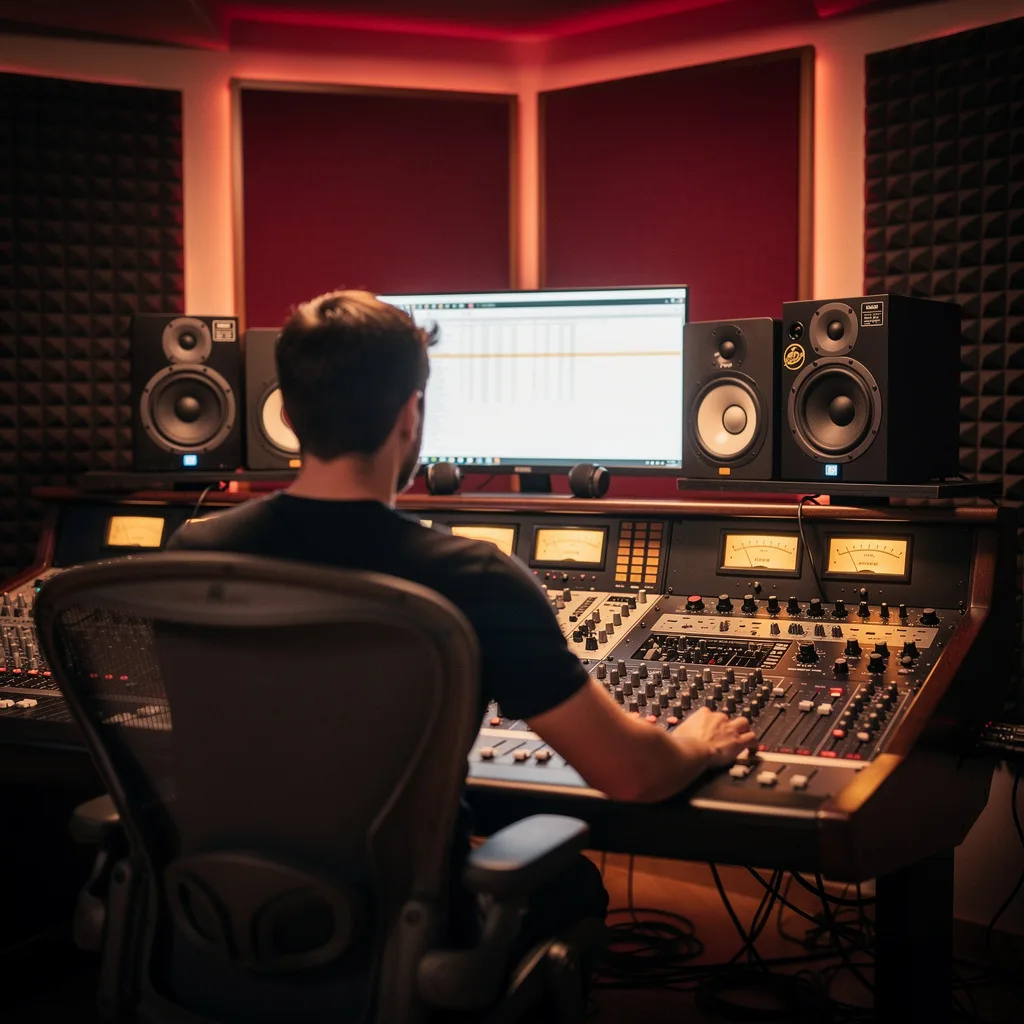
What is Audio Mastering Techniques?
Audio Mastering Techniques Training
The Audio Mastering Techniques certificate program provides a comprehensive, hands-on education in the art and science of finalizing audio recordings. Designed for aspiring mastering engineers, music producers, and audio post-production professionals, this course teaches you to transform raw mixes into polished, release-ready masters. The primary outcome is the ability to apply professional mastering workflows, from critical listening and monitoring to dynamic processing, equalization, stereo enhancement, and final loudness management.
The program is structured as a beginner-friendly progression that builds from foundational concepts to advanced techniques. You will develop core skills in five key areas: critical listening and monitoring, dynamics and equalization, stereo imaging and spatial processing, loudness and limiting, and final delivery including dithering and format-specific mastering. With lessons covering reference track analysis, sequencing, and quality control, this training is ideal for anyone seeking to master the complete mastering chain. Now, as streaming platforms demand consistent loudness and high-quality audio, mastering these techniques is more essential than ever.
What is Audio Mastering Techniques?
Audio mastering is the final creative and technical step in music and audio production, where a mixed stereo track is prepared for distribution across various media. It encompasses a range of processes including equalization, dynamic range compression, stereo enhancement, limiting, and dithering to ensure sonic consistency, clarity, and optimal playback on all systems. Mastering also involves sequencing tracks for an album, adjusting spacing, and applying metadata for digital delivery.
Today, mastering is critical as listeners consume audio on diverse platforms—from high-fidelity headphones to smartphone speakers and streaming services with loudness normalization. The field has evolved with digital tools, allowing precise control over loudness standards (e.g., LUFS) and format-specific masters for vinyl, CD, and streaming. Mastering engineers now work in both dedicated studios and home setups, making the skill set accessible yet demanding of deep technical and artistic knowledge.
Mastering audio techniques builds a unique skill stack combining critical listening, technical proficiency with processors, and aesthetic judgment. Professionals in music production, film and game audio, podcasting, and broadcasting benefit from mastering knowledge to ensure their final product competes in a crowded market. For independent artists and producers, mastering skills enable self-sufficiency and creative control over the final sound of their releases.
Common Questions About Audio Mastering Techniques
Can I learn audio mastering without prior mixing experience?
Does this course cover both analog and digital mastering?
Why is the 2 dB rule important in mastering EQ?
What is the difference between minimum phase and linear phase EQ?
How does Mid-Side processing work in mastering?
- Encoding: The stereo signal is converted into mid (L+R) and side (L-R) components using a matrix.
- Processing: You apply EQ, compression, or saturation to the mid and side channels separately. For example, boosting the side channel's high frequencies adds air without affecting the center vocal or bass.
- Decoding: The processed mid and side are summed back to stereo. The Haas effect can also be used to create psychoacoustic width without actual widening.
Why does order matter in the mastering signal chain?
Is mastering just making the track louder?
What Will This Course Bring You?
- Analyze the fundamental principles of audio mastering, including signal flow and gain staging, to establish a proper workflow.
- Apply critical listening techniques and monitor calibration to accurately evaluate the sonic characteristics of a mix.
- Implement dynamic range compression and expansion to control loudness and enhance musicality in a master.
- Design corrective and creative equalization curves to balance frequency content and address tonal issues.
- Apply stereo enhancement and mid-side processing to improve spatial width while maintaining mono compatibility.
- Measure and adjust integrated loudness levels to meet platform-specific LUFS targets for consistent playback.
- Select appropriate limiting and clipping strategies to achieve competitive loudness without introducing audible distortion.
- Evaluate different dithering types and bit depth reduction methods to minimize quantization noise in final audio files.
Curriculum
12 Units1. Fundamentals of Audio Mastering
1 hour
2. Critical Listening and Monitoring
1 hour
3. Dynamics Processing in Mastering
1 hour
4. Equalization for Mastering
1 hour
5. Stereo Enhancement and Spatial Processing
1 hour
6. Loudness and Level Management
1 hour
7. Limiting and Clipping
1 hour
8. Sequencing and Spacing
1 hour
9. Reference Tracks and A/B Comparison
1 hour
10. Dithering and Bit Depth
1 hour
11. Mastering for Different Formats
1 hour
12. Final Delivery and Quality Control
1 hour
Exam – Audio Mastering Techniques
20 Questions • 70% Pass • 30 min
Unlock All Units for Free
Create an account, enroll in the course, and start with the first unit right away.
Exam – Audio Mastering Techniques
20 Questions • Pass: 70% • 30 min
Course Duration
720
Total Minutes
12
Unit
1
Final Exam
~60
Min / Unit
Audio Mastering Techniques Certificate Program
Document Your Skill
Those who pass the 20-question, 30-minute exam with 70% receive the Audio Mastering Techniques Certificate.
Stand Out on Your CV
By adding your certificate to your CV, gain a professional reference in job applications and stand out from the crowd.
Career Advantage
With the verification code, employers can check your certificate instantly — a concrete way to show your growth.
CERTIFICATE FEE
At the end of the course, an online exam consisting of 20 questions with a 30-minute time limit is given. The exam appears automatically after you complete the topics. Anyone who scores at least 70 out of 100 on the certificate exam is awarded the Audio Mastering Techniques Document (certificate of attendance). You can add the certificate you earn to your CV for job applications in the many sectors listed above, and use it as a reference proving that you took this interactive course.
The Certificate of Achievement you receive with the Audio Mastering Techniques course program holds value that proves your personal and professional development in the business world. By adding it to your CV, it can serve as an important reference in your job applications. Moreover, compared with certificates from other private training institutions, Catch Wisdom certificates are offered to our participants at a much more affordable price.
The Audio Mastering Techniques course certificate is a document that proves, with a unique verification code, that you completed the course. Employers can instantly check its authenticity with this code, which helps you show your development concretely in your job applications.
For more information, we recommend visiting the Support page.
Certificate in 7 Languages
Earning success certificates from our courses is now more meaningful and global. With certificates available in Turkish, English, German, French, Spanish, Arabic, and Russian, we fully unlock the potential of students worldwide.
Why Certificate in 7 Languages?
-
01
Global Skill Development
Receiving your certificates in 7 different languages strengthens your communication skills as you engage with more people worldwide. It lets you operate more confidently and capably on the international stage.
-
02
International Job Opportunities
Employers may see your certificates in multiple languages as a sign of your ability to seize global opportunities. You can open more doors to new jobs and projects.
-
03
Cultural Richness
The chance to earn certificates in different languages helps you build closer ties with various cultures and broadens your worldview. It enriches your global perspective and deepens cultural understanding.
-
04
Ability to Participate in International Projects
Multilingual certificates give you an edge to work more effectively on international projects. They boost your chances of leadership and participation in diverse projects in the business world.
-
05
Prove Yourself on the Global Stage
Certificates in multiple languages give you the opportunity to present your skills and knowledge worldwide.
Language diversity opens worldwide opportunities. If you want to prove yourself in the international arena, join our online Audio Mastering Techniques course program and begin this journey with us.
Frequently Asked Questions (FAQ)
Is this course paid?
How do I join the course?
Can I take the course at my own pace?
How can I get my certificate?
What are the advantages of the certificate?
Boost Your Career
Take a new career step with the Audio Mastering Techniques course. Add your certificate to your CV, stand out in job applications, and open the door to new opportunities in the industry.
StartStudent Reviews
No reviews yet
Enroll in this course and be the first to leave a review about your experience with Audio Mastering Techniques.
Start