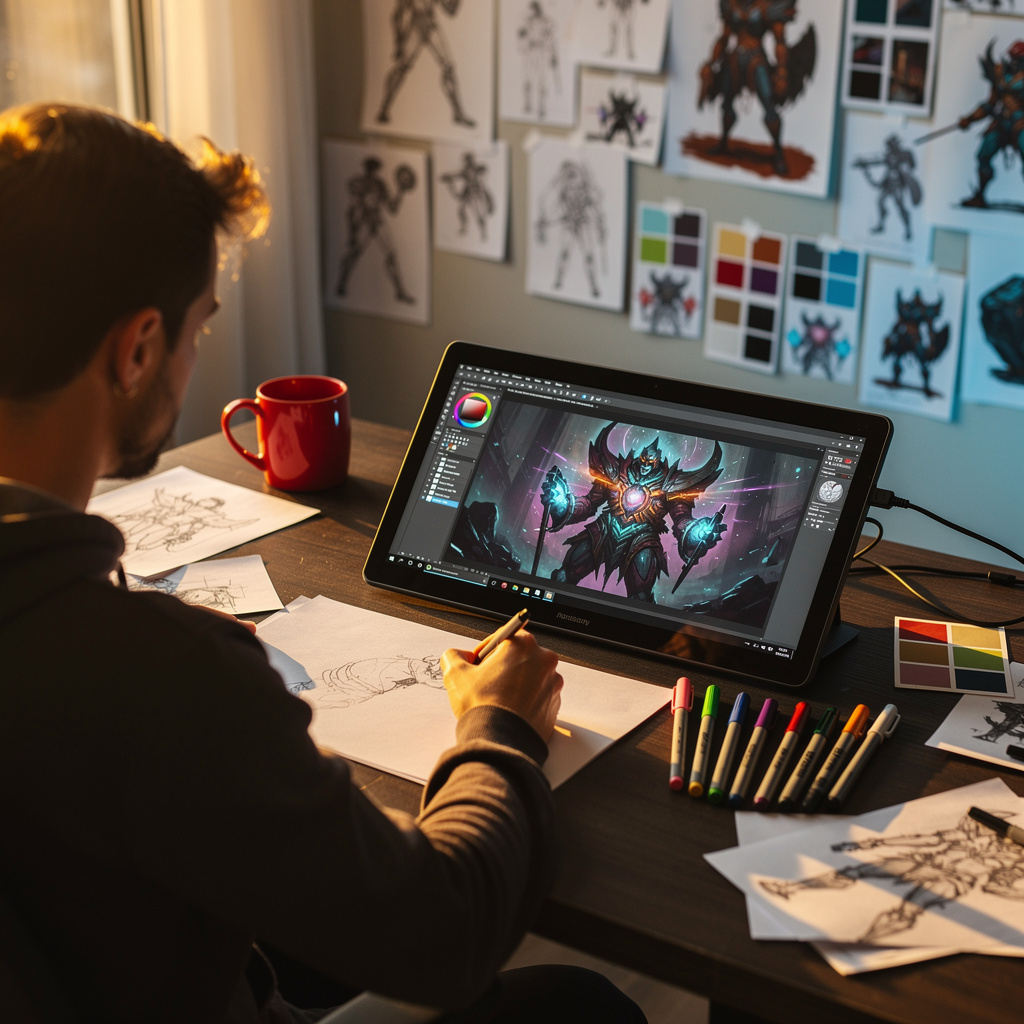
What is Concept Art Fundamentals?
Concept Art Fundamentals Certificate Program
Concept Art Fundamentals certificate program teaches aspiring artists, illustrators, game designers, and animation students how to develop production-ready visual ideas from first research to final portfolio presentation. The curriculum covers visual research and mood boards, shape design and silhouette readability, drawing foundations in form, volume, and construction, perspective and camera basics, value, light, and material rendering, color theory, thumbnails and iteration, character and creature design, prop, vehicle, and environment design, composition and narrative, and studio workflow. It is designed for beginners who want a structured entry into concept art as well as self-taught artists who need to fill gaps in their foundational pipeline knowledge. The main practical outcome is a coherent body of concept art work that demonstrates clear thinking, readable design, and professional presentation across multiple asset types.
The program is structured as a beginner-friendly progression that moves from understanding concept art in production pipelines and gathering visual research into foundational drawing, perspective, and camera control before advancing to design, rendering, and portfolio presentation. Each module balances concise theory with hands-on exercises, so learners practice thumbnails, iteration, visual problem solving, and studio-style feedback while building the four core skill areas of visual research, foundational drawing, design communication, and rendering with color and light. A fifth area, narrative composition and portfolio workflow, ties the work together so individual designs read clearly in context and meet real production expectations. Learners choose this program now because studios increasingly need concept artists who can think across characters, creatures, props, vehicles, and environments while working quickly, collaboratively, and with a strong visual rationale.
What is Concept Art Fundamentals?
Concept art fundamentals is the discipline of visually developing ideas for characters, creatures, props, vehicles, environments, and other assets before they are modeled, animated, or built in full production. Its scope spans ideation, visual research, design language, shape and silhouette clarity, construction and perspective, lighting and material cues, color scripting, and narrative composition. Core concepts include readability, iteration, visual problem solving, and the ability to communicate a fictional world through consistent design choices. Rather than treating illustration as a standalone finished artwork, the subject frames every image as a functional step in a larger creative pipeline.
Concept art fundamentals matter today because games, film, animation, television, XR, and interactive media rely on fast visual development to align directors, designers, and production teams before expensive assets are created. In industry, concept artists work at the intersection of storytelling, game design, and technical constraints, producing references that guide 3D modeling, texturing, animation, and marketing. Recent shifts toward real-time engines, virtual production, and global remote collaboration have made clear, readable design communication even more valuable than isolated rendering skill. In academic settings, the subject also provides a bridge between traditional drawing, digital painting, and media-specific design thinking, helping students understand why an idea works before they polish it.
Mastering concept art fundamentals builds a portable skill stack: visual literacy, research synthesis, structural drawing, design ideation, spatial reasoning, lighting and color judgment, and narrative composition. These skills support professional roles such as concept artist, visual development artist, character or environment designer, prop designer, storyboard or previsualization artist, and art director track positions. They also benefit adjacent fields like game design, animation, illustration, architecture visualization, and independent worldbuilding, where clear visual thinking accelerates collaboration. On a personal level, the subject gives creators a disciplined way to turn vague imagination into convincing, shareable designs that can survive critique and production constraints.
Common Questions About Concept Art Fundamentals
Is Concept Art Fundamentals suitable for complete beginners with no drawing?
How long does the Concept Art Fundamentals course take to finish?
How do silhouette readability tests work in character design?
- Solid black shape: fill the whole figure in one flat dark tone and ask whether the pose still communicates.
- Thumbnail scale: shrink the design until it is tiny, because small size exposes a shape that only works when viewed large.
- Neighbour comparison: line the design up beside the other characters in the cast and check that no two outlines are interchangeable.
How do mood boards differ from plain reference collections?
What are the three stages of a production pipeline in concept art?
How do value scales help organize light and shadow in rendering?
Do you need natural talent to learn shape design and perspective?
What Will This Course Bring You?
- Analyze concept art's role across pre-production, production, and post-production pipelines to identify deliverable expectations and collaboration points.
- Build focused mood boards and visual research libraries that support a given art brief with credible references and clear thematic direction.
- Design readable character and creature silhouettes by applying shape language, proportion, and visual hierarchy to communicate role and personality.
- Apply form, volume, and constructive drawing principles to sketch believable props, vehicles, and environments from imagination.
- Implement one-, two-, and three-point perspective with camera choices to stage concept art shots that feel spatially convincing and intentional.
- Evaluate value, light, and material rendering choices to create forms that read clearly under different lighting conditions and surface qualities.
- Apply color theory and mood application to develop palettes that reinforce narrative tone and focus within concept art compositions.
- Produce iterative thumbnail sets and portfolio-ready concept art that demonstrate visual problem solving, composition, and studio workflow awareness.
Curriculum
12 Units1. Understanding Concept Art in Production Pipelines
1 hour
2. Visual Research, Reference, and Mood Boards
1 hour
3. Shape Design and Silhouette Readability
1 hour
4. Drawing Foundations: Form, Volume, and Construction
1 hour
5. Perspective and Camera Basics for Concept Art
1 hour
6. Value, Light, and Material Rendering
1 hour
7. Color Theory and Mood Application
1 hour
8. Thumbnails, Iteration, and Visual Problem Solving
1 hour
9. Character and Creature Design Fundamentals
1 hour
10. Prop, Vehicle, and Environment Design Fundamentals
1 hour
11. Composition and Narrative in Concept Art
1 hour
12. Portfolio Presentation and Studio Workflow
1 hour
Exam – Concept Art Fundamentals
20 Questions • 70% Pass • 30 min
Unlock All Units for Free
Create an account, enroll in the course, and start with the first unit right away.
Exam – Concept Art Fundamentals
20 Questions • Pass: 70% • 30 min
Course Duration
720
Total Minutes
12
Unit
1
Final Exam
~60
Min / Unit
Concept Art Fundamentals Certificate Program
Document Your Skill
Those who pass the 20-question, 30-minute exam with 70% receive the Concept Art Fundamentals Certificate.
Stand Out on Your CV
By adding your certificate to your CV, gain a professional reference in job applications and stand out from the crowd.
Career Advantage
With the verification code, employers can check your certificate instantly — a concrete way to show your growth.
CERTIFICATE FEE
At the end of the course, an online exam consisting of 20 questions with a 30-minute time limit is given. The exam appears automatically after you complete the topics. Anyone who scores at least 70 out of 100 on the certificate exam is awarded the Concept Art Fundamentals Document (certificate of attendance). You can add the certificate you earn to your CV for job applications in the many sectors listed above, and use it as a reference proving that you took this interactive course.
The Certificate of Achievement you receive with the Concept Art Fundamentals course program holds value that proves your personal and professional development in the business world. By adding it to your CV, it can serve as an important reference in your job applications. Moreover, compared with certificates from other private training institutions, Catch Wisdom certificates are offered to our participants at a much more affordable price.
The Concept Art Fundamentals course certificate is a document that proves, with a unique verification code, that you completed the course. Employers can instantly check its authenticity with this code, which helps you show your development concretely in your job applications.
For more information, we recommend visiting the Support page.
Certificate in 7 Languages
Earning success certificates from our courses is now more meaningful and global. With certificates available in Turkish, English, German, French, Spanish, Arabic, and Russian, we fully unlock the potential of students worldwide.
Why Certificate in 7 Languages?
-
01
Global Skill Development
Receiving your certificates in 7 different languages strengthens your communication skills as you engage with more people worldwide. It lets you operate more confidently and capably on the international stage.
-
02
International Job Opportunities
Employers may see your certificates in multiple languages as a sign of your ability to seize global opportunities. You can open more doors to new jobs and projects.
-
03
Cultural Richness
The chance to earn certificates in different languages helps you build closer ties with various cultures and broadens your worldview. It enriches your global perspective and deepens cultural understanding.
-
04
Ability to Participate in International Projects
Multilingual certificates give you an edge to work more effectively on international projects. They boost your chances of leadership and participation in diverse projects in the business world.
-
05
Prove Yourself on the Global Stage
Certificates in multiple languages give you the opportunity to present your skills and knowledge worldwide.
Language diversity opens worldwide opportunities. If you want to prove yourself in the international arena, join our online Concept Art Fundamentals course program and begin this journey with us.
Frequently Asked Questions (FAQ)
Is this course paid?
How do I join the course?
Can I take the course at my own pace?
How can I get my certificate?
What are the advantages of the certificate?
Boost Your Career
Take a new career step with the Concept Art Fundamentals course. Add your certificate to your CV, stand out in job applications, and open the door to new opportunities in the industry.
StartStudent Reviews
No reviews yet
Enroll in this course and be the first to leave a review about your experience with Concept Art Fundamentals.
Start