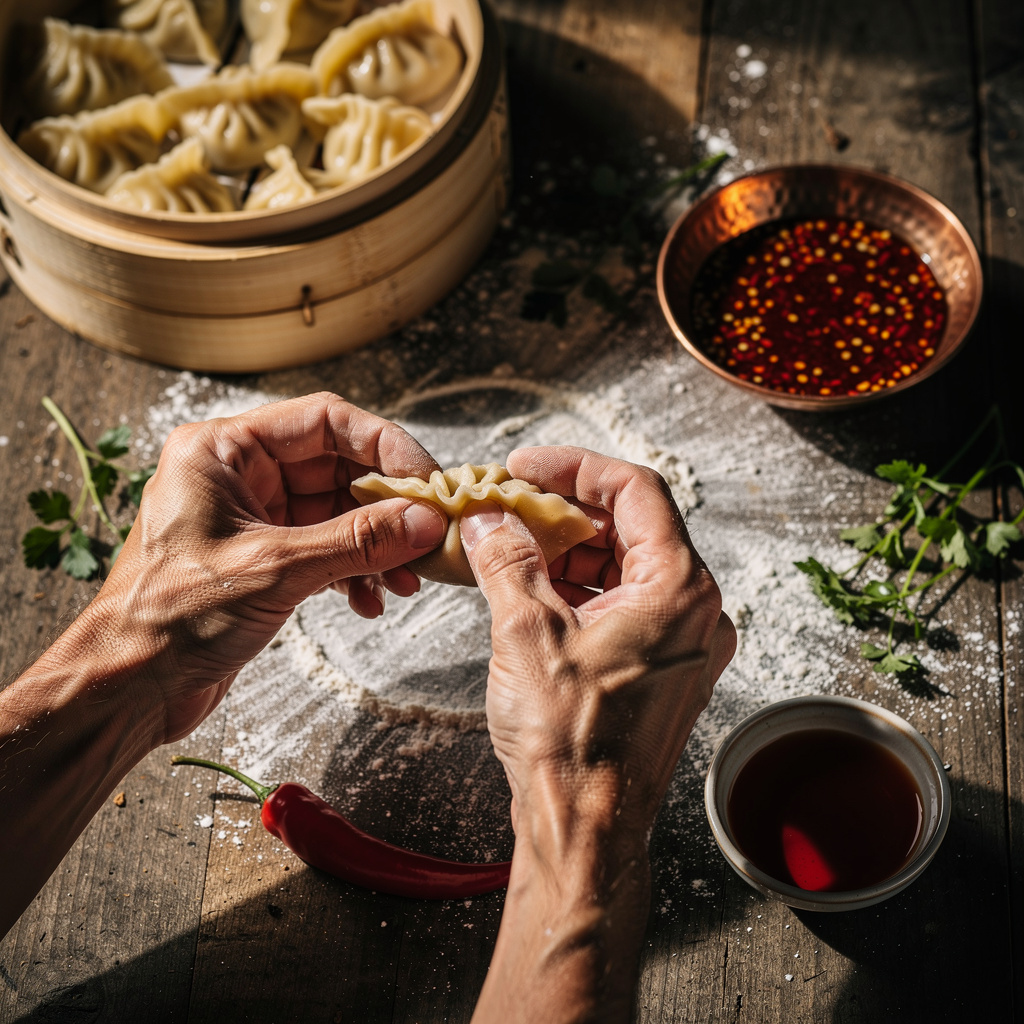
What is Dumplings of the World?
Dumplings of the World Training
The Dumplings of the World certificate program offers a comprehensive culinary journey across continents, teaching you the art and science of dumpling making from scratch. Designed for home cooks, aspiring chefs, and food enthusiasts alike, this course transforms your kitchen into a global dumpling lab, covering everything from doughs and wrappers to fillings, folding techniques, and cooking methods like boiling, steaming, frying, and baking. By the end, you will confidently craft jiaozi, gyoza, manti, pierogi, momos, and even sweet dessert dumplings, complete with authentic sauces and serving traditions.
The program is structured as a beginner-friendly progression that balances theoretical knowledge with hands-on practice, building four core skill areas: dough preparation, filling composition, shaping and folding, and cooking mastery. Each lesson builds on the previous, starting with foundational concepts like "What Makes a Dumpling?" and moving through regional specialties—from Chinese dim sum to Central Asian manti, European gnocchi, and Southeast Asian siopao—before finishing with sweet dumplings and dipping sauces. Choosing this program now taps into the rising global appreciation for comfort food and handmade culinary traditions, giving you a versatile skill set that is both personally rewarding and professionally valuable in today's food-centric world.
What is Dumplings of the World?
Dumplings are a universal culinary category defined by a simple yet profound concept: a portion of dough—whether unleavened, leavened, or made from potatoes or rice—wrapped around a filling, then cooked by boiling, steaming, frying, or baking. The scope of dumplings spans every continent, from Chinese jiaozi and Japanese gyoza to Central Asian manti, European pierogi and knödel, and South Asian momos. Core concepts include the wrapper's texture and thickness, the filling's moisture and flavor balance, and the cooking method's effect on final taste and mouthfeel, all of which vary dramatically across cultures and traditions.
Today, dumplings matter more than ever as global food culture becomes increasingly interconnected. They appear in fine dining restaurants, street food stalls, and home kitchens worldwide, and have sparked fusion innovations like kimchi dumplings or dessert dumplings with chocolate. The rise of food media and culinary tourism has elevated dumplings from humble comfort food to a subject of academic study in gastronomy and cultural anthropology, while the demand for plant-based and gluten-free options has pushed chefs to reimagine traditional recipes. Understanding dumplings offers a lens into migration, trade, and local agriculture, making them a living archive of human history.
Mastering the subject of dumplings builds a robust skill stack that extends beyond the kitchen: you develop precision in dough handling, creativity in filling development, and an intuitive sense of how texture and temperature interact. This knowledge directly benefits professional contexts such as restaurant menu development, food writing, or culinary instruction, while also enriching personal life through cultural appreciation and the joy of hosting memorable meals. Whether you aim to perfect a family recipe or explore global flavors, the subject of dumplings equips you with a versatile, hands-on expertise that bridges technique and tradition.
Common Questions About Dumplings of the World
Is this dumpling course suitable for beginners with no cooking experience?
What format does the Dumplings of the World training use: video, live, or self-paced?
Why does water temperature change the texture of dumpling dough?
What is the most common mistake when folding a classic pleated crescent dumpling?
What is the secret to making juicy but not watery dumpling filling?
- High-moisture vegetables like cabbage and zucchini need heavy salting and squeezing.
- Gelatin-rich meats like pork shoulder hold their juices naturally and create a rich broth.
- Starch binders like potato starch or cornstarch trap moisture and prevent leakage.
Is it true that all dumplings are boiled?
What Will This Course Bring You?
- Analyze the universal definition of a dumpling by comparing diverse cultural examples to identify core components.
- Design custom doughs and wrappers by adjusting flour types, hydration, and resting times for specific dumpling styles.
- Apply flavor-balancing principles to construct fillings that harmonize with regional spice profiles and textures.
- Implement folding and shaping techniques to replicate authentic forms for jiaozi, gyoza, and pierogi.
- Evaluate how boiling, steaming, frying, and baking alter the texture and flavor of different dumpling varieties.
- Analyze the evolution of Chinese dumplings from jiaozi to dim sum, noting regional variations in preparation.
- Build a repertoire of European dumpling recipes, including pierogi, knödel, and gnocchi, using traditional techniques.
- Create sweet dumpling desserts from various cultures, adapting fillings and cooking methods for dessert applications.
Curriculum
12 Units1. What Makes a Dumpling?
1 hour
2. Doughs and Wrappers
1 hour
3. Fillings and Flavor Profiles
1 hour
4. Folding and Shaping Techniques
1 hour
5. Cooking Methods: Boil, Steam, Fry, Bake
1 hour
6. Chinese Dumplings: Jiaozi to Dim Sum
1 hour
7. Japanese and Korean Dumplings: Gyoza and Mandu
1 hour
8. Central Asian Dumplings: Manti, Pelmeni, and Beyond
1 hour
9. European Dumplings: Pierogi, Knödel, and Gnocchi
1 hour
10. South and Southeast Asian Dumplings: Momos, Siopao, and More
30 minutes
11. Sweet Dumplings: Dessert Dumplings Worldwide
1 hour
12. Sauces, Dips, and Serving Traditions
1 hour
Exam – Dumplings of the World
20 Questions • 70% Pass • 30 min
Unlock All Units for Free
Create an account, enroll in the course, and start with the first unit right away.
Exam – Dumplings of the World
20 Questions • Pass: 70% • 30 min
Course Duration
690
Total Minutes
12
Unit
1
Final Exam
~58
Min / Unit
Dumplings of the World Certificate Program
Document Your Skill
Those who pass the 20-question, 30-minute exam with 70% receive the Dumplings of the World Certificate.
Stand Out on Your CV
By adding your certificate to your CV, gain a professional reference in job applications and stand out from the crowd.
Career Advantage
With the verification code, employers can check your certificate instantly — a concrete way to show your growth.
CERTIFICATE FEE
At the end of the course, an online exam consisting of 20 questions with a 30-minute time limit is given. The exam appears automatically after you complete the topics. Anyone who scores at least 70 out of 100 on the certificate exam is awarded the Dumplings of the World Document (certificate of attendance). You can add the certificate you earn to your CV for job applications in the many sectors listed above, and use it as a reference proving that you took this interactive course.
The Certificate of Achievement you receive with the Dumplings of the World course program holds value that proves your personal and professional development in the business world. By adding it to your CV, it can serve as an important reference in your job applications. Moreover, compared with certificates from other private training institutions, Catch Wisdom certificates are offered to our participants at a much more affordable price.
The Dumplings of the World course certificate is a document that proves, with a unique verification code, that you completed the course. Employers can instantly check its authenticity with this code, which helps you show your development concretely in your job applications.
For more information, we recommend visiting the Support page.
Certificate in 7 Languages
Earning success certificates from our courses is now more meaningful and global. With certificates available in Turkish, English, German, French, Spanish, Arabic, and Russian, we fully unlock the potential of students worldwide.
Why Certificate in 7 Languages?
-
01
Global Skill Development
Receiving your certificates in 7 different languages strengthens your communication skills as you engage with more people worldwide. It lets you operate more confidently and capably on the international stage.
-
02
International Job Opportunities
Employers may see your certificates in multiple languages as a sign of your ability to seize global opportunities. You can open more doors to new jobs and projects.
-
03
Cultural Richness
The chance to earn certificates in different languages helps you build closer ties with various cultures and broadens your worldview. It enriches your global perspective and deepens cultural understanding.
-
04
Ability to Participate in International Projects
Multilingual certificates give you an edge to work more effectively on international projects. They boost your chances of leadership and participation in diverse projects in the business world.
-
05
Prove Yourself on the Global Stage
Certificates in multiple languages give you the opportunity to present your skills and knowledge worldwide.
Language diversity opens worldwide opportunities. If you want to prove yourself in the international arena, join our online Dumplings of the World course program and begin this journey with us.
Frequently Asked Questions (FAQ)
Is this course paid?
How do I join the course?
Can I take the course at my own pace?
How can I get my certificate?
What are the advantages of the certificate?
Boost Your Career
Take a new career step with the Dumplings of the World course. Add your certificate to your CV, stand out in job applications, and open the door to new opportunities in the industry.
StartStudent Reviews
No reviews yet
Enroll in this course and be the first to leave a review about your experience with Dumplings of the World.
Start