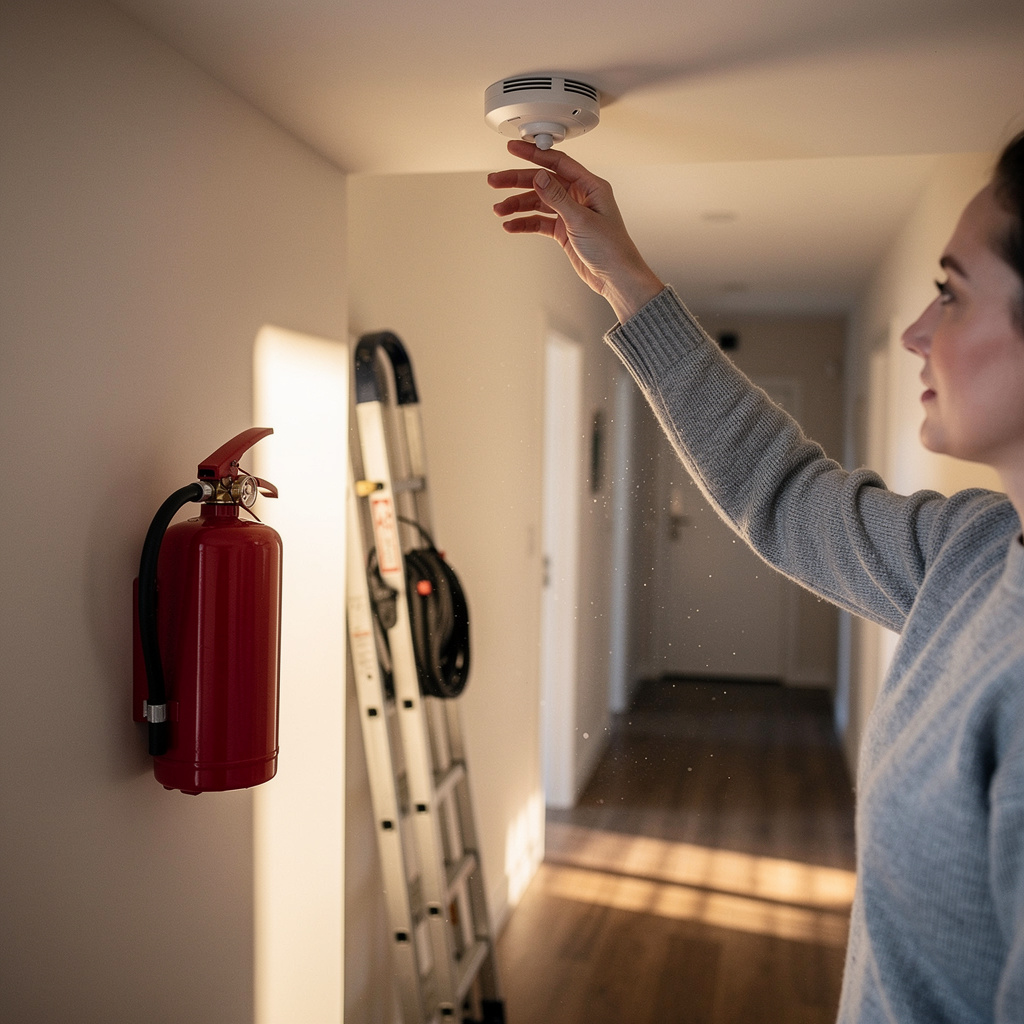
What is Fire Safety at Home?
Fire Safety at Home Training
Fire Safety at Home certificate program is a practical training designed to help householders recognize, prevent, and respond to residential fire risks with confidence. It teaches how fires start and spread, how to identify hazards in rooms and systems, and how everyday habits, electrical equipment, cooking, and heating appliances can create or reduce risk. The course is intended for homeowners, renters, caregivers, and anyone responsible for the safety of a household, including people supporting vulnerable family members. The main practical outcome is a home with fewer ignition hazards, working early-warning measures, suitable suppression options, and a clear escape and survival plan that residents can actually follow.
The program is structured as a beginner-friendly progression, starting with fire science basics and hazard identification before moving into prevention habits, electrical safety, cooking and kitchen risks, heating systems, smoke alarms, extinguishers, escape planning, evacuation, vulnerable household members, and long-term maintenance. Each stage balances short theoretical explanations with practical checks, such as inspecting outlets, testing alarms, placing extinguishers, and walking through escape routes. Across the lessons, it builds five core skill areas: prevention and hazard inspection, electrical and appliance safety, early warning and basic suppression, escape planning and evacuation, and sustained safety and recovery planning. Choosing this program now is useful because homes contain more electrical devices, synthetic furnishings, and open-plan layouts than in the past, while households also need to plan for older adults, children, and other vulnerable members.
What is Fire Safety at Home?
Fire safety at home is the applied practice of reducing the chance that a residential fire starts, limiting its spread, and ensuring that people can detect and escape before conditions become life-threatening. Its scope includes the behavior of fire, the relationship between heat, fuel, oxygen, and ignition sources, and the ways that building contents, room layouts, and household systems influence smoke movement and flashover risk. Core concepts include prevention through hazard control, early warning through detection, basic suppression when safe, evacuation planning, and recovery after an incident. The subject also considers human factors such as age, mobility, sleep, and caregiving responsibilities, because fire safety measures must fit the people who actually live in the home.
Fire safety at home matters today because modern dwellings concentrate more electrical loads, lithium-ion battery devices, synthetic furnishings, and open-plan spaces that can shorten escape time once a fire begins. It is used in everyday household decisions, in fire and rescue service prevention work, in housing and property management, in insurance risk assessment, and in public health and social care planning for vulnerable residents. Recent shifts include greater attention to battery charging hazards, the need for interconnected smoke alarms, and escape plans that account for older adults, children, and people with disabilities. Academic and professional interest also links fire safety to building design, human behavior in emergencies, and community risk reduction, making it a practical subject with broader relevance than simple extinguisher use.
Mastery of this subject builds a skill stack that combines risk assessment, preventive maintenance, emergency decision-making, communication with household members, and post-incident recovery planning. These skills are valuable in personal contexts where people manage their own homes, care for family members, or coordinate safety for rental properties and shared housing. They also support professional contexts such as property management, home care, community safety education, insurance inspections, and fire prevention outreach. The subject bridges knowledge and action by turning fire science and hazard awareness into routines, checks, and plans that can be maintained over time rather than treated as a one-off exercise.
What Will This Course Bring You?
- Analyze how heat, fuel, and oxygen interact to explain how common household fires start and spread.
- Identify and prioritize fire hazards in each room of a home by applying a structured household risk assessment.
- Implement everyday fire prevention habits, including safe storage, housekeeping, and appliance use, to reduce ignition risks at home.
- Evaluate electrical and heating fire risks in a home and recommend specific safety measures for outlets, cords, and appliances.
- Design a home fire escape plan that includes two exits per room, a meeting point, and practice drills for all residents.
- Apply correct selection, placement, testing, and maintenance procedures for smoke alarms and portable fire extinguishers in a household.
- Adapt fire safety and evacuation guidance for vulnerable household members, including children, older adults, and people with mobility limitations.
- Develop a post-fire recovery checklist that covers safe re-entry, documentation, cleaning, and long-term fire safety maintenance.
Curriculum
12 Units1. Fire Science Basics: How Fires Start and Spread
1 hour
2. Identifying Fire Hazards in the Home
1 hour
3. Everyday Fire Prevention Habits
1 hour
4. Electrical Safety and Fire Risks
1 hour
5. Cooking and Kitchen Fire Safety
1 hour
6. Heating Systems and Appliance Safety
1 hour
7. Smoke Alarms and Early Warning Systems
1 hour
8. Fire Extinguishers and Basic Suppression
1 hour
9. Designing a Home Fire Escape Plan
1 hour
10. Responding to a Fire: Evacuation and Survival
1 hour
11. Fire Safety for Vulnerable Household Members
1 hour
12. Maintaining Long-Term Fire Safety and Post-Fire Recovery
1 hour
Exam – Fire Safety at Home
20 Questions • 70% Pass • 30 min
Unlock All Units for Free
Create an account, enroll in the course, and start with the first unit right away.
Exam – Fire Safety at Home
20 Questions • Pass: 70% • 30 min
Course Duration
720
Total Minutes
12
Unit
1
Final Exam
~60
Min / Unit
Fire Safety at Home Certificate Program
Document Your Skill
Those who pass the 20-question, 30-minute exam with 70% receive the Fire Safety at Home Certificate.
Stand Out on Your CV
By adding your certificate to your CV, gain a professional reference in job applications and stand out from the crowd.
Career Advantage
With the verification code, employers can check your certificate instantly — a concrete way to show your growth.
CERTIFICATE FEE
At the end of the course, an online exam consisting of 20 questions with a 30-minute time limit is given. The exam appears automatically after you complete the topics. Anyone who scores at least 70 out of 100 on the certificate exam is awarded the Fire Safety at Home Document (certificate of attendance). You can add the certificate you earn to your CV for job applications in the many sectors listed above, and use it as a reference proving that you took this interactive course.
The Certificate of Achievement you receive with the Fire Safety at Home course program holds value that proves your personal and professional development in the business world. By adding it to your CV, it can serve as an important reference in your job applications. Moreover, compared with certificates from other private training institutions, Catch Wisdom certificates are offered to our participants at a much more affordable price.
The Fire Safety at Home course certificate is a document that proves, with a unique verification code, that you completed the course. Employers can instantly check its authenticity with this code, which helps you show your development concretely in your job applications.
For more information, we recommend visiting the Support page.
Certificate in 7 Languages
Earning success certificates from our courses is now more meaningful and global. With certificates available in Turkish, English, German, French, Spanish, Arabic, and Russian, we fully unlock the potential of students worldwide.
Why Certificate in 7 Languages?
-
01
Global Skill Development
Receiving your certificates in 7 different languages strengthens your communication skills as you engage with more people worldwide. It lets you operate more confidently and capably on the international stage.
-
02
International Job Opportunities
Employers may see your certificates in multiple languages as a sign of your ability to seize global opportunities. You can open more doors to new jobs and projects.
-
03
Cultural Richness
The chance to earn certificates in different languages helps you build closer ties with various cultures and broadens your worldview. It enriches your global perspective and deepens cultural understanding.
-
04
Ability to Participate in International Projects
Multilingual certificates give you an edge to work more effectively on international projects. They boost your chances of leadership and participation in diverse projects in the business world.
-
05
Prove Yourself on the Global Stage
Certificates in multiple languages give you the opportunity to present your skills and knowledge worldwide.
Language diversity opens worldwide opportunities. If you want to prove yourself in the international arena, join our online Fire Safety at Home course program and begin this journey with us.
Frequently Asked Questions (FAQ)
Is this course paid?
How do I join the course?
Can I take the course at my own pace?
How can I get my certificate?
What are the advantages of the certificate?
Boost Your Career
Take a new career step with the Fire Safety at Home course. Add your certificate to your CV, stand out in job applications, and open the door to new opportunities in the industry.
StartStudent Reviews
No reviews yet
Enroll in this course and be the first to leave a review about your experience with Fire Safety at Home.
Start