What is Growing Chili Peppers?
Growing Chili Peppers Certificate Program
Growing Chili Peppers certificate program teaches home gardeners and small-scale growers how to cultivate chili peppers from seed to harvest, covering botany, variety selection, garden planning, indoor seed starting, transplanting, watering and fertilization, pest and disease management, pruning and staking, harvesting and storage, seed saving, container growing, and advanced techniques like overwintering and grafting. It is designed for beginners who want a structured path into edible gardening as well as experienced growers seeking to refine their yields and extend their growing season. The main practical outcome is the ability to plan, plant, maintain, and harvest a healthy chili pepper crop suited to your climate and available space, with confidence in diagnosing common problems and preserving your harvest.
The program is structured as a beginner-friendly progression: it starts with chili pepper botany and variety selection, moves through site planning and seed starting, then builds into seedling care, ongoing maintenance, pest and disease management, and finally harvesting, seed saving, and advanced yield optimization. Each lesson balances theoretical understanding—such as how temperature and day length affect capsaicin production—with practical steps like hardening off seedlings, mixing container media, or pruning for airflow. Across the twelve lessons, learners develop five core skill areas: botanical literacy for variety choice, garden planning and soil preparation, seed starting and transplanting, integrated crop maintenance, and harvest-to-seed stewardship. Choosing this program now makes sense as food gardeners increasingly seek reliable, climate-adaptive techniques and as interest in homegrown spice varieties, container gardening, and seed sovereignty continues to rise.
What is Growing Chili Peppers?
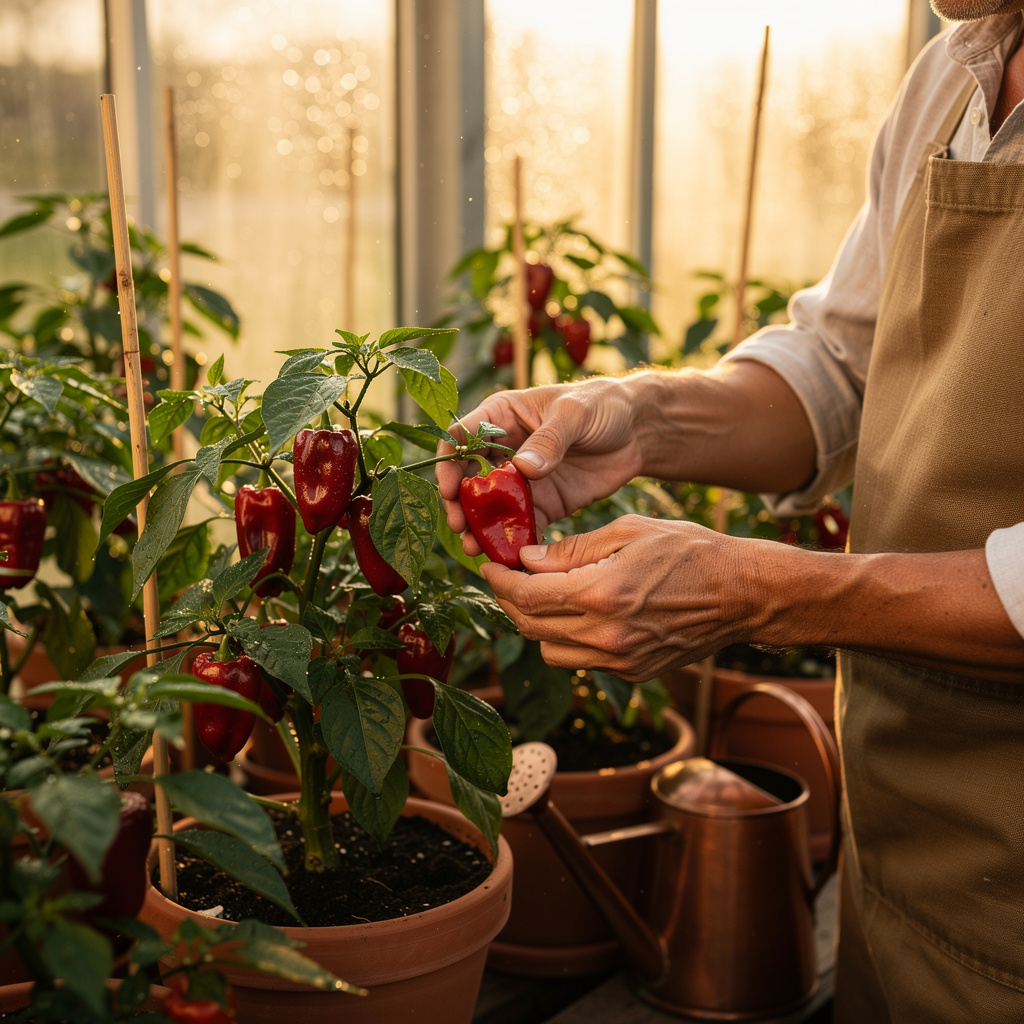
Growing chili peppers is the horticultural practice of cultivating plants from the Capsicum genus for their fruits, which range from mild bell-like peppers to intensely pungent varieties, and it spans seed selection, propagation, soil and water management, pest ecology, and post-harvest handling. The subject covers core concepts such as capsaicinoid biosynthesis, photoperiod sensitivity, pollination biology, soil pH and fertility, integrated pest management, and the physiological differences between determinate and indeterminate growth habits. It also includes environmental design choices—container versus field culture, season extension, and microclimate selection—that determine whether a variety thrives in a given location. In scope, growing chili peppers bridges botany, horticulture, and food preservation, making it both a practical garden skill and a window into plant science.
Chili peppers matter today because they are among the most widely traded spice crops globally, with culinary, economic, and cultural significance across Asia, the Americas, Africa, and Europe, and because home gardeners increasingly value locally adapted, organic, and distinctive varieties that are hard to find in supermarkets. In industry, chili peppers underpin hot sauce, spice blending, and food manufacturing supply chains, while in academia they serve as model systems for studying fruit development, capsaicinoid genetics, and plant stress responses. Recent shifts include the rise of urban and container growing, greater interest in overwintering and grafting for season extension, and a growing emphasis on seed saving and regional variety preservation. Climate variability has also pushed growers toward more resilient cultivars and water-wise cultivation methods, making practical chili horticulture more relevant than ever.
Mastering chili pepper cultivation builds a transferable skill stack: plant identification and variety evaluation, propagation and nursery management, soil and water stewardship, pest and disease diagnosis, pruning and canopy management, and post-harvest handling including drying, freezing, and seed extraction. These competencies support personal food production, community garden leadership, small farm enterprise, and educational workshops, and they translate well to other solanaceous crops such as tomatoes and eggplants. Professionals in horticulture, sustainable agriculture, food retail, and extension education benefit from understanding how chili peppers perform under different environmental and management regimes. Whether for household self-sufficiency or commercial specialty production, the subject equips learners with a practical, science-informed approach to growing a high-value crop.
What Will This Course Bring You?
- Analyze chili pepper botany and variety characteristics to distinguish Capsicum species, heat levels, and growth habits for cultivation decisions.
- Design a climate-appropriate chili pepper garden plan that selects suitable varieties and specifies site, soil preparation, and planting season.
- Implement indoor chili pepper seed-starting procedures including seed treatment, sowing depth, temperature control, and light management to produce vigorous seedlings.
- Apply transplanting and early-care techniques that reduce chili pepper seedling shock and establish healthy plants in garden beds.
- Evaluate watering, fertilizing, and maintenance schedules to prevent chili pepper stress and support steady vegetative and flowering growth.
- Implement integrated pest and disease management for chili peppers by identifying common problems and selecting appropriate cultural, biological, or chemical controls.
- Demonstrate pruning, staking, and support techniques that improve chili pepper airflow and harvest access, then evaluate harvest timing and storage methods.
- Design a container or small-space chili pepper system and apply seed-saving, overwintering, grafting, or yield-optimization techniques to sustain future production.
Curriculum
12 Units1. Understanding Chili Pepper Botany and Varieties
1 hour
2. Selecting the Right Chili Pepper Varieties for Your Climate
1 hour
3. Planning Your Chili Pepper Garden: Site, Soil, and Season
1 hour
4. Starting Chili Peppers from Seed Indoors
1 hour
5. Transplanting and Early Care for Chili Pepper Seedlings
1 hour
6. Watering, Fertilizing, and Maintaining Healthy Chili Pepper Plants
1 hour
7. Managing Common Pests and Diseases in Chili Peppers
1 hour
8. Pruning, Staking, and Supporting Chili Pepper Plants
1 hour
9. Harvesting Chili Peppers: Timing, Techniques, and Storage
1 hour
10. Saving Seeds and Propagating Chili Peppers
1 hour
11. Growing Chili Peppers in Containers and Small Spaces
1 hour
12. Advanced Techniques: Overwintering, Grafting, and Yield Optimization
1 hour
Exam – Growing Chili Peppers
20 Questions • 70% Pass • 30 min
Unlock All Units for Free
Create an account, enroll in the course, and start with the first unit right away.
Exam – Growing Chili Peppers
20 Questions • Pass: 70% • 30 min
Course Duration
720
Total Minutes
12
Unit
1
Final Exam
~60
Min / Unit
Growing Chili Peppers Certificate Program
Document Your Skill
Those who pass the 20-question, 30-minute exam with 70% receive the Growing Chili Peppers Certificate.
Stand Out on Your CV
By adding your certificate to your CV, gain a professional reference in job applications and stand out from the crowd.
Career Advantage
With the verification code, employers can check your certificate instantly — a concrete way to show your growth.
CERTIFICATE FEE
At the end of the course, an online exam consisting of 20 questions with a 30-minute time limit is given. The exam appears automatically after you complete the topics. Anyone who scores at least 70 out of 100 on the certificate exam is awarded the Growing Chili Peppers Document (certificate of attendance). You can add the certificate you earn to your CV for job applications in the many sectors listed above, and use it as a reference proving that you took this interactive course.
The Certificate of Achievement you receive with the Growing Chili Peppers course program holds value that proves your personal and professional development in the business world. By adding it to your CV, it can serve as an important reference in your job applications. Moreover, compared with certificates from other private training institutions, Catch Wisdom certificates are offered to our participants at a much more affordable price.
The Growing Chili Peppers course certificate is a document that proves, with a unique verification code, that you completed the course. Employers can instantly check its authenticity with this code, which helps you show your development concretely in your job applications.
For more information, we recommend visiting the Support page.
Certificate in 7 Languages
Earning success certificates from our courses is now more meaningful and global. With certificates available in Turkish, English, German, French, Spanish, Arabic, and Russian, we fully unlock the potential of students worldwide.
Why Certificate in 7 Languages?
-
01
Global Skill Development
Receiving your certificates in 7 different languages strengthens your communication skills as you engage with more people worldwide. It lets you operate more confidently and capably on the international stage.
-
02
International Job Opportunities
Employers may see your certificates in multiple languages as a sign of your ability to seize global opportunities. You can open more doors to new jobs and projects.
-
03
Cultural Richness
The chance to earn certificates in different languages helps you build closer ties with various cultures and broadens your worldview. It enriches your global perspective and deepens cultural understanding.
-
04
Ability to Participate in International Projects
Multilingual certificates give you an edge to work more effectively on international projects. They boost your chances of leadership and participation in diverse projects in the business world.
-
05
Prove Yourself on the Global Stage
Certificates in multiple languages give you the opportunity to present your skills and knowledge worldwide.
Language diversity opens worldwide opportunities. If you want to prove yourself in the international arena, join our online Growing Chili Peppers course program and begin this journey with us.
Frequently Asked Questions (FAQ)
Is this course paid?
How do I join the course?
Can I take the course at my own pace?
How can I get my certificate?
What are the advantages of the certificate?
Boost Your Career
Take a new career step with the Growing Chili Peppers course. Add your certificate to your CV, stand out in job applications, and open the door to new opportunities in the industry.
StartStudent Reviews
No reviews yet
Enroll in this course and be the first to leave a review about your experience with Growing Chili Peppers.
Start