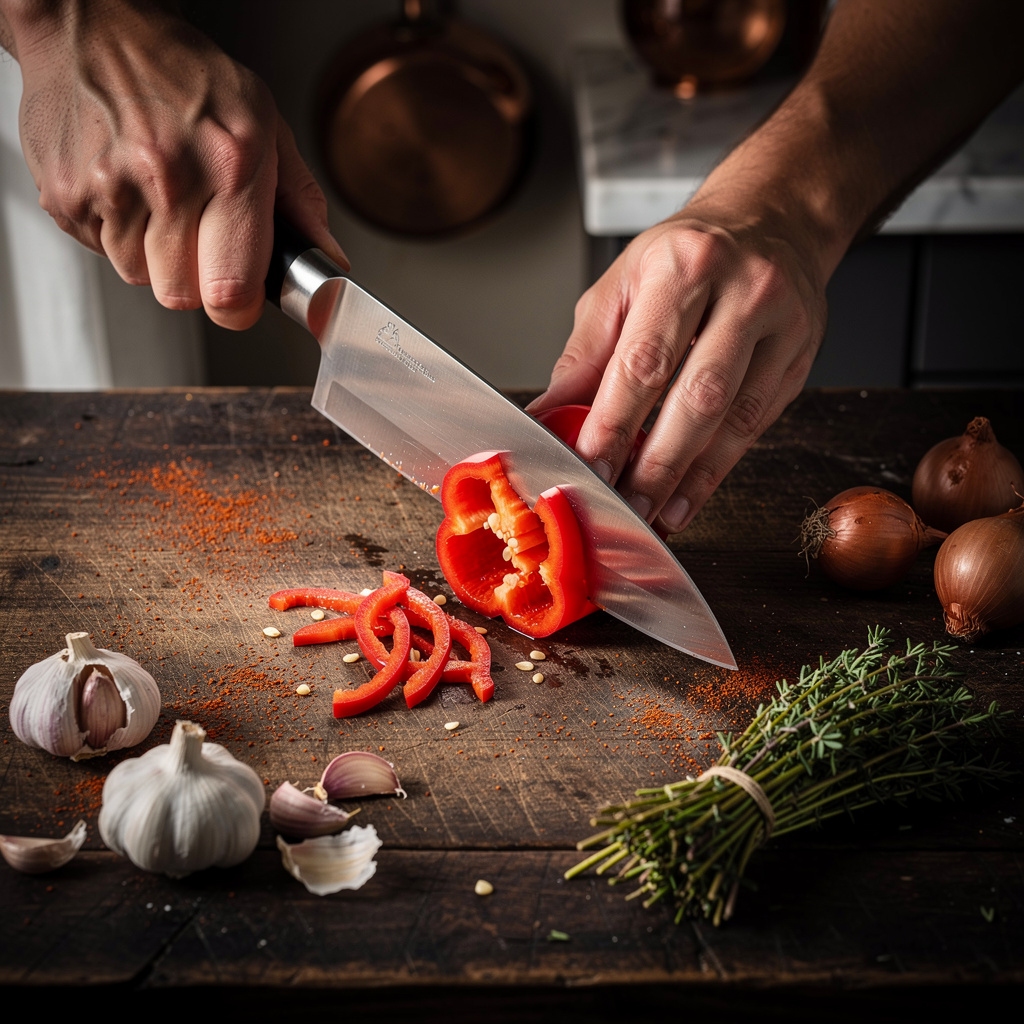
What is Knife Skills for Home Cooks?
Knife Skills for Home Cooks Training
The Knife Skills for Home Cooks certificate program transforms hesitant choppers into confident, efficient cooks by teaching the foundational techniques used in professional kitchens. Designed for absolute beginners and home cooks who want to elevate their meal prep, this course covers everything from knife anatomy and safe handling to advanced precision cuts like brunoise and batonnet. By the end, you will be able to break down vegetables, fruits, herbs, meat, poultry, and fish with speed and accuracy, dramatically reducing prep time and improving the consistency of your dishes.
Structured as a beginner-friendly progression, the program balances short, focused theory segments with hands-on practice across twelve targeted lessons. You will build four core skill areas: grip and guiding hand mechanics, fundamental and precision cutting techniques, ingredient-specific methods for produce and proteins, and long-term knife care through sharpening, honing, and proper storage. With specialty cuts like chiffonade and bias, plus dedicated modules on meat, poultry, and seafood, this course addresses the exact challenges home cooks face daily—making it the ideal choice for anyone ready to upgrade their kitchen confidence and cooking speed right now.
What is Knife Skills for Home Cooks?
Knife skills for home cooks is the systematic study of how to select, hold, and maneuver a chef’s knife to produce uniform, safe, and efficient cuts across a wide range of ingredients. Its core concepts include blade anatomy, proper grip and guiding hand placement, and a hierarchy of cuts—from basic slices and dices to precision julienne, brunoise, and batonnet—each with specific dimensions and applications. The subject also encompasses sharpening and honing techniques, as well as the physics of cutting, such as leverage, angle, and pressure, which together determine both safety and speed.
Today, knife skills matter more than ever as home cooking has surged in popularity, with meal kits, online cooking classes, and social media food content pushing enthusiasts to replicate restaurant-quality results. In professional culinary education, knife work remains the first and most rigorously tested competency, while in everyday life, efficient knife handling reduces prep time, minimizes waste, and lowers the risk of injury—a critical concern given that knife accidents are among the most common kitchen injuries. Recent shifts toward whole-food cooking and butchery-at-home have also renewed interest in breaking down proteins and produce, making these skills directly relevant to modern food trends.
Mastering knife skills builds a transferable skill stack that includes hand-eye coordination, spatial awareness, time management, and even mindfulness, as the repetitive motions require focused attention. For home cooks, this translates into faster weekday dinners, more beautiful plated meals, and the confidence to tackle complex recipes that call for specific cuts. Professionally, these competencies are the gateway to line cook positions, prep roles, or culinary school success, while for hobbyists, they unlock a deeper appreciation of ingredient texture and flavor release—proving that the humble knife is the most powerful tool in any kitchen.
Common Questions About Knife Skills for Home Cooks
Can a complete beginner learn knife skills online?
Is this course designed for home cooks only?
How does the pinch grip improve control?
What's the best way to dice an onion without tears?
- Cut off the top (not the root end) and peel the onion.
- Keep the root end intact – it holds the layers together.
- Make horizontal cuts from the side toward the root, stopping just before it.
- Make vertical cuts lengthwise, again stopping at the root.
- Finally, slice across to create uniform dice.
What is the suprême technique for citrus?
What's the difference between slicing and dicing?
Is a dull knife actually safer than a sharp one?
What Will This Course Bring You?
- Apply proper grip and guiding hand techniques to maintain control and safety while cutting various ingredients.
- Execute basic cuts including slicing, dicing, and julienne with consistent size and shape for even cooking.
- Demonstrate precision cuts such as brunoise, small dice, and batonnet to achieve uniform dimensions for professional presentation.
- Evaluate the appropriate cutting technique for different vegetables to maximize yield and minimize waste.
- Implement sharpening and honing procedures to maintain a razor-sharp edge on kitchen knives.
- Apply specialized techniques for cutting meat and poultry, including deboning and portioning, to ensure safe and efficient preparation.
- Analyze the structure of fish and seafood to apply appropriate cutting methods for fillets and portions.
- Design an efficient workflow for knife tasks, incorporating proper knife care and storage to extend tool longevity.
Curriculum
12 Units1. Knife Anatomy and Safety
1 hour
2. Grip and Guiding Hand
1 hour
3. Basic Cuts: Slicing, Dicing, and Julienne
1 hour
4. Precision Cuts: Brunoise, Small Dice, and Batonnet
1 hour
5. Mincing and Chopping
1 hour
6. Specialty Cuts: Chiffonade, Bias, and Roll
1 hour
7. Vegetable-Specific Techniques
1 hour
8. Fruit and Herb Techniques
1 hour
9. Sharpening and Honing
1 hour
10. Cutting Meat and Poultry
1 hour
11. Cutting Fish and Seafood
1 hour
12. Efficiency and Knife Care
1 hour
Exam – Knife Skills for Home Cooks
20 Questions • 70% Pass • 30 min
Unlock All Units for Free
Create an account, enroll in the course, and start with the first unit right away.
Exam – Knife Skills for Home Cooks
20 Questions • Pass: 70% • 30 min
Course Duration
720
Total Minutes
12
Unit
1
Final Exam
~60
Min / Unit
Knife Skills for Home Cooks Certificate Program
Document Your Skill
Those who pass the 20-question, 30-minute exam with 70% receive the Knife Skills for Home Cooks Certificate.
Stand Out on Your CV
By adding your certificate to your CV, gain a professional reference in job applications and stand out from the crowd.
Career Advantage
Catch Wisdom certificates are recognized by HR departments and increase career opportunities.
CERTIFICATE FEE
At the end of the course, an online exam consisting of 20 questions with a 30-minute time limit is given. The exam appears automatically after you complete the topics. Anyone who scores at least 70 out of 100 on the certificate exam is awarded the Knife Skills for Home Cooks Document (certificate of attendance). You can add the certificate you earn to your CV for job applications in the many sectors listed above, and use it as a reference proving that you took this interactive course.
The Certificate of Achievement you receive with the Knife Skills for Home Cooks course program holds value that proves your personal and professional development in the business world. By adding it to your CV, it can serve as an important reference in your job applications. Moreover, compared with certificates from other private training institutions, Catch Wisdom certificates are offered to our participants at a much more affordable price.
Because HR departments recognize Catch Wisdom as a reputable institution in this field, they value these certificates and may evaluate your job applications favorably. For this reason, a Knife Skills for Home Cooks course certificate from Catch Wisdom can make your applications more attractive and place you in an advantageous position in the business world.
For more information, we recommend visiting the Support page.
Certificate in 7 Languages
Earning success certificates from our courses is now more meaningful and global. With certificates available in Turkish, English, German, French, Spanish, Arabic, and Russian, we fully unlock the potential of students worldwide.
Why Certificate in 7 Languages?
-
01
Global Skill Development
Receiving your certificates in 7 different languages strengthens your communication skills as you engage with more people worldwide. It lets you operate more confidently and capably on the international stage.
-
02
International Job Opportunities
Employers may see your certificates in multiple languages as a sign of your ability to seize global opportunities. You can open more doors to new jobs and projects.
-
03
Cultural Richness
The chance to earn certificates in different languages helps you build closer ties with various cultures and broadens your worldview. It enriches your global perspective and deepens cultural understanding.
-
04
Ability to Participate in International Projects
Multilingual certificates give you an edge to work more effectively on international projects. They boost your chances of leadership and participation in diverse projects in the business world.
-
05
Prove Yourself on the Global Stage
Certificates in multiple languages let you showcase your skills and knowledge worldwide. You can become an internationally recognized professional.
Language diversity opens worldwide opportunities. If you want to prove yourself in the international arena, join our online Knife Skills for Home Cooks course program and begin this journey with us.
Frequently Asked Questions (FAQ)
Is this course paid?
How do I join the course?
Can I take the course at my own pace?
How can I get my certificate?
What are the advantages of the Certified Certificate?
Boost Your Career
Take a new career step with the Knife Skills for Home Cooks course. Add your certificate to your CV, stand out in job applications, and open the door to new opportunities in the industry.
StartStudent Reviews
No reviews yet
Enroll in this course and be the first to leave a review about your experience with Knife Skills for Home Cooks.
Start